
You know your pet has a wellness visit coming up. A dental procedure has also been discussed for later in the year. There is money in “pet savings,” but the same balance seems to be covering several future needs at once.
Is $500 enough?
That question is hard to answer if the same $500 is mentally assigned to more than one bill.
A sinking fund for vet bills works better when each planned veterinary expense has its own target, timeline, and assigned share of savings.
Quick answer: There is no useful universal amount everyone should save for vet bills each month. Your number should come from veterinary care you can reasonably foresee: assign existing savings once, calculate each remaining funding gap, divide that gap by the months available, then combine the monthly amounts.
The goal is not to predict your pet’s health.
It is to make veterinary expenses you can already see easier to pay for when they arrive.
Start With Three Different Money Lanes
Pet spending becomes confusing when everything lives inside one generic “Pet Fund.”
A cleaner system uses three lanes.
Monthly pet-health budget is for costs that genuinely recur every month or almost every month, such as a regular prescription refill, pet insurance premium, or wellness-plan payment.
Vet bill sinking fund is for non-monthly veterinary care that is known or reasonably foreseeable: a scheduled wellness visit, vaccinations already planned, veterinarian-recommended testing, a known follow-up appointment, or planned dental care.
Emergency or risk protection is for genuinely unpredictable events such as accidents, sudden serious illness, emergency hospitalization, or urgent treatment you could not reasonably plan in advance.
A scheduled appointment and an emergency do not need the same financial tool.
For the broader financial distinction, Frugenza Living’s guide to sinking funds versus emergency funds explains why known future expenses and true emergencies should not be expected to do the same job.
Most importantly, a budgeting worksheet should never become a reason to delay veterinary attention when an animal may need urgent care.
Build the Plan From Care You Can Actually See
Do not begin with a national average.
Start with information that belongs to your pet.
Useful planning inputs might include:
- an appointment reminder;
- a written veterinary estimate;
- a recent invoice for comparable planned care;
- a known follow-up;
- a future care window already discussed with your veterinarian.
A vet bill sinking fund could include a scheduled wellness visit, planned vaccinations, veterinarian-recommended bloodwork or screening, planned dental care, or another foreseeable non-emergency veterinary expense.
That does not mean every animal needs every item on that list.
Your actual care plan decides what gets a line.
If the amount is still approximate, label it as an estimate and update it when better information becomes available.
That is more useful than treating an internet average as a personalized quote.
If you are deciding how narrowly different savings goals should be separated, Frugenza’s sinking fund categories guide covers the broader category decision.
One Dollar Can Fund Only One Vet Bill at a Time
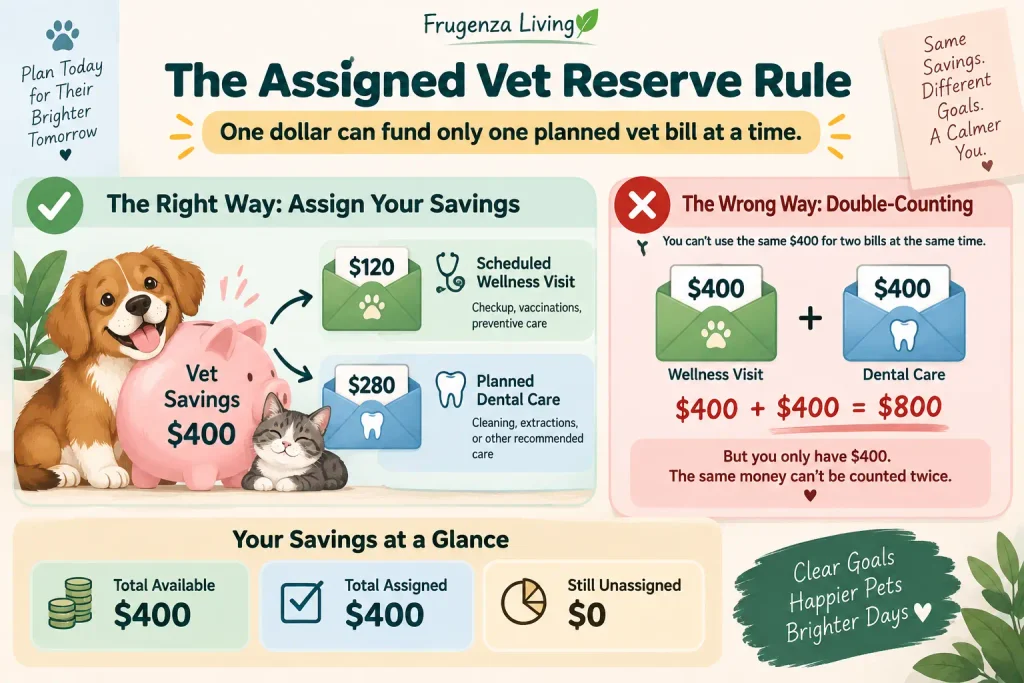
This is the Assigned Vet Reserve Rule:
One dollar of pet-care savings can be assigned to only one planned obligation at a time.
Suppose you have $400 in savings specifically available for planned veterinary care.
You assign:
- $120 to a scheduled wellness visit;
- $280 to planned dental care.
Now:
Total available: $400
Total assigned: $400
Still unassigned: $0
You do not have $400 available for the wellness visit and another $400 available for dental care.
A single savings balance can make this easy to miss because the money is physically sitting in one place.
Before calculating what you still need to save, decide which dollars belong to which planned bill.
The label on the bank account does not create extra money.
Give Each Planned Vet Bill Its Own Runway
Once existing savings have been assigned, use the Vet Bill Runway Method.
For each planned expense:
Remaining Funding Gap = Planned Cost − Applied Reserve
Then:
Monthly Pace = Remaining Funding Gap ÷ Months Until Expected Care
Consider two illustrative expenses.
Scheduled wellness visit
Planning target: $220
Assigned reserve: $40
Expected in: 4 months
Remaining gap:
$220 − $40 = $180
Monthly pace:
$180 ÷ 4 = $45 per month
Planned dental care
Planning target: $600
Assigned reserve: $150
Expected in: 9 months
Remaining gap:
$600 − $150 = $450
Monthly pace:
$450 ÷ 9 = $50 per month
Combined current contribution:
$45 + $50 = $95 per month
Now compare that with simply adding both targets:
$220 + $600 = $820
and dividing by 12:
$820 ÷ 12 ≈ $68.33
The math works as an annual average.
It fails the four-month deadline.
At that pace, the earlier visit may still be underfunded when it arrives.
That is why each planned vet bill needs its own runway before monthly contributions are combined.
Vet Bill Runway Planner
Use this planner for veterinary care that is already known or reasonably foreseeable.
If multiple care items draw from one shared vet sinking-fund balance, enter that balance at the top. The tool will warn you if you assign more money than is actually available.
Vet Bill Runway Planner
Assign existing savings once, give each planned veterinary expense its own runway, and calculate the current monthly pace across your visible care costs.
Your Vet Bill Runways
For expected or reasonably foreseeable veterinary care only. This planner does not estimate medical needs or emergency costs. Do not delay urgent veterinary care because of a savings target.
The calculator deliberately calls the result a current monthly pace, not a guaranteed final contribution.
If you enter a shared savings balance but leave part of it unassigned, the tool tells you that the monthly pace assumes those dollars have not yet been applied.
That prevents available savings from being ignored—or silently counted twice.
What If One Care Item Is Already Overfunded?
Saving more than a current target is not necessarily a problem.
But the surplus should be visible.
Suppose a scheduled visit has a target of $220, while you have assigned $260 to it.
Only $220 is needed to fully fund that planned bill.
The other $40 is above the current target.
You can intentionally leave it there, reassign it to another planned veterinary expense, or return it to an unassigned reserve.
What you should not do is quietly count the same $40 toward another target while still treating the first bill as if the full $260 remains committed to it.
That is why the planner separates assigned reserve, applied reserve, and above-target reserve.
What If the Vet Estimate Changes?
A sinking fund is a working plan, not a guarantee that an estimate will stay fixed.
Suppose planned dental care was originally estimated at $600.
You have already reserved $300, but a newer estimate is $720.
Do not start the calculation from $720 as though the existing savings disappeared.
The updated remaining gap is:
$720 − $300 = $420
Then divide that $420 by the remaining months before the expected care.
If the estimate falls, update the target the same way.
If you are already saving for several irregular expenses, deciding how many sinking funds you actually need can keep your budget organized without creating too many separate accounts.
Pet Insurance Changes the Cash Flow, Not the Need to Plan
Pet insurance can change what your household ultimately pays, but it does not automatically eliminate the need for savings.
The National Association of Insurance Commissioners’ pet insurance overview explains that coverage, exclusions, deductibles, reimbursement methods, and payment limits can differ across policies, and that most pet insurance policies operate on a reimbursement basis.
Before reducing a vet sinking-fund target because you have insurance, check the policy you actually own.
Look at:
- whether the planned care is covered;
- your deductible;
- how reimbursement is calculated;
- applicable exclusions or limits;
- whether routine or wellness care is included;
- whether you may need to pay the provider before reimbursement arrives.
A useful budgeting rule is:
Build the target around what your household reasonably expects to pay—not the headline price of care and not an assumed insurance reimbursement.
Insurance and savings may solve different parts of the same cash-flow problem.
What Should Stay Outside This Fund?
Keep the category narrow enough that its balance still tells you something useful.
Regular pet food, treats, toys, grooming, boarding, and pet sitting generally belong elsewhere in the household budget.
A genuinely unexpected accident, sudden serious illness, emergency hospitalization, or another urgent veterinary event should not be disguised as a predictable sinking-fund expense either.
And if a cost occurs reliably every month, the monthly budget may be the simpler home for it.
The purpose of this fund is not to absorb every dollar connected to pet ownership.
It is to prepare specifically for planned or reasonably foreseeable non-monthly veterinary care.
Let Each Appointment Improve the Next Plan
The best planning information for the next cycle may come from the visit you just paid for.
Keep the invoice.
Notice which charges were recurring and which were one-time.
If another follow-up or future care window has been discussed, record it while the information is still fresh.
Then ask:
Will this likely happen again?
Do I have a useful planning amount?
When might I need the money?
How much is already assigned to it?
Those answers provide a much better starting point than searching for a generic “average vet bill” every year.
If you need the mechanics for maintaining several savings goals, Frugenza’s beginner sinking-fund setup covers the broader system.
The Goal Is to Make Visible Vet Bills Boring
A good sinking fund for vet bills does not predict accidents or future diagnoses.
It does something much more practical.
It identifies veterinary expenses that have already become visible, assigns real savings to them once, and respects the timeline of each bill.
If a scheduled visit is four months away, calculate the runway for that visit.
If planned dental care may be nine months away, give it a different runway.
If both are drawing from one savings balance, make sure the same dollars are not funding both on paper.
And if part of that shared balance has not yet been assigned, decide where it belongs before treating your monthly pace as final.
Then update the plan when a better estimate, appointment date, reimbursement detail, or actual invoice becomes available.
You may still face veterinary costs you could not predict. That is why emergency savings and insurance remain separate tools.
But the expenses you can already see do not have to arrive as financial surprises.
Assign each dollar once. Fund each visible gap on its own timeline. Leave true emergencies out of the forecast.
Methodology note: Dollar figures in this article are illustrative budgeting examples, not national veterinary-cost estimates or medical recommendations. Veterinary needs, timing, prices, and insurance coverage vary. This article provides general budgeting education, not veterinary, insurance, legal, or individualized financial advice. Contact a veterinarian promptly when an animal may need urgent care.

The ideas shared here come from real-life experience and practical habits that actually work.
→ Read more about Jeffi
- Vacation Sinking Fund: How Much to Save for Your Trip - September 12, 2026
- Moving Sinking Fund: How Much to Save Before Moving Day - September 12, 2026
- Appliance Replacement Sinking Fund: How Much Should You Save? - September 11, 2026