
It is May. A $1,200 insurance renewal is four months away, vehicle registration is six months away, and a $360 professional fee is due nine months from now.
Add those bills together and divide by 12, and you get a neat monthly average.
But that average does not tell you what the next few months actually require.
That is the challenge of building an annual bills sinking fund after several billing cycles have already started. Some bills need catch-up funding now. Others are already close to a comfortable 12-month pace. And once each bill is paid, the total monthly funding requirement can change again.
The goal is not simply to turn every annual bill into a monthly number.
It is to know what needs funding now, what that pressure may look like later, and when each bill gets its own fresh funding cycle.
If you have not yet identified your once-a-year and non-monthly expenses, start with this annual expenses checklist. This guide assumes you already know which bills belong in the plan.
Let the Bill Define the Funding Year
A calendar year begins in January.
Your annual bills do not care.
An insurance policy renewed every September effectively has a September-to-September funding cycle. Registration due each February has a February-to-February cycle. A professional license renewed in June follows its own June-to-June rhythm.
That distinction is easy to miss because budgeting templates often organize everything around January through December.
For a recurring annual bill, a more useful reset point is usually the payment itself.
Once the September insurance bill has been paid, you can begin reserving for the next expected September bill immediately. There is no reason to wait until January and lose several months of preparation.
This also explains why someone starting an annual sinking fund halfway through the year may initially need much more per month than someone who has already been funding the same bills for a full cycle.
For annual bills, the timing matters just as much as the total.
Before You Fund a Bill, Make Sure It Is Not Already Being Smoothed
Before adding an annual expense to a new sinking fund, check how it is already being paid.
Some households are already spreading certain non-monthly costs across monthly payments without thinking of them as sinking funds.
For example, CFPB’s explanation of mortgage escrow accounts notes that part of a monthly mortgage payment may be collected for expenses such as property taxes and homeowners insurance, with the servicer paying those bills when they come due.
If that is already happening, automatically saving the full annual amount again could duplicate the same job.
The same principle applies to annual services that have already been converted to monthly billing.
Ask:
Will my household still need to produce this annual payment separately when the due date arrives?
If yes, it may belong in the rolling reserve.
If no, understand what the existing payment arrangement already covers before creating another savings target.
Annual subscriptions are one specialized version of this problem. If renewals make up a meaningful part of your list, the annual subscription sinking fund guide covers that narrower situation in more detail.
The Number You Need Today May Be Much Higher Than Your Long-Run Average
For a bill that is not yet fully funded, calculate:
Current Monthly Funding Pace = (Expected Bill − Already Reserved) ÷ Months Remaining
Then compare it with:
Full-Cycle Monthly Baseline = Expected Bill ÷ 12
These numbers answer different questions.
The first asks:
What does my budget need to contribute now to reach the next bill?
The second asks:
What would the monthly pace look like if I had a complete 12-month cycle using the current estimate?
The full-cycle baseline is not a forecast that next year’s bill will stay identical. It is a planning reference.
Consider the three bills from the opening.
Auto Insurance
Expected bill: $1,200
Already reserved: $200
Due in: 4 months
Remaining gap:
$1,200 − $200 = $1,000
Current pace:
$1,000 ÷ 4 = $250/month
Full-cycle baseline:
$1,200 ÷ 12 = $100/month
Catch-up difference:
$150/month
Vehicle Registration
Expected bill: $240
Already reserved: $40
Due in: 6 months
Remaining gap:
$200
Current pace:
$200 ÷ 6 ≈ $33.33/month
Full-cycle baseline:
$20/month
Catch-up difference:
about $13.33/month
Professional Fee
Expected bill: $360
Already reserved: $90
Due in: 9 months
Remaining gap:
$270
Current pace:
$270 ÷ 9 = $30/month
Full-cycle baseline:
$30/month
This bill is already moving at approximately its full-cycle pace.
Combined, the budget currently needs:
$250 + $33.33 + $30 = $313.33/month
But the full-cycle baseline using the same estimates is:
$100 + $20 + $30 = $150/month
Of the current $313.33 monthly requirement, $163.33 is positive catch-up pressure created because some bills entered the plan partway through their funding cycles.
That distinction matters.
A $313.33 calculation does not automatically mean annual bills will permanently require $313.33 from every future monthly budget.
The Monthly Load Changes as Bills Reset
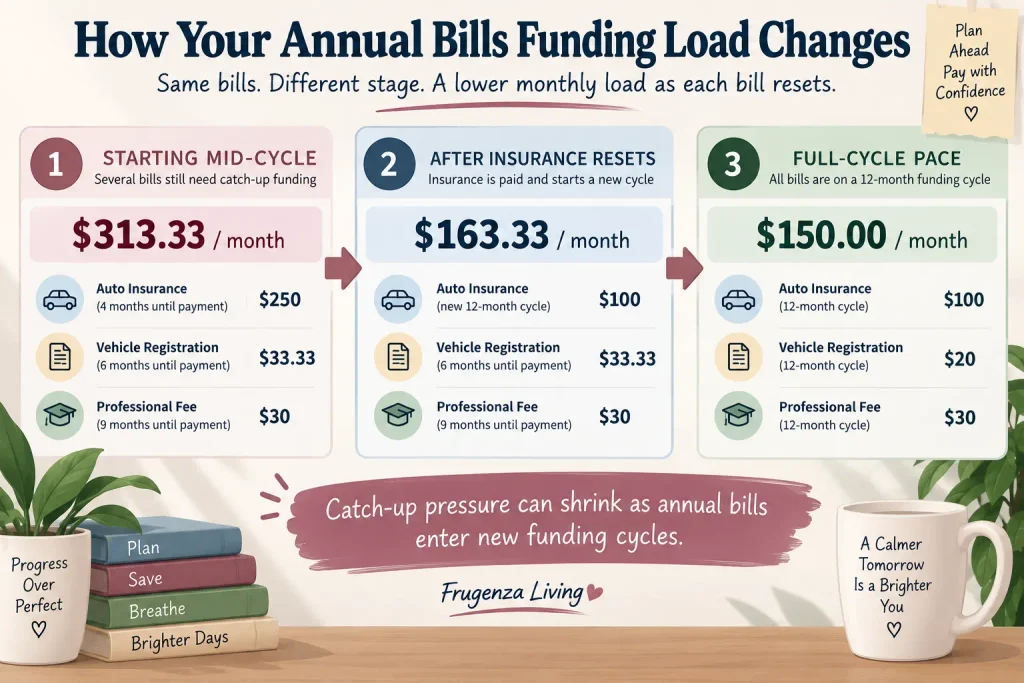
This is where annual-bill planning becomes more useful than simply dividing one yearly total by 12.
Start with:
Today
Insurance: $250
Registration: $33.33
Professional fee: $30
Combined load: $313.33/month
Four months later, assume the insurance target reaches approximately $1,200 and the bill is paid.
If $1,200 remains the best available planning estimate for the next insurance cycle and there is no leftover surplus assigned to it, the new 12-month funding pace becomes:
$100/month
The combined funding load becomes:
$100 + $33.33 + $30 = $163.33/month
Later, registration is paid.
If its next planning amount remains $240 and there is no carried-forward surplus, its contribution resets from approximately $33.33 to:
$20/month
The combined load becomes:
$100 + $20 + $30 = $150/month
So the same set of bills can move approximately like this:
| Funding Stage | Monthly Annual-Bill Load |
|---|---|
| Starting partway through several cycles | $313.33 |
| After insurance begins a new full cycle | $163.33 |
| After registration begins a new full cycle | $150.00 |
| Full-cycle baseline using current estimates | $150.00 |
That progression—$313.33 → $163.33 → $150—is the part a simple annual-total calculation cannot show.
Your annual-bill funding load is not necessarily fixed. It changes as individual bills finish catch-up funding and begin new cycles.
Not every reset makes the number smaller.
If a bill is already fully funded or has more reserved than the upcoming payment requires, some money may remain assigned to the following cycle. Likewise, a bill that is already ahead of schedule may need a higher contribution after the current payment resets the cycle.
The point is not that the funding load always falls.
The point is that it changes as individual bills move through their own cycles.
Annual Bills Rolling Reserve Planner
Enter up to five annual bills below.
The planner shows:
- what each bill requires now;
- its full-cycle baseline;
- positive catch-up pressure;
- the next active bill that still needs funding;
- and how the combined monthly load may change as each bill is paid.
For annual bills, enter 1 to 12 months until the next payment.
If you have already reserved more than the upcoming bill requires, the planner carries that surplus into the projected next cycle instead of making it disappear.
Annual Bills Rolling Reserve Planner
See what your annual bills need today, how much positive catch-up pressure exists, and how the combined monthly load may change after each payment.
Bill-by-Bill Funding
Projected Load Transition
Projection assumes each bill begins a new 12-month cycle after payment using the same current estimate. Any amount reserved above the current bill remains assigned to that bill’s next cycle. Actual future amounts may change.
For general budgeting education only. Amounts, renewal dates, payment requirements, billing arrangements, and consequences for nonpayment vary by provider and location.
What If the Catch-Up Load Does Not Fit the Budget?
The calculator may reveal an uncomfortable number.
Suppose annual bills currently require $313.33 per month, but only $180 per month is realistically available.
A useful plan should show that shortfall instead of hiding it.
Start by checking the inputs.
Make sure the dates are current. Replace stale estimates with confirmed renewal notices or bills when available. Check whether anything on the list is optional, duplicated elsewhere in the budget, or already being paid through another arrangement.
Then look at consequences, not just dollar size.
An optional membership can be treated differently from registration, insurance, licensing, taxes, or another obligation with significant consequences for nonpayment. Those consequences vary by bill, provider, and location, so use the actual terms that apply.
If $180 still cannot fund everything on schedule, do not mark every category as “on track.”
Leave the underfunded goal visible.
As earlier bills are paid and begin new funding cycles, monthly capacity may change. In the example above, insurance moving from $250 to approximately $100 frees about $150 per month under the current assumptions.
Part of that capacity can then support another bill that is still behind.
That does not magically solve an affordability problem. It does help separate temporary timing pressure from the underlying annual cost.
When a Renewal Amount Changes, Recalculate Only What Is Still Missing
Annual does not mean fixed.
When a confirmed renewal notice replaces an estimate, update the target and recalculate only the remaining gap. Money already reserved still counts.
For example, if a $1,200 insurance estimate becomes $1,280 and $700 is already saved, the new gap is:
$1,280 − $700 = $580
Do not restart the calculation from $1,280.
If the amount, timing, or both are genuinely uncertain rather than simply updated, the broader irregular-bills budgeting framework is the better tool because that is a different planning problem.
Avoid automatically adding an arbitrary percentage cushion and treating it as universal. Use the strongest current information available instead.
One Account Can Hold Several Annual-Bill Reserves
Separate bank accounts are optional.
Separate assignments are not.
A $1,000 savings balance might contain:
- $600 reserved for insurance;
- $150 assigned to registration;
- $250 reserved for another annual obligation.
That full $1,000 already has a job.
A spreadsheet, budgeting app, bank subaccount, or simple ledger can track the assignments. The account structure matters less than being able to tell which money is available for which bill.
If you still need the broader basics—how sinking funds work, what belongs in them, and how to start—use the sinking funds for beginners guide rather than rebuilding that system inside this one.
A Mature Annual-Bill Plan Looks Different From the First One
The first calculation can be misleading if you treat it as permanent.
Starting halfway through several cycles may produce:
$313.33 per month today.
After one bill is paid and begins a fresh cycle:
$163.33 per month.
After another reset:
$150 per month.
Those figures are illustrative, but the principle is more important than the exact amounts.
Your annual bills are not one giant yearly expense with one reset date.
They are several recurring obligations moving through different points in their own funding cycles.
Track what is still missing before the next payment. Make sure a bill is not already being funded elsewhere. Keep money already assigned to one obligation from being counted again for another.
When a bill is paid, carry forward any genuine surplus still assigned to that bill and begin the next funding cycle instead of waiting for January.
Over time, more of the system may operate on full cycles instead of catch-up cycles.
The bills themselves have not disappeared.
What changes is how much of the next one must be solved by the paychecks immediately before it.
Methodology note: All numerical examples are illustrative budgeting scenarios, not household averages or guarantees. Bill amounts, renewal dates, payment arrangements, and consequences for nonpayment vary by provider and location. Replace planning estimates with current bills, renewal notices, official documents, or provider information when available. This article provides general budgeting education, not individualized financial, tax, legal, or insurance advice.

Read about Jeffi and Frugenza Living
- How to Budget a 10-Month Salary Over 12 Months - October 16, 2026
- Pet Adoption Budget Checklist: What You Still Need to Pay - October 16, 2026
- Proportional Bill Split Calculator for Two Incomes - October 15, 2026