A car maintenance sinking fund gives you money for service, wear items, and repairs before those costs have to compete with groceries, rent, or your next paycheck.
There is no single correct balance such as $1,000 or $2,000. A better target reflects what your car is likely to need, how much uncertainty you want to absorb, and what your cash flow can handle without turning a repair into new debt.
If you have not estimated upcoming vehicle costs yet, start with how to budget for car maintenance. This guide covers the next step: building, using, reviewing, and refilling the money.
Quick answer: Build a useful starter floor first. Then set a working target equal to expected maintenance + known wear items + a repair-readiness cushion. Once you reach that target, review upcoming needs before automatically adding more money.
Give the Fund One Clear Job
A car sinking fund does not need to predict every mechanical problem. Its job is to make ordinary vehicle expenses less disruptive.
If sinking funds are new to you, this beginner’s guide to sinking funds explains the broader system. For a vehicle fund, keep the purpose narrower:
prepare for expected maintenance, known wear items, and a reasonable amount of repair uncertainty.
A useful car fund is not the biggest balance you can build. It is a balance that can do its job without unnecessarily taking money away from higher-priority goals.
That means the fund can cover things such as routine servicing, oil changes, tires, brakes, batteries, inspections, wear-related replacements, and repairs you intentionally prepare for.
Gas or charging, parking, tolls, insurance premiums, and a regular car payment normally belong elsewhere. Registration can be included, but a separate annual-bills fund may be clearer.
Also separate car maintenance from car replacement. Money reserved for today’s tires should not quietly become tomorrow’s down payment.
Use a Three-Zone Car Fund System
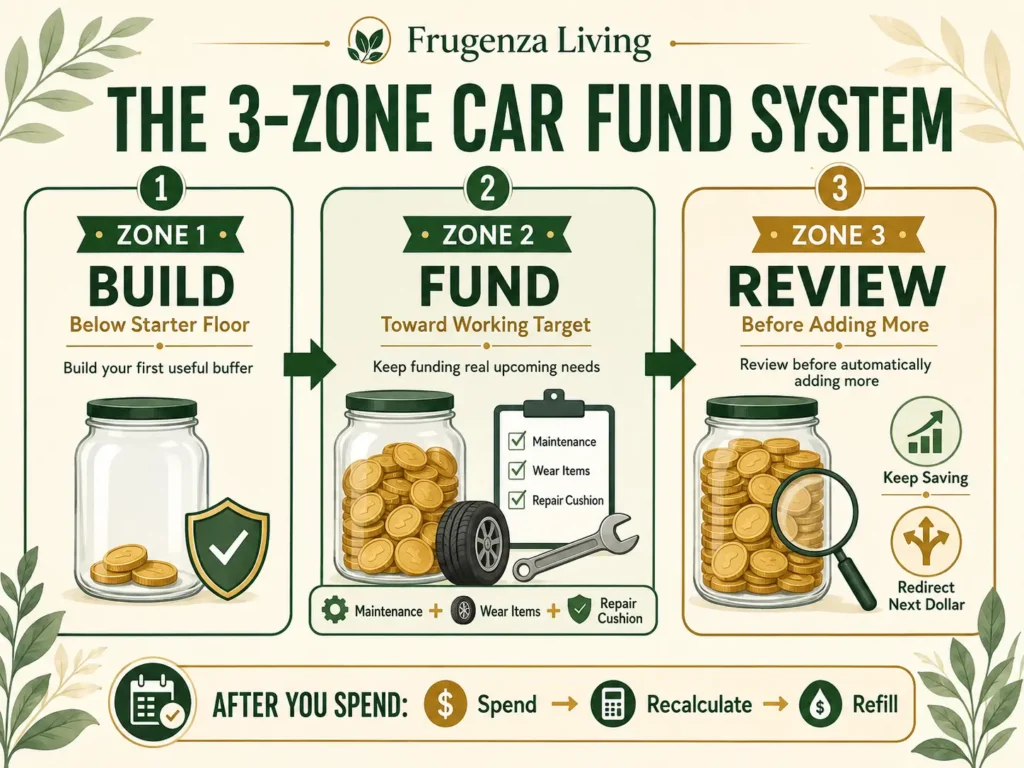
For this guide, we’ll use a simple Three-Zone Car Fund System. It avoids treating one internet-recommended number as the finish line.
Zone 1: Below Your Starter Floor — Build First
Your starter floor is the first balance that gives you meaningful protection.
Do not choose it because someone online says every car fund needs $500 or $1,000. Ask:
If a car bill arrived this week, at what amount would I need a credit card, delay an essential bill, or raid savings meant for something else?
You do not have to cover that full amount immediately. Your starter floor can be the first useful layer of protection against reaching it.
Zone 2: Between the Starter Floor and Working Target — Keep Funding
Your working target is what the fund currently needs to do.
Use:
Working Target = Expected Near-Term Maintenance + Known Wear Items + Repair-Readiness Cushion
If that total is lower than your starter floor, use the starter floor as the working target.
The right fund is not an amount that could cover every possible repair. It is an amount that covers what you reasonably expect plus enough uncertainty that an ordinary repair does not immediately become new debt.
How to Choose the Repair-Readiness Cushion
Instead of defaulting to $500 or $1,000, check three pressures:
Vehicle uncertainty: recent repairs, high mileage, expired coverage, unresolved findings, or several wear items approaching replacement.
Transportation dependency: how disruptive would several days without the car be?
Cash-flow capacity: how much surprise cost could checking absorb without new debt or sacrificing another priority?
Your cushion should protect the gap between what cash flow can comfortably absorb and what would otherwise become a financial problem. More uncertainty or dependence can justify a larger cushion; stronger cash flow or reliable backup transportation may justify less.
Zone 3: At or Above the Working Target — Review the Next Dollar
Once the fund reaches its working target, do not assume the same contribution must continue forever.
Review what is approaching, whether your estimates changed, whether your repair cushion still fits, and whether another goal now has a stronger claim on the next dollar.
This is why “stop at $2,000” is a weak rule. The same $2,000 can be comfortably funded for one vehicle and already committed to tires, brakes, and service for another.
Turn the Target Into a Contribution
Once you know the target:
Funding Gap = Working Target − Current Balance
Then divide the gap by the time available.
Monthly Contribution = Funding Gap ÷ Months Available
or:
Per-Paycheck Contribution = Funding Gap ÷ Paychecks Available
If your working target is $1,500 and the fund contains $540:
$1,500 − $540 = $960
With eight months available:
$960 ÷ 8 = $120 per month
That is not a universal $120 rule; it simply closes your current gap on that timeline. If it does not fit your budget, fund the most likely near-term expense first and extend the rest where reasonable.
Car Maintenance Sinking Fund Target Builder
Use the calculator below to estimate your working target, funding gap, and monthly or per-paycheck contribution. If you already used the fund, choose Rebuilding After a Withdrawal, enter your balance after the withdrawal, and include only costs that are still ahead.
Frugenza Living Budget Tool
Car Maintenance Sinking Fund Target Builder
Estimate a working target, funding gap, and contribution—or rebuild after a withdrawal.
Refilling? Enter your balance after the withdrawal and include only maintenance or wear costs that are still ahead. Do not count the expense you already paid.
Enter non-negative dollar amounts and at least one saving period.
Planning estimate only. This tool organizes a savings target; it does not predict future repairs or replace professional automotive or financial advice.
Example: Build, Spend, Recalculate, Refill
Consider Maya, who drives a seven-year-old sedan and has $460 saved.
Over the next nine months, she expects about $210 in routine maintenance, thinks tires may cost around $640, and chooses a $650 repair-readiness cushion because the car is her household’s main transportation and a larger surprise repair would be difficult to absorb from one month’s cash flow.
Her working target is:
$210 + $640 + $650 = $1,500
Her funding gap is:
$1,500 − $460 = $1,040
Over nine months:
$1,040 ÷ 9 = $115.56 per month
She rounds the contribution to about $116.
Five months later, she has added about $580, bringing the fund to roughly $1,040. Then the tires need replacing earlier than expected and cost $590.
Her remaining balance is:
$1,040 − $590 = $450
The tires are now paid for, so she removes them from the future-cost list. She still wants $210 available for upcoming maintenance plus the $650 repair cushion.
Her updated working target becomes:
$210 + $650 = $860
The new refill gap is:
$860 − $450 = $410
With four months remaining:
$410 ÷ 4 = $102.50 per month
That is the full cycle:
Build → Spend → Recalculate → Refill.
The withdrawal did not break the plan. Paying for the tires was the plan working.
Maintenance is not the only irregular cost of owning a car. You may also want a car registration sinking fund for predictable renewal and licensing fees.
After a Withdrawal, Recalculate Before You Refill
Do not automatically rebuild to the old balance after every repair. Record the withdrawal, remove completed costs, add newly discovered needs, recalculate the working target, and refill only the gap that still exists.
The fund’s job changes after an expense is paid. Rebuilding blindly to an old target can leave too much cash in one category while other priorities wait.
A simple ledger or separate savings bucket is enough. If you want a ready-made structure for tracking contributions and withdrawals, use this sinking fund tracker template.
When Can You Pause Contributions?
Consider reducing or pausing contributions when all of these are reasonably true:
- the balance has reached the current working target;
- known near-term maintenance is covered;
- the repair cushion still fits the vehicle and household;
- no new major wear item has appeared;
- another financial priority may now benefit more from the next dollar.
The important word is review, not stop.
Review again after a major withdrawal, new inspection finding, meaningful mileage change, or change in how dependent you are on the vehicle.
Why the Target Needs Periodic Review
Car costs do not stay frozen. The U.S. Bureau of Labor Statistics reported that motor vehicle maintenance and repair prices were 6.6% higher in July 2026 than a year earlier, with maintenance and servicing up 7.3% and repair up 6.2%.
That does not mean increasing your fund by 6.6%. It means old receipts and stale budget estimates deserve a refresh. The formula is only as useful as the numbers you feed into it.
What About an Older or High-Mileage Car?
Age alone does not justify a higher monthly number. A larger cushion makes more sense when several signals line up: repeated repairs, unresolved inspection findings, multiple wear items approaching replacement, expired coverage, high mileage, or serious consequences if the vehicle becomes unavailable.
For two cars, one combined fund can work if each vehicle’s needs are labeled; separate balances may be clearer when one has much higher near-term costs.
If money is tight, build the starter floor first rather than abandoning the category because the ideal target feels unreachable.
What If the Repair Arrives Before the Fund Is Ready?
First, confirm which work is necessary and whether relevant warranty, recall, service-contract, or insurance coverage applies. Then use the available car fund and see what current cash flow can reasonably cover.
If an urgent, necessary repair exceeds both, emergency savings may become relevant depending on your household’s rules. A planned car fund and emergency savings have different jobs; this guide to sinking funds vs. emergency funds explains the distinction more fully.
Do not postpone a safety-critical repair simply to preserve a savings balance.
Afterward, calculate the updated target and refill gap rather than automatically chasing the old balance.
Frequently Asked Questions
How much should I have in a car maintenance sinking fund?
There is no universal amount. Start with a useful floor, then build a working target from expected maintenance, known wear items, and a repair cushion that reflects your vehicle uncertainty, transportation dependency, and cash-flow capacity.
How much should I put into a car maintenance sinking fund each month?
Subtract your current balance from your working target and divide the gap by the number of months available. This produces a contribution based on your situation rather than a fixed rule.
Should tires be included?
Usually, yes. Tires are predictable wear items and fit naturally into a vehicle maintenance sinking fund. Avoid counting them twice if you already maintain a separate tire fund.
Should I stop saving when the fund reaches $2,000?
Not automatically. Compare the balance with upcoming maintenance, known wear costs, and your current repair cushion. If those jobs are adequately funded, review whether the next contribution is better used elsewhere.
Is a car repair a sinking-fund or emergency-fund expense?
A repair you deliberately prepared for can come from the car sinking fund. If an urgent repair substantially exceeds what you prepared, emergency savings may be appropriate depending on how your household defines an emergency.
The Bottom Line
A car maintenance sinking fund works better when you stop searching for one universal savings number.
Build a starter floor that gives you useful protection. Move toward a working target based on the expenses your car actually faces and a cushion that reflects how much repair uncertainty your household can absorb.
Once you reach that target, review before adding more automatically. And after the fund does its job, do not blindly rebuild an outdated balance:
spend, recalculate, then refill the gap that still exists.
That keeps your car savings connected to the vehicle you drive and the budget you have now.
Educational note: This guide provides general budgeting information. Vehicle expenses and household priorities vary, so use current estimates and qualified professional advice when appropriate.

Read about Jeffi and Frugenza Living
- Proportional Bill Split Calculator for Two Incomes - October 15, 2026
- How to Split Grocery Bills With Roommates - October 14, 2026
- First Apartment Kitchen Essentials on a Budget - October 13, 2026