
A holiday sinking fund is money you set aside before year-end seasonal spending starts. Here, “holiday” means end-of-year celebrations and related seasonal spending—not a vacation fund.
The mistake is treating the holidays like one December bill. Travel may be booked in October, gifts purchased in November, shipping paid in early December, and food bought closer to the celebration.
A useful holiday fund should answer two questions:
How much do I actually want to spend?
When will each part of that money be needed?
Quick answer: Add the holiday spending you genuinely intend to fund, subtract what you have already saved, then give each major category its own first-spend deadline. Divide each category’s remaining gap by the paychecks left before that deadline—not simply by the months until Christmas.
If sinking funds are new to you, this beginner’s guide to sinking funds covers the general system. This article focuses specifically on holiday execution.
Start With the Holiday You Actually Plan to Have
Do not start with a national holiday-spending average. It does not know your income, traditions, family size, travel plans, or current priorities.
Use last year’s spending only after cleaning it up. Remove one-time décor, unusual travel, reimbursed costs, gifts that will not repeat, or temporary circumstances that inflated spending. Then add new commitments expected this year.
For this guide, group spending into four decision buckets:
Gifts & Giving — presents, teacher gifts, tips, charitable giving, or similar commitments.
Gatherings & Food — holiday meals, baking, hosting, drinks, or contributions to shared gatherings.
Travel & Events — holiday-specific transportation, lodging, parking, tickets, or seasonal events.
Holiday Friction Costs — the name we’ll use for easy-to-miss extras such as shipping, wrapping, cards, postage, small exchanges, extra grocery runs, pet care, or hostess gifts.
The goal is not dozens of categories. It is preventing “gifts” from becoming shorthand for every dollar the season creates.
If you are still deciding which expenses deserve dedicated savings categories, use the sinking fund categories list.
Separate Core Commitments From Flexible Holiday Spending
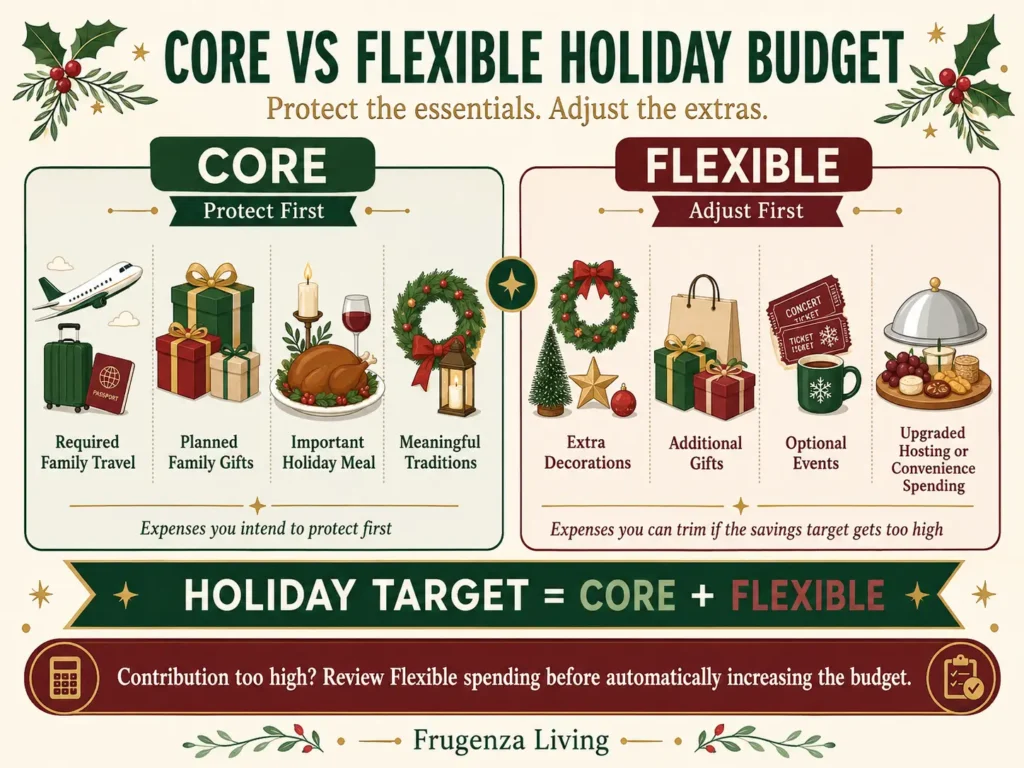
Divide the rough total into two layers.
Core Commitments are expenses you want to protect first, such as agreed family gifts, necessary holiday travel, planned hosting, or traditions that genuinely matter.
Flexible Holiday Spending includes expenses you would enjoy but could reduce: extra décor, additional gifts, optional events, upgraded hosting, or convenience purchases.
Then calculate:
Holiday Target = Core Commitments + Flexible Holiday Spending
This prevents a wish list from quietly turning into an obligation. If your first draft totals $1,500 but cash flow reasonably supports $1,250, the answer does not have to be “find another $250.” Shrinking the flexible layer may be the better decision.
Do Not Give Every Holiday Dollar the Same Deadline
A traditional formula says:
Holiday Goal ÷ Months Remaining = Monthly Savings
That can work for a rough estimate, but it misses timing.
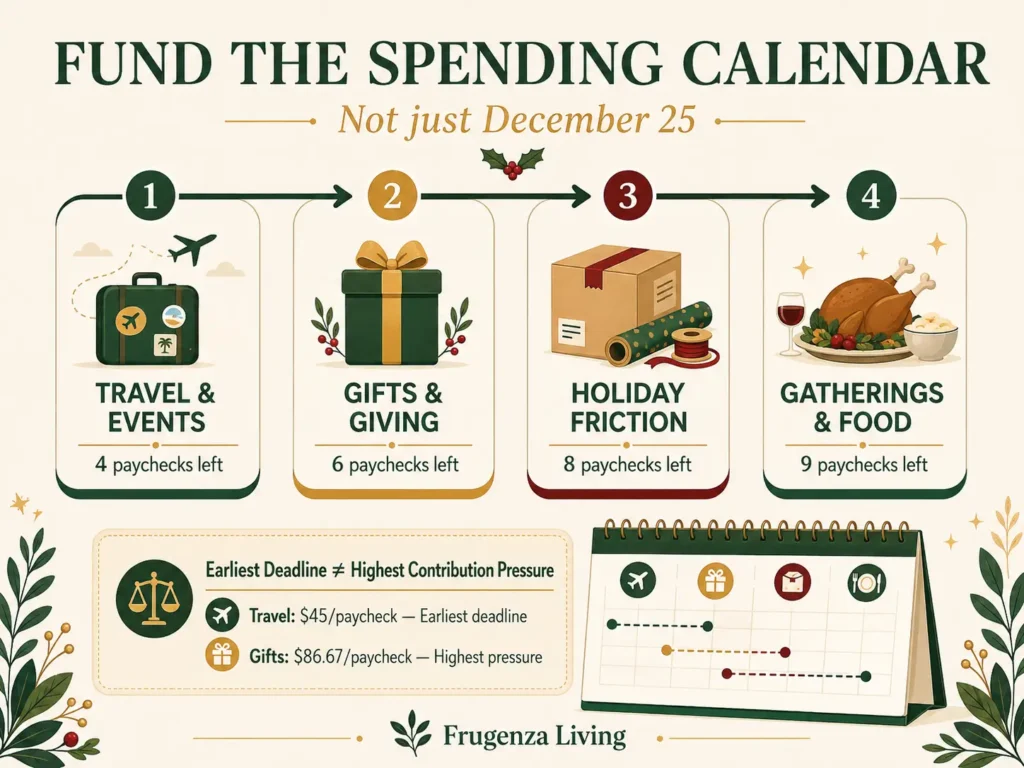
Suppose you need $350 for travel four paychecks from now and $350 for holiday food nine paychecks from now. The targets are identical, but the funding pressure is not.
For every meaningful category, identify:
Target Amount + First Spend Date
Then calculate:
Category Funding Gap = Target − Amount Already Saved
Required Per Paycheck = Funding Gap ÷ Paychecks Before First Spend
This creates two signals.
Earliest unfunded deadline tells you what needs money soonest.
Highest contribution pressure tells you which category requires the most money per paycheck to stay on schedule.
They are not always the same category.
Holiday Sinking Fund Deadline Planner
Use this tool to compare Core and Flexible categories, identify the earliest unfunded deadline, measure contribution pressure, and calculate what is currently required per paycheck.
Using one holiday savings pool? Temporarily assign the current balance across the categories it needs to cover before entering your numbers. The tool also separates money applied to targets from any unassigned excess.
You can download the finished plan as a CSV file for Excel or Google Sheets.
Frugenza Living Budget Tool
Holiday Sinking Fund Deadline Planner
Plan by spending deadline, not just by the holiday date.
One savings pool? Temporarily assign the balance across the categories it needs to cover before entering your numbers.
Core or Flexible? Mark protected commitments as Core and adjustable extras as Flexible. If the required contribution is too high, review Flexible targets first.
Use non-negative dollar amounts and whole paychecks of 1 or more.
Current required per paycheck: $0.00. This changes as categories become funded, deadlines move, or targets change.
Planning estimate only. This tool organizes a savings plan; it does not determine what your household should spend.
Example: One Holiday Total, Four Different Deadlines
Consider Daniel and Priya, a fictional household with an illustrative $1,360 holiday target.
They plan $620 for Gifts & Giving, with $500 Core and $120 Flexible; $260 for Gatherings & Food, mostly Core; $360 for Travel & Events, Core; and $120 for Holiday Friction Costs, Flexible.
They have already saved $280: $180 for travel and $100 for gifts.
A simple calculation says:
$1,360 − $280 = $1,080 remaining
But it does not show when the money is needed.
Travel has four paychecks before its first spend:
$360 − $180 = $180 gap
$180 ÷ 4 = $45 per paycheck
Gifts have six:
$620 − $100 = $520 gap
$520 ÷ 6 = about $86.67 per paycheck
Travel is the earliest deadline. Gifts have the highest contribution pressure.
Now suppose the combined contribution needed to keep every category on schedule feels too high. Instead of automatically increasing the holiday budget or using a card, Daniel and Priya can review the $120 Flexible portion of gifts and other Flexible spending first.
The target can change before their essential monthly budget has to.
What Actually Belongs in the Fund?
The holiday fund should contain spending created by the season—not ordinary December bills renamed as holiday expenses.
Gifts, seasonal meals, holiday-specific travel, events, giving, wrapping, shipping, and planned seasonal extras can fit naturally. Rent, regular utilities, normal transportation costs, debt payments, and unrelated annual bills should remain in their normal categories.
If December regularly exposes expenses unrelated to the holidays, use an annual expenses checklist to separate predictable yearly obligations from seasonal spending.
Otherwise, the holiday target can become a catch-all for every expensive thing that happens near year-end.
If One Category Goes Over, Transfer Before You Expand
Suppose your gift target was $600 but purchases are heading toward $660.
Instead of immediately raising the holiday budget by $60, use a closed-budget adjustment first.
Ask whether the extra cost protects a Core commitment or expands a Flexible choice. Check Flexible categories that are not yet committed. Move money only if doing so will not damage a nearer deadline, then recalculate the remaining gaps.
You might reduce optional décor by $35 and an optional event by $25. The gift category rises, but the overall holiday target stays unchanged.
If another category is overfunded, the planner’s Unassigned Excess shows money that could potentially be reassigned.
Starting Late? Compress the Plan, Not Your Entire Budget
Starting in October or November does not make a holiday sinking fund useless. It changes what is realistic.
Calculate what you can save before the earliest first-spend dates. Protect Core commitments, then reduce Flexible spending until the required contribution fits the cash flow you actually have.
Do not build the plan around a bonus, refund, overtime, or side income that has not materialized.
When the timeline gets shorter, shrink the target before forcing the contribution beyond what your budget can support.
A smaller holiday funded intentionally can be more useful than a larger plan that becomes January debt.
If you also buy birthday gifts throughout the year, keep those costs separate from holiday savings with a dedicated birthday sinking fund.
Track Committed Money, Not Just the Account Balance
Once shopping begins, the account balance can mislead you.
Suppose the fund shows $900, but $350 is reserved for booked travel and $400 for gifts due next week. Only $150 is still available for other decisions.
Track:
Target → Saved → Committed → Spent
A simple ledger is enough. If you want a reusable structure, use this sinking fund tracker template.
After the Holidays, Review Both Amount and Timing
Do not close the fund the moment the last gift is opened.
For each main category compare:
Planned Amount → Actual Amount → Difference
Then add:
Expected First-Spend Date → Actual First-Spend Date
Timing matters because your total can be accurate while the funding schedule is wrong. You may expect to book travel in November, only to discover the realistic booking window arrives in October. Next year, that category needs money earlier even if its total target barely changes.
Also note why amount differences happened. Was shipping underestimated? Was food cheaper than expected? Was travel unusual? Did you buy décor that should not repeat next year?
If money remains, leave it as next year’s opening balance, redirect it to another priority, or split it between both.
Frequently Asked Questions
How much should I save in a holiday sinking fund?
Add the spending you genuinely intend to fund, separate Core commitments from Flexible spending, subtract what you have already saved, and make sure the required contribution fits your actual cash flow.
When should I start saving for Christmas or the holidays?
Start early enough to fund the first meaningful spending deadline. If travel needs booking in October or gift shopping starts in November, those dates matter more than December 25.
What should a holiday sinking fund cover?
It can cover seasonal gifts, food and hosting, holiday-specific travel or events, giving, wrapping, shipping, and other holiday-driven expenses. Keep ordinary bills and unrelated yearly obligations outside the fund.
What should I do with leftover holiday fund money?
Give it a new job. Roll it into next year’s fund, redirect it to another priority, or split the money between both.
The Bottom Line
A holiday sinking fund works better when it is built around a spending calendar instead of one final holiday date.
Choose the holiday you can realistically afford. Separate Core commitments from Flexible spending. Give each meaningful category a first-spend deadline, then watch both the earliest unfunded deadline and highest contribution pressure.
If the numbers become uncomfortable, adjust Flexible spending before automatically expanding the total.
Ask one question about the next holiday expense likely to hit your account:
How many paychecks do I have before I actually need this money?
That is the deadline your sinking fund should fund first.
Educational note: This guide provides general budgeting information. Household priorities and costs vary, so use your own current numbers.
Methodology Note
The calculations use category-specific savings gaps and the number of whole paychecks remaining before each category’s first expected spending date. Core and Flexible labels are decision tools, not universal financial classifications. All dollar examples are illustrative, not spending recommendations.

Read about Jeffi and Frugenza Living
- Proportional Bill Split Calculator for Two Incomes - October 15, 2026
- How to Split Grocery Bills With Roommates - October 14, 2026
- First Apartment Kitchen Essentials on a Budget - October 13, 2026