A package can look generous because it says “mega rolls,” yet contain less usable paper than expected. A cheaper pack may disappear quickly, while a premium option may cost more than your household needs.
Learning how to save money on toilet paper starts with the back-of-pack data. Compare total square footage, check sheet dimensions and ply, set a comfort floor, and test one roll before buying a case. Also check whether the roll fits the holder and tears cleanly. Do not replace toilet paper with wipes or other products that should not be flushed.
This guide focuses on U.S. households. Package sizes, promotions, plumbing systems, water rates, and bidet rules vary by location and household.
The Front of the Pack Is Marketing; the Back Has the Data
Terms such as double roll, mega roll, super mega, family roll, and regular-roll equivalent can explain how one product compares within its own line. They are not universal units for comparing every brand.
Turn the package around and look for total square feet, total sheet count, sheets per roll, sheet dimensions, number of physical rolls, and ply.
Are mega rolls actually cheaper? Sometimes, but the name alone cannot prove it. Compare the package price, total square footage, physical roll count, and holder fit before deciding.
Independent consumer testing has found substantial differences in sheets per roll, total length, and area among toilet-tissue products. Package specifications vary by market, but the principle remains useful: measurable quantity is more reliable than front-of-pack wording.
Keep this comparison separate from paper-towel shopping because the products serve different jobs. The related guide can help you compare paper towels separately from bathroom tissue.
Compare the Price per 100 Square Feet
Use total area as the primary unit-price calculation:
Price per 100 square feet = amount paid ÷ total square feet × 100
Suppose Pack A costs $16 and contains 800 square feet:
$16 ÷ 800 × 100 = $2.00 per 100 square feet
Pack B costs $12 and contains 500 square feet:
$12 ÷ 500 × 100 = $2.40 per 100 square feet
Pack A has the lower area-based price. Pack B has the lower upfront price. The better purchase still depends on cash flow, storage, holder fit, comfort, and whether the household will use the package.
If total square footage is not printed but all required measurements are clearly stated, calculate it:
Total square feet = physical rolls × sheets per roll × sheet width in inches × sheet length in inches ÷ 144
Use this fallback only when every figure comes directly from the package or a reliable retailer listing. Do not estimate missing dimensions.
Sheet Count Helps Only When Sheet Sizes Are Similar
A second calculation can help when packages have similar sheet dimensions:
Price per 100 sheets = amount paid ÷ total sheet count × 100
A $12 pack containing 1,200 sheets costs $1 per 100 sheets.
Use this metric carefully. A high sheet count can come from shorter or narrower sheets. Ply, strength, texture, and perforation may also affect normal household use.
Price per sheet is supporting context, not the main cross-brand measure. Do not multiply square footage by the number of plies to create a larger “paper amount.” Ply describes construction; it is not a universal economic multiplier.
Set a Comfort Floor, Not a Sheet Quota
Saving money should not require monitoring bathroom visits, assigning sheets per person, or instructing people how to use toilet paper.
Instead, choose the lowest-cost option that remains comfortable, suitable, and strong enough for regular users. A very cheap product may not be economical if it tears easily, feels unacceptable, appears to require more paper, or leads someone to replace it before the package is finished.
One-ply is not automatically cheapest in practice, and three-ply is not automatically wasteful. A premium product may meet one household’s needs and be unnecessary for another.
Children, older adults, temporary illness, limited mobility, and individual needs can affect use. Protect comfort, dignity, and accessibility rather than forcing a universal target.
Check the Holder Before Blaming the Household
A poor holder fit may contribute to accidental overpull.
Check whether the roll spins too freely, leaves a loose tail, rubs against the wall because it is oversized, tears poorly because the perforation is hard to reach, or sits in an inaccessible position.
A roll that catches may encourage harder pulling. One that spins too freely may unwind farther than intended.
The roll should turn smoothly, stop predictably, and tear without awkward movement. Light resistance may help in some bathrooms, but accessibility comes first. Do not crush the cardboard core, hide the paper, or make the dispenser deliberately difficult.
Test One Roll Before Buying a Case
A one-roll trial evaluates value without tracking personal bathroom behavior.
Check whether the roll fits and rotates properly, tears cleanly, remains comfortable, feels strong enough during normal use, and is accepted by regular users. Notice whether it appears to require more paper than the current option and whether a larger package would fit available storage.
This is a household observation, not a scientific product test. One acceptable roll provides more useful information than a large discount on a case the household may dislike.
Before You Buy the Case
Use one normal roll to check the bathroom fit before committing to a large package.
Holder Fit
Does the roll fit without rubbing against the wall or holder?
Keep if: It rotates smoothly and remains easy to reach.
Tearing
Does the paper separate cleanly without awkward pulling?
Keep if: The perforation works with the existing holder.
Comfort Floor
Is the paper suitable and acceptable for regular users?
Keep if: Saving money does not make normal use unpleasant.
Storage and Value
Would a larger package fit clean, dry storage and current cash flow?
Keep if: The area-based price remains competitive after the trial.
Price per 100 sq. ft. = package price ÷ total square feet × 100
A one-roll trial does not measure intimate behavior. It checks product fit, accessibility, comfort, storage, and package value before a bulk commitment.
Store Brand, Premium, or Bulk: Which One Wins?
Are store brands worth it? They may be when price per 100 square feet is competitive and the one-roll trial confirms acceptable comfort, strength, tearing, and holder fit. Store brands are not automatically identical to name brands.
Is premium toilet paper worth it? It can be when comfort or strength matters to the household and the higher price is not offset by noticeably greater use. Premium does not automatically mean better value.
Does buying toilet paper in bulk save money? Only when the area-based unit price is lower, the product passed the trial, the rolls fit the holder, and the purchase does not strain cash flow.
Bulk buying also requires clean, dry storage. A lower unit price loses value if rolls absorb moisture, become damaged, or occupy space needed for other essentials.
Coupons and subscriptions reduce purchase price but cannot repair product mismatch. There is no universal backup quantity. Base your supply on household size, store access, disability needs, weather disruption, and storage. Avoid panic buying or using debt to build a stockpile.
Could a Bidet Pay for Itself?
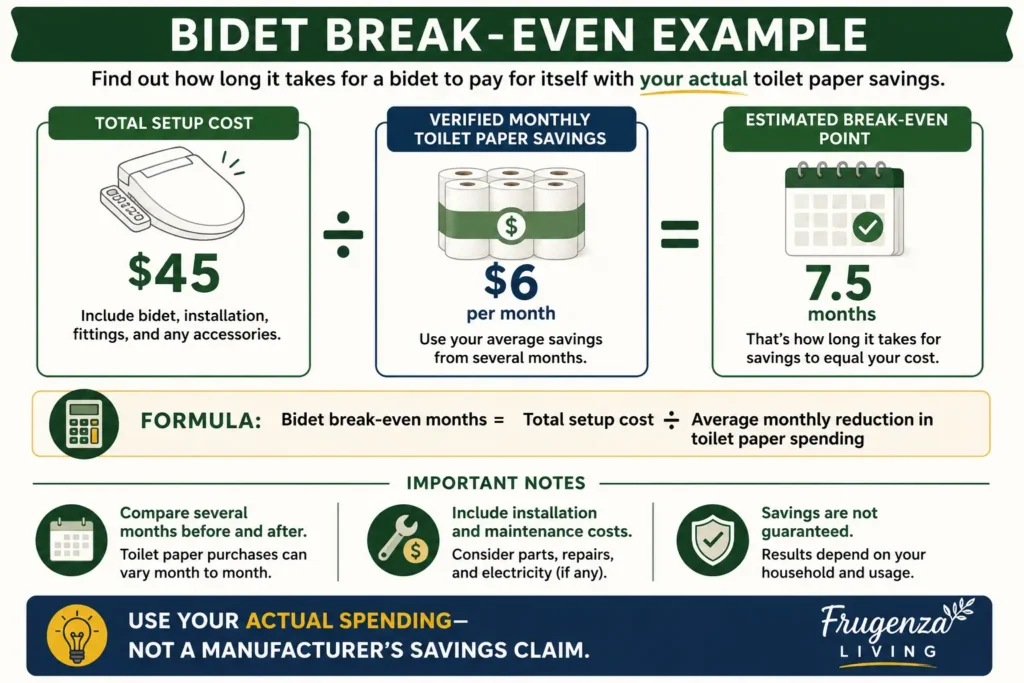
A bidet attachment may reduce toilet-paper spending for some households, but it is optional and does not eliminate paper use for everyone.
Use actual before-and-after averages:
Bidet break-even months = total setup cost ÷ verified monthly reduction in toilet-paper spending
Illustrative example:
- total setup cost: $45;
- verified monthly reduction: $6;
- $45 ÷ $6 = 7.5 months.
Calculate the monthly reduction from comparable periods, ideally averaging several months before and after installation rather than comparing two isolated purchase months. Adjust the comparison if household size or time spent at home changed materially.
Tracking what you already have before buying more is one of the easiest ways to save money at home.
Include professional installation, fittings, electricity, water, maintenance, and replacement parts when relevant. Renters should check the lease, permission requirements, compatibility, and removal rules. Follow manufacturer instructions and do not attempt plumbing or electrical work beyond your skills or local requirements.
Do Not Replace Toilet Paper With Flushable Wipes
Saving a little on paper is not worthwhile if the substitute creates plumbing or septic trouble.
EPA guidance says to flush only human waste and toilet paper. Put wipes and other personal-care products in the trash, including products marketed as flushable when local wastewater guidance says not to flush them. Paper towels, facial tissues, menstrual products, dental floss, cotton products, and diapers are not toilet-paper substitutes for flushing.
Toilet-paper products can differ in how they disintegrate, but ply alone cannot tell you whether a product is suitable for a particular plumbing or septic system. Follow EPA septic guidance, local wastewater advice, and recommendations for your system.
Buy for the Bathroom You Have
A good purchase has to pass several tests:
- fair area-based price;
- acceptable comfort and strength;
- correct holder fit;
- practical dry storage;
- manageable upfront cost;
- safe flushing habits.
Label math helps reject weak deals. The comfort floor prevents savings from becoming unpleasant. The one-roll trial prevents expensive bulk mistakes.
Apply the same balanced approach when you manage other personal-care and bathroom essentials.
Spend Less Without Turning Hygiene Into a Rulebook
Use back-of-pack data, not the loudest roll claim. Compare price per 100 square feet, treat sheet count as supporting context, and test one roll before committing to a case.
That is how to save money on toilet paper without sacrificing comfort: choose the lowest-cost option that fits the holder, works for the household, and protects the plumbing.
The best-value toilet paper is not the roll with the loudest claim or lowest shelf price. It is the one that fits the bathroom, meets the household’s needs, and costs less for the usable paper inside.
Use the same decision-making discipline to reduce other recurring household expenses.

Read about Jeffi and Frugenza Living
- How to Budget a 10-Month Salary Over 12 Months - October 16, 2026
- Pet Adoption Budget Checklist: What You Still Need to Pay - October 16, 2026
- Proportional Bill Split Calculator for Two Incomes - October 15, 2026