
If your days feel packed, saving money can become another task competing for attention. A plan that needs an hour of preparation every evening may be difficult to use on the days you need it most.
Start with one repeated decision: the meal bought after a late finish, a service that renews unnoticed, or a transfer you keep meaning to review. Prepare a workable alternative and check its real cost before turning it into a routine.
This guide explains how to set up those defaults, check whether they help, and use a short weekly money review. The dollar example is hypothetical and keeps reduced spending separate from transfers to savings.
What Is Frugal Living for Busy People?
Frugal living for busy people means organizing repeated spending decisions so a lower-cost option is easier to use when time is limited. It can involve reminders, a repeat shopping list, a backup meal, or an affordable savings transfer.
Setup does not remove the need to check results. Prices, schedules, and bills can change, so keep a short review point for each routine.
The Busy Person Frugal System
Separate the initial setup from the work you will repeat. Choose one action you can prepare, verify, and maintain before adding another.
| Repeated problem | First setup | Check that it worked |
|---|---|---|
| A charge you no longer need | Review terms and cancel before renewal when appropriate | Confirm the next charge is absent and include any replacement cost |
| Food orders after a late finish | Choose one usable backup meal and plan its ingredients | Record what you ate, spent, and left unused |
| Forgetting a savings contribution | Check cash availability and choose a transfer or reminder | Confirm the transfer did not leave upcoming costs short |
A one-time account change and a meal you must prepare every week create different workloads. Choose the action that fits both your money and the time available.
Find One Expensive Default
Look at a few recent ordinary weeks and find a purchase that repeats when you are busy. It might be a delivery order, a forgotten renewal, or buying a duplicate because you could not find what was at home. Use your own records rather than assuming a typical household saving.
Write down when it happens, what it costs, and which alternative you could use at that moment. If there is no feasible cheaper alternative, leave that expense alone for now and check another. A crowded schedule is useful information for choosing the change.
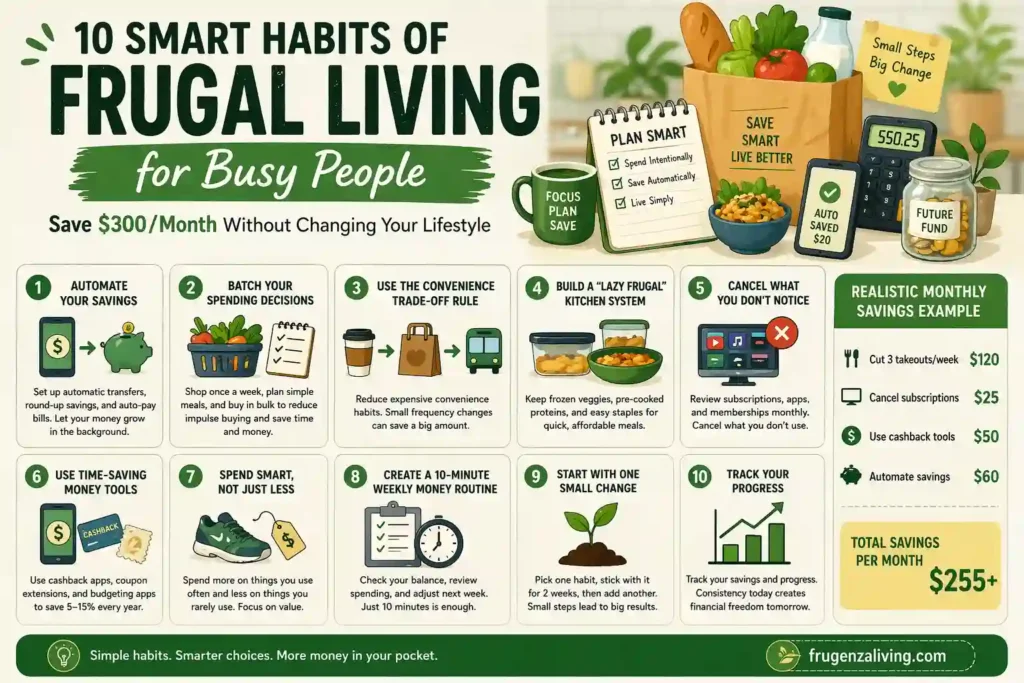
1. Automate After Checking Payment Dates
Begin with income that has cleared and a list of bills, essential spending, existing reserves, and a checking buffer. Choose a transfer amount only from money still available after those commitments. A fixed transfer may need review or a pause when income or costs change.
The CFPB’s guide to automatic saving explains recurring transfers and stresses timing, account balances, and possible overdraft fees. Check your own account’s terms. A reminder to review your balance can be more suitable than an automatic transfer when the available amount changes each payday.
As a contribution illustration, $20 each week for 52 weeks totals $1,040 before interest or withdrawals. It is money moved to savings, not a $1,040 reduction in spending. The transfer still needs funding.
Before adding a routine, compare its ongoing work with the expected benefit. This guide to living frugally with less ongoing effort helps you choose between a setup task, a substitution, and an extra job you must repeat.
2. Batch Decisions You Can Reuse
Reuse a short grocery list, a few familiar meals, or a reminder for recurring bills. Grouping decisions can reduce repeated planning, but the schedule needs to fit your storage, travel, and pay dates.
- Check supplies before your usual grocery trip.
- Choose meals that share ingredients you will finish.
- Buy a larger pack only when its usable price, upfront cost, and storage fit the plan.
One weekly shop is an option, not a requirement. A small fresh-food refill may work better than buying more than you can use. For a food-specific plan, see how to save money on groceries for one person.
3. Use the Convenience Trade-Off Rule
Compare a convenience with the alternative you can realistically use. Include the full checkout cost, preparation, cleanup, and any extra trip. A cheaper meal that sits uneaten is not a useful replacement for delivery.
You might keep delivery on your latest working evening and replace it on a day when a backup meal is available. The point is to decide which occasions need the convenience and which have a workable alternative. Your schedule determines the test; there is no universal frequency to follow.
Record the difference after trying the change. Include replacement costs, rather than treating the entire avoided order as money saved. The fourteen-day illustration below shows that calculation.
4. Keep a Small Backup-Meal System
Choose two or three meals you can prepare with your actual kitchen and energy level. The useful backup may be eggs and toast, a frozen meal with vegetables, or pasta with a sauce you already use. A prepared ingredient can be worthwhile when it makes the home option feasible.
Keep the ingredients together on a short repeat shopping list, check what is already available, and plan how you will use the rest of each package. Include preparation and cleanup when deciding whether the routine fits your evening. Follow the food’s storage and cooking instructions.
If a larger recipe leaves awkward quantities, use the recipe quantity calculator for one or two servings before shopping. Smaller portions still need suitable cookware and their own doneness check; cooking time does not shrink in the same proportion as ingredient quantities.
5. Check an Unused Charge Before Canceling
Review a subscription you no longer need or would not choose again. Check whether anyone else uses it, when it renews, and whether canceling changes a bundle price or creates a fee.
- Confirm the next charge and the cancellation deadline.
- Check whether cancellation ends access immediately or at the end of the paid term.
- Keep the confirmation and verify the next statement.
Turning off an annual renewal prevents a future charge if the terms allow it; it does not automatically refund the current term. Record when the avoided payment would have happened. If you buy a replacement service, subtract that cost when assessing the reduction.
6. Use a Tool for a Specific Question
Choose a tool when it removes a repeated calculation or helps you spot a gap. A grocery price book can compare the unit prices and offers you enter. It does not retrieve store prices or prove that a larger package fits your cash and storage limits.
A paycheck bill funding tracker can show which assigned bill amounts still need money reserved. It does not confirm that a provider has been paid.
For a cashback or coupon service, compare the final usable price with the purchase you would otherwise make. Account for any subscription charge, minimum purchase, or extra spending required. A discount on an unnecessary purchase can increase spending. Use the record that helps your decision without turning several apps into another weekly task.
7. Check Usable Value Before Upgrading
A higher price does not automatically mean better value, and frequent use alone does not make an upgrade necessary. Start with the job you need the item to do and whether something you already own does it.
For a replacement, compare suitable options, their total purchase costs, and the use you reasonably expect. Avoid buying an expensive version to justify a cost-per-use calculation based on years of use you have not established. If the current item works, waiting may require less money and effort than shopping for a better deal.
8. Give One Change a Trial and a Backup
Choose the occasion when your plan usually becomes difficult: arriving home late, shopping without a list, or reaching a renewal date during a busy week. Prepare one alternative for that occasion and try it before committing to a bigger routine.
A simple meal can have a lower-effort backup using food already available. A subscription cancellation can have a reminder to check the next statement. If the change repeatedly fails for the same reason, adjust the preparation or choose a different action rather than adding more rules.
9. A 14-Day Example With Costs Kept Separate
This is a hypothetical 14-day US-dollar illustration. All costs, rewards, and eligibility terms are assumed for this example. Begin with $200 allocated to the costs below after reserving money for other obligations. Track this $200 pot separately; apart from the listed transactions, no money enters or leaves it during the trial.
The original plan is four delivery orders at $20 each, including taxes, fees, and tips, plus an unused $12 subscription charge due during the period. The revised plan replaces all four orders with suitable $7 ready-to-eat grocery meals and cancels the subscription before that charge, with no cancellation fee or replacement service.
Assume the meals are bought and eaten during the trial, their prices include tax, and they create no extra cooking, equipment, travel, or wasted-food costs. Existing usable food stocks are not depleted to make the replacement appear cheaper.
Count Cashback Only After Its Conditions and Costs
For this illustration, a purchase already included in the $28 grocery total qualifies for a $4 cash rebate. A related service fee costs $2 during the trial. Assume all eligibility and redemption requirements are met, no return or exclusion applies, and the $4 is deposited into the tracked cash pot before day 14. There are no other reward-related fees or extra purchases.
The $28 grocery total is the amount paid before the rebate. The $4 has not already been deducted from that price. An advertised reward, pending balance, or unredeemed points would need a different cash calculation. Check the actual service terms and payment record for your own purchase.
| Item | Original plan | Revised plan |
|---|---|---|
| Four meals | 4 × $20 = $80 paid | 4 × $7 = $28 paid |
| Subscription charge | $12 paid | $0 |
| Reward-service fee | $0 | $2 paid |
| Total cash paid | $92 | $30 |
| Cashback received | $0 | $4 received |
| Net cash outflow: paid minus received | $92 | $26 |
The meal and subscription changes alone reduce costs by $92 − $28 = $64. The reward adds $4 − $2 = $2 net after its fee. Together, they leave $66 more cash than the original plan. The table shows the same result as $92 − $26 = $66. Count the service fee and rebate once in either method.
Decide whether that $2 net reward is worth its setup and follow-up. A reward that requires unnecessary spending, a higher purchase price, or more fees may be unsuitable. This example does not establish what an app will return for your purchases.
Reconcile the Ending Amount Before and After a Transfer
- Original plan: $200 − $92 = $108 remaining.
- Revised plan before a transfer: $200 − $30 + $4 = $174 remaining.
- After moving $60 to savings: $114 remains in the tracked pot and $60 has been added to savings. Together, they are still $174.
The improvement remains $174 − $108 = $66. Moving $60 changes where that money is held; it does not increase the improvement to $126. Review remaining obligations before making the transfer, and record it once.
If the $4 rebate is still pending at day 14 while the $2 fee has been paid, the cash remaining before a transfer is $200 − $30 = $170, an improvement of $62. Record the rebate as a cash inflow when it actually arrives. Keep the dates and costs of your own comparison together rather than projecting this trial into a monthly or annual promise.
Try a 10-Minute Weekly Money Check
This is a short maintenance check after your basic bill list and account setup exist. A new budget, disputed charge, or cash shortfall may need longer. Use ten minutes as a starting appointment, not proof that every obligation has been reviewed.
- Minutes 1–2: Check available cash, pending payments, and money already reserved for bills.
- Minutes 3–4: Look at upcoming payment dates through the next reliable payday. Include a larger bill that needs contributions earlier.
- Minutes 5–6: Review recent purchases for one repeated expense or an unexpected charge.
- Minutes 7–8: Prepare one action for the coming week: a backup meal, a cancellation follow-up, or a reminder to check a quote.
- Minutes 9–10: Update the plan. Transfer only money genuinely available after obligations; if nothing remains, record the shortfall and the next action.
If the check reveals a problem, schedule the follow-up instead of treating the ten-minute timer as the end of the task. Do not repeat a savings transfer that has already been completed for this pay cycle.
Frequently Asked Questions
How can I save money when I have very little time?
Choose one repeated expense and one usable alternative. Check the full cost, set up the change, and give it a review date. An unused subscription may need a cancellation and statement check; a meal replacement needs ingredients, preparation, and cleanup. Choose the workload you can maintain.
Should I automate savings if my income changes?
Use only money that remains available after bills, necessary spending, and a checking buffer are covered. If that amount changes each payday, review the actual deposit before transferring instead of relying on a fixed schedule. Lower or pause a transfer when the cash is needed for obligations.
How do I know whether a convenient option is worth keeping?
Compare it with the alternative you would actually use, including fees, unused purchases, extra travel, and the time involved. Keep a convenience when its cost fits your budget and it solves a real scheduling problem. Verify the result over a few ordinary uses before making it your default.
Can I add a savings transfer to spending reductions and cashback?
Keep the transfer separate. In the illustration, the meal and subscription changes provide $64 and the received rebate adds $2 after its fee, for a $66 cash improvement. Moving $60 of the remaining cash to savings does not create another $60 improvement.
Choose One Default to Improve This Week
Find one repeated decision that becomes expensive when your schedule is full. Prepare a workable alternative, check the money and effort it requires, and choose a review date. Keep the change if it helps; simplify it if the workload prevents you from using it. Add another task only when the first fits your routine.

Read about Jeffi and Frugenza Living
- How to Save for a Car Insurance Deductible - November 9, 2026
- How to Rebuild an Emergency Fund After Using It - November 4, 2026
- How to Budget a 10-Month Salary Over 12 Months - October 16, 2026