Parents often treat back-to-school spending like one giant shopping trip. That creates a problem: some costs are known weeks before classes begin, while others do not become clear until a teacher, schedule, activity, or classroom reveals them.
A back-to-school sinking fund gives those school-year launch costs money before they compete with your normal monthly budget. But the goal is not to finish the season with an empty fund.
Being fully funded does not mean being fully spent before school starts.
Quick answer: Check what your household can reuse, total the confirmed purchases needed before school, then add money for items that still need school confirmation and likely first-month costs. Subtract your current fund balance and divide the remaining gap by your available saving periods. Save the full target, but spend only the confirmed pre-start portion before day one.
If sinking funds are new to you, this beginner’s guide to sinking funds explains the general system.
Decide What “Back to School” Means in Your Budget
A useful back-to-school fund needs boundaries. It can cover launch costs such as confirmed supplies, replacement backpack or lunch gear, required uniforms, necessary school shoes, required technology, and school-specific fees due near the start of classes.
It should not automatically absorb every education expense for the next nine months. Regular lunches, ongoing childcare, routine transportation, monthly tutoring, tuition, and year-round extracurricular costs usually belong elsewhere.
If another account would create unnecessary complexity, this guide to how many sinking funds you should have can help you decide whether school launch costs belong inside a broader family fund.
Inventory Before You Pick a Savings Goal
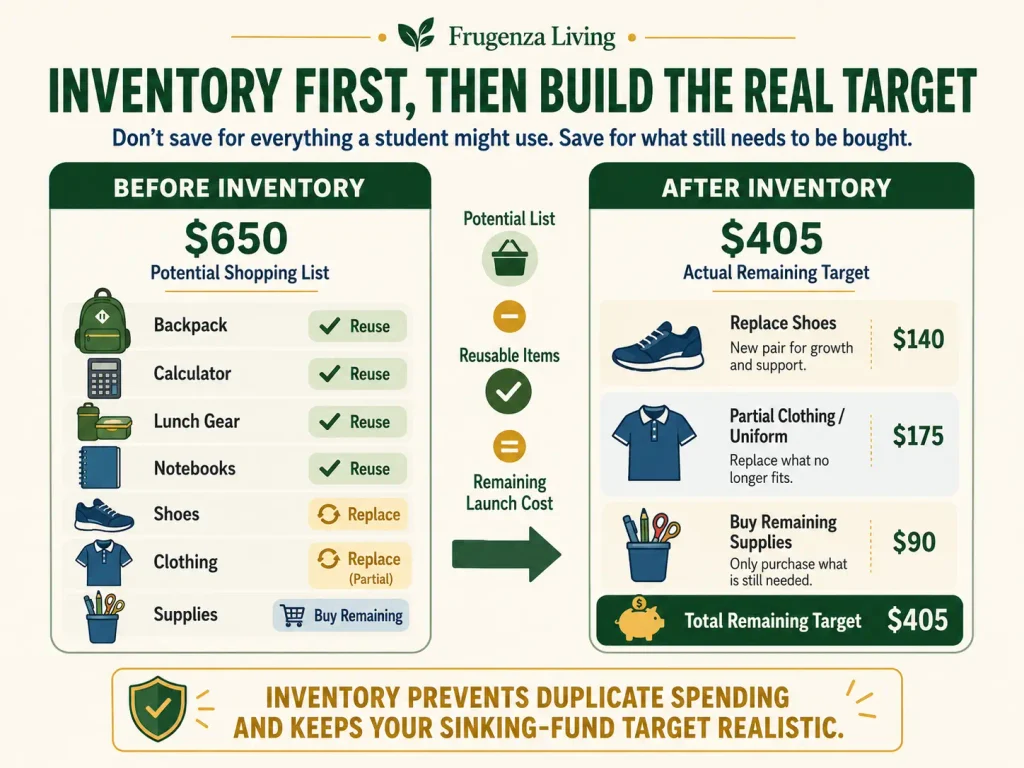
Before estimating the target, inspect what you already own.
Empty backpacks and pencil cases. Check unused notebooks, folders, calculators, chargers, lunch containers, uniform pieces, and school shoes. Ask: Does the student already own this, and does it actually need replacing?
A functioning backpack does not become a back-to-school expense because stores are displaying new ones. The same applies to technology if the school provides a device or an existing one still meets the requirement.
If last year’s backpack, lunch bag, and calculator still work, those previous purchases do not automatically belong in this year’s target.
Your target should represent:
what you still need to buy—not the retail value of everything a student could potentially use.
Split the Fund by When the Money Should Be Used
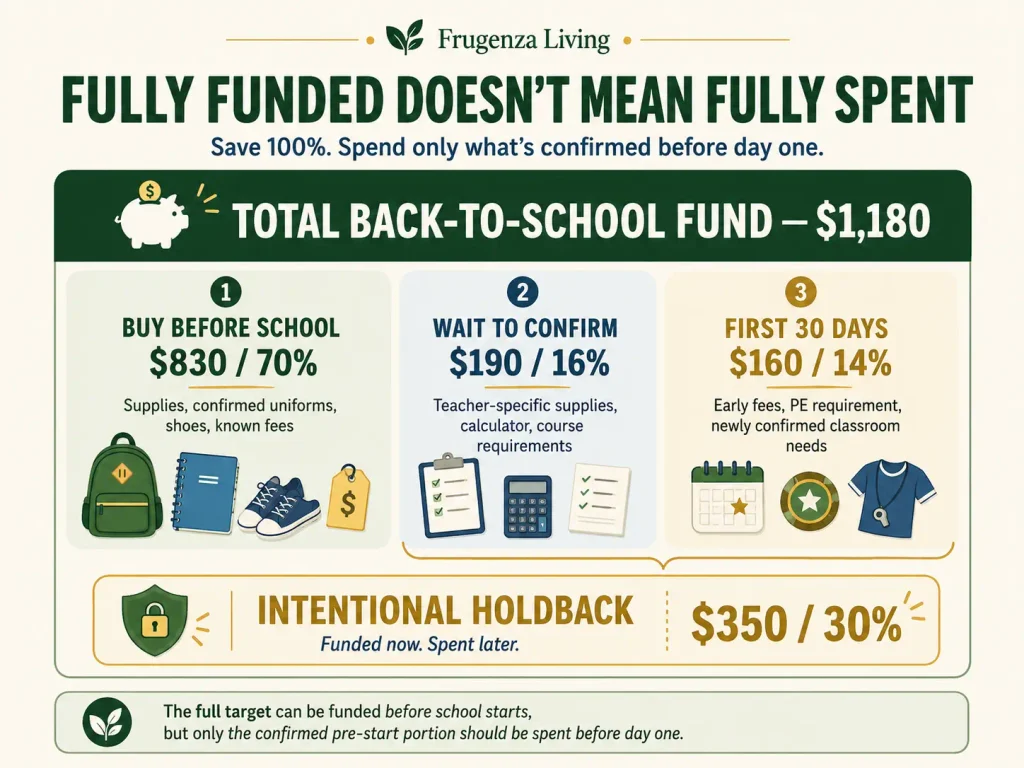
Once you know what remains, sort every purchase into one of three timing groups.
Buy Before School
This covers confirmed costs genuinely needed before classes begin: basic supplies, required uniform pieces, replacement shoes, a needed backpack, or known fees.
Wait to Confirm
This is money that is funded but intentionally not spent yet. It may cover teacher-specific notebooks, a calculator model, course materials, or other requirements that are still unclear.
First 30 Days
This is a limited amount for costs that become clearer after school begins, such as an additional classroom requirement, PE item, or activity fee.
If a known first-month cost is already listed separately, do not count it again inside a general First-Weeks Reserve.
This phased approach reflects how families actually shop. In the National Retail Federation’s July 2026 survey, 47% of back-to-school shoppers said they planned to buy only the essentials needed for the start of school and replenish supplies as needed throughout the year.
Use:
Total Back-to-School Target = Buy-Before-School Target + Wait-to-Confirm Holdback + First-30-Day Reserve
Then:
Funding Gap = Total Target − Current Fund Balance
And:
Contribution Per Saving Period = Funding Gap ÷ Saving Periods Remaining
The full target may be saved by your ready-by date while only one part is meant to leave the account before school.
The key number is therefore your Intentional Holdback: money that is fully funded but deliberately reserved for later.
Back-to-School Sinking Fund — Buy Now & Hold Back Planner
Use this planner to assign remaining costs to a student or household group, decide when each dollar should be spent, calculate your funding gap, and see how much of the final target should remain unspent before day one.
Frugenza Living Budget Tool
Back-to-School Buy Now & Hold Back Planner
Fund the full school-year launch without spending every dollar before day one.
Start with remaining costs. Check what you already own first. Choose “Reuse / No Purchase Needed” for anything that does not need to be bought.
Avoid double counting. If you list a known first-month fee or item separately, do not include the same cost again inside a general First-Weeks Reserve. Use that reserve only for genuinely uncertain early costs.
Student / Group Subtotals
Planning estimate only. School requirements vary by student, teacher, program, and location. Confirm actual requirements with the school before purchasing.
Example: Why a Fully Funded $1,180 Plan Should Still Have Money Left
Consider Rachel and Devon, a fictional U.S. household with two children. Their amounts are illustrative.
Their younger child can reuse several items, while their older child is entering middle school and has a higher launch cost.
After inventorying what they already own, the family estimates $830 in Buy-Before-School purchases, $190 in items that should Wait to Confirm, and $160 for the First 30 Days.
Their total target is:
$830 + $190 + $160 = $1,180
They already have $500 saved, leaving:
$1,180 − $500 = $680
With four saving periods remaining:
$680 ÷ 4 = $170 per saving period
By the ready-by date, the full $1,180 can be funded. But Rachel and Devon spend only $830 before classes and leave $350 in the account.
They are 100% funded, but only about 70% of the target is meant to be spent before school. Roughly 30% is intentional holdback.
That $350 already has a later job. It is not extra shopping money.
Adjust for the School Year You Are Entering
Last year’s actual spending can be useful, but it should not be copied automatically.
A move into middle school or high school, a school change, new uniform policy, different PE requirement, or course-specific equipment can change the launch cost. A large device or backpack bought last year may also remain usable.
A better starting calculation is:
Last Year’s Repeatable Launch Costs − Reusable or One-Time Purchases + Confirmed Transition Changes
Verify the actual school list, technology policy, uniform rules, and known fees whenever possible instead of adding an arbitrary percentage to last year’s total.
If You Have More Than One Child, Build Each Cost First
Do not choose one family target and divide it equally among children.
One student may reuse almost everything while another has outgrown uniform pieces or is entering a transition year. Build each student’s remaining launch cost first, then add shared household items.
The planner’s Student / Group field shows subtotals for each child or shared category.
If other predictable non-monthly costs compete for the same paycheck, an annual expenses checklist can help keep them separate from this school launch plan.
Starting Late? Narrow the Shopping List Before Forcing the Contribution
If school begins in only a few paychecks, your calculated contribution may not fit your budget. Do not treat that as an instruction to borrow.
Recheck what can be reused. Protect confirmed school-required purchases. Delay unconfirmed spending. Separate upgrades from replacement needs. Where appropriate, ask the school about supply programs, device programs, fee assistance, or other available support.
When the savings runway gets shorter, narrow the shopping list before forcing an impossible contribution.
A smaller plan built around real requirements is more useful than a larger target filled with purchases that may never be needed.
Do Not Close the Fund on the First Day of School
Keep the fund open until the launch period settles.
Then review: what you bought before school, what you waited to confirm, what appeared after school started, and what you never needed.
For next year, separate repeatable launch costs from reusable purchases, transition-only items, and unnecessary spending. Then add known changes for the next school stage.
The result is not simply this year’s total divided by 12. It is a cleaner estimate of what the next launch is likely to require.
If you want to keep a separate record of contributions and withdrawals, the sinking fund tracker template can handle the ongoing balance.
Frequently Asked Questions
How much should I save in a back-to-school sinking fund?
Add confirmed pre-start purchases, items you want funded while waiting for confirmation, and a reasonable first-weeks reserve. Subtract the current fund balance to find the remaining gap. Use your actual requirements, not a national spending average.
When should I start saving for back-to-school expenses?
Start early enough to spread the funding gap across manageable saving periods. The right date depends on your school calendar, current balance, and known requirements.
What should a back-to-school sinking fund cover?
It can cover school-year launch costs such as supplies, necessary backpacks or lunch gear, uniforms, shoes, required technology, school-specific fees, and early classroom requirements.
Should I buy everything before the first day of school?
No. Buy confirmed essentials needed before classes begin. Keep funded money unspent for requirements that are still uncertain and costs deliberately assigned to the first weeks.
The Bottom Line
The goal of a back-to-school sinking fund is not to reach the first day of school with an empty savings account and a completed shopping cart.
Check what you already own, then label each remaining cost:
Buy Before School → Wait to Confirm → First 30 Days
Fund the school-year launch—not just the first shopping trip.
If money is still sitting in the fund after day one, that can mean the plan is working exactly as intended.
Educational note: This guide provides general budgeting information. School requirements, available support, and household priorities vary, so confirm actual requirements with your school before purchasing.

Read about Jeffi and Frugenza Living
- Proportional Bill Split Calculator for Two Incomes - October 15, 2026
- How to Split Grocery Bills With Roommates - October 14, 2026
- First Apartment Kitchen Essentials on a Budget - October 13, 2026