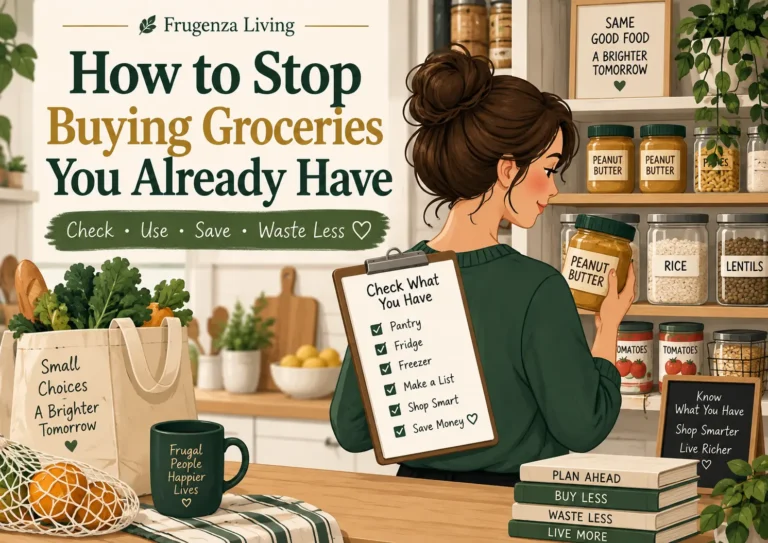
You get home, unpack the groceries, and put a new jar of peanut butter in the cabinet. Then you notice the unopened jar you bought last week.
You made a grocery list. The problem is that one item reached it because you remembered needing it, not because you confirmed you were out.
If you want to know how to stop buying groceries you already have, you do not need to memorize every shelf. Add one verification step between “I think I need this” and “this belongs in my cart.”
Duplicate and premature purchases can pull spending into this week’s grocery trip before necessary, hide older food, and make your kitchen harder to read. This is one narrow part of saving money on groceries for one person, but it deserves its own method because the mistake often happens before you enter the store.
A grocery list should contain confirmed gaps, not remembered possibilities.
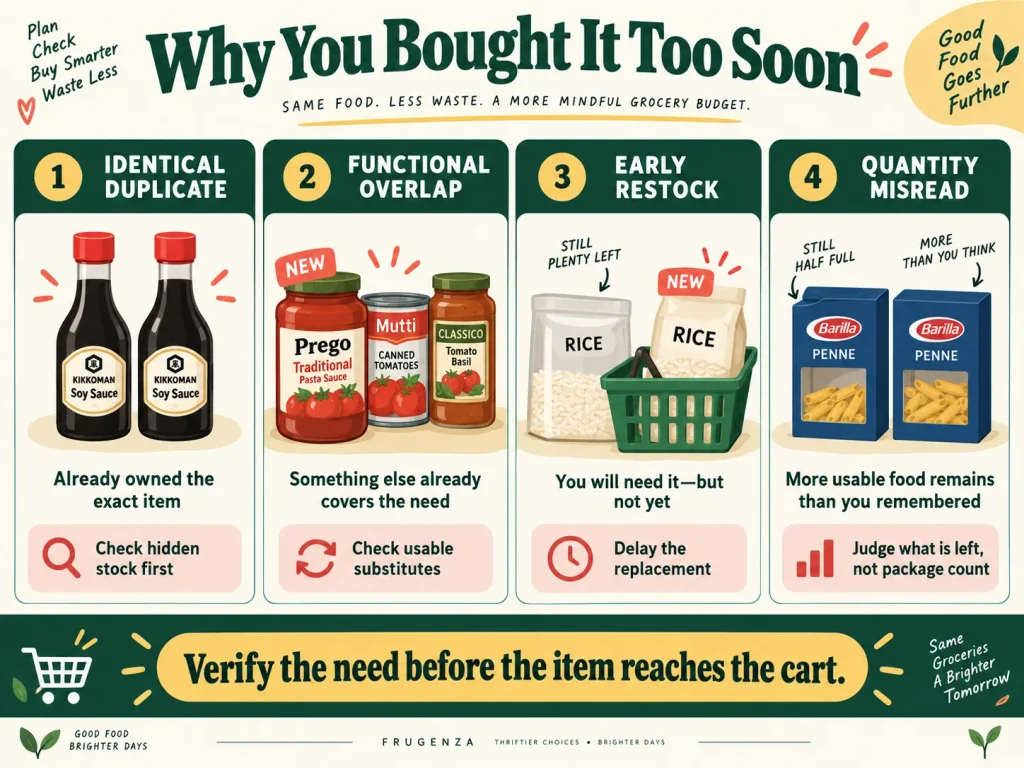
Four Reasons You Buy Groceries Before You Really Need Them
Extra groceries do not all come from the same mistake.
| Pattern | What happened | Example |
|---|---|---|
| Identical Duplicate | The exact product was already at home | You buy soy sauce while another bottle is in the cabinet |
| Functional Overlap | Something you own can reasonably serve the same purpose | You buy pasta sauce when another suitable sauce can cover the meal |
| Early Restock | You will use the food eventually, but replace it too soon | A large rice bag looks low even though several meals remain |
| Quantity Misread | You remembered the food but underestimated what remained | Two partial pasta boxes together are enough for dinner |
This is why “check the pantry” is incomplete advice. You can see a product and still replace it too early. You can also confirm that an exact ingredient is missing while overlooking something you would genuinely use instead.
The real problem is the verification gap between a suspected need and a confirmed one.
Read the Grocery List Backwards Against Your Kitchen
Start with your normal draft list. Do not count every can or audit every shelf.
If the list says milk, oats, mustard, frozen peas, and tortillas, verify those items. For each uncertain entry, ask:
Where would this be if I already owned it?
Mustard may require checking the fridge door and a backup shelf. Frozen peas mean checking the freezer. A recipe ingredient deserves another question: do you already have a realistic substitute?
Use this sequence:
List → Locate → Verify → Decide
A draft item then becomes:
- Buy — genuinely needed before the next normal grocery trip.
- Remove — Already Have — enough of the exact product or backup already exists.
- Delay — Enough for Now — you are getting low, but not low enough to buy today.
- Use Substitute — something already at home reasonably fills the intended role.
- Verify Again — the evidence still does not establish whether you should buy it.
The goal is not perfect knowledge of everything in your kitchen. It is making uncertain grocery purchases prove that they belong on the final list.
Before You Buy: Grocery Check
Add only groceries you are considering buying. The tool combines why the item entered your list with what you actually found at home to suggest a decision.
You can override the suggestion when your circumstances differ, but an inconsistent override stays in Check Again Before Leaving rather than being treated as verified.
Before You Buy: Grocery Check
Add only items you are considering buying. Check the kitchen, record what you found, and let the evidence shape the final list.
Verified Shopping List
Check Again Before Leaving
“Planned Spend Removed This Trip” includes optional prices only for evidence-consistent Already Have, Delay, or Use Substitute decisions. It is not guaranteed permanent savings. A delayed item may be purchased later. This temporary shopping list remains in this browser until you start a new trip or clear browser storage.
If duplicate buying affects dozens of pantry foods instead of a few uncertain purchases, maintaining a pantry inventory checklist for one person may be more useful. For an ordinary grocery trip, verifying only candidate purchases is much lighter.
When an Empty Shelf Still Does Not Prove You Need More
Suppose you put crackers on the list because you “usually buy them.”
You check the pantry and find none.
That confirms the stock level: zero.
It does not answer whether crackers belong in this week’s cart.
Compare that with milk you use every morning or an ingredient required for a meal you already plan to cook. If those are gone, the evidence for buying is much stronger.
This is why the tool uses both why the item entered the list and what you found.
If an item appears only from habit or uncertainty, “nothing left” should trigger one last question:
Do I actually need this before my next shopping opportunity?
When You Still Cannot Remember
Sometimes uncertainty appears after you are already in the store.
For a nonessential item, especially when another shopping opportunity is coming soon, waiting can be reasonable. Confirm it at home instead of buying “just in case.”
If the item is genuinely required before your next normal shopping opportunity and there is no suitable substitute, buying the smallest practical amount may make more sense than disrupting meals you already planned.
A pantry or fridge photo can help if you already keep one. Another household member may be able to check. You do not need a full inventory app to settle a handful of uncertain purchases.
Uncertainty is a signal to check, not automatic evidence that you need more.
A Sale Does Not Confirm the Need
Promotions can change the question from “Do I need another one?” to “Will I ever get this price again?”
A discount improves the price of a purchase you need. It does not prove that the purchase itself belongs in your cart.
If two bottles of a condiment already cover months of normal use, another discounted bottle may simply move future spending into today’s grocery bill. Bulk buying can still make sense when your consumption supports it; verify the need before letting the price persuade you.
Removing a $6 Item Does Not Always Mean Saving $6 Forever
Suppose a $6 jar is on your draft list and you discover an unopened one at home. Removing it takes $6 of planned spending out of today’s trip.
The long-term result depends on what happens next.
Purchase avoided: you never need the extra jar.
Purchase delayed: you use the existing one and buy another several weeks later.
Food waste prevented: noticing old stock helps you use it before it is forgotten or deteriorates.
Those outcomes are related, but they are not interchangeable. That is why the tool reports Planned Spend Removed This Trip, not “Money Saved.”
The U.S. Environmental Protection Agency recommends checking the refrigerator, freezer, and pantry before shopping to avoid buying food you already have and planning purchases around food you expect to use.
If duplicate purchases keep happening, look at the rest of your shopping routine as well—overbuying and shopping without a plan often occur together.
What If the Extra Food Is Already There?
Verification prevents the next unnecessary purchase. It does not remove duplicates already in your kitchen.
If you find several sauces, partial packages, or repeated freezer backups, use those foods before treating another trip as the solution. A shop your pantry challenge is better suited to turning excess stock into meals.
Then look for the cause. Was the original item hidden? Did “low” feel like “out”? Was the product automatically added every week? Did a promotion make uncertainty feel harmless?
Fixing that trigger is more useful than promising to be more careful.
Close the Loop After Shopping
When you put groceries away, clear the temporary verification session and keep backups somewhere visible.
You do not need to log every spice, count every can, or maintain a permanent spreadsheet just to stop buying groceries you already have. For many households, the grocery list itself is the shortest useful stock check.
Draft it from memory if that is convenient.
Just do not let memory have the final vote.

The ideas shared here come from real-life experience and practical habits that actually work.
→ Read more about Jeffi
- No Spend Month Challenge for Beginners: A 30-Day Plan - September 24, 2026
- Low Buy Month Challenge: Realistic Rules for 30 Days - September 23, 2026
- How to Stop Buying Groceries You Already Have - September 20, 2026