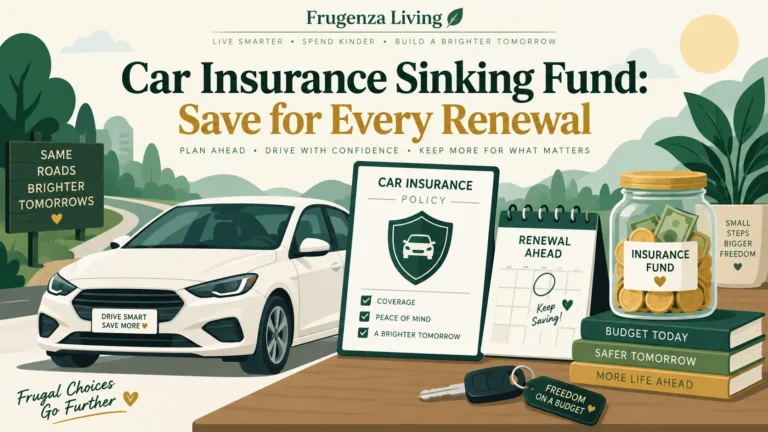
A $960 car insurance renewal can feel like a major expense when it arrives in one week.
Spread across a six-month policy cycle, however, that same premium represents:
$960 ÷ 6 = $160 per month
That is the budgeting idea behind a frugal car insurance sinking fund: turn a predictable future premium into smaller contributions before renewal becomes urgent.
Quick answer: Take the premium you plan to fund, subtract money already reserved, then divide the remaining gap across the usable months or paychecks before payment. After paying the premium, begin the next cycle. When your actual renewal quote arrives, replace the old estimate with the new amount.
Use your renewal notice or current insurer quote as the source of truth for the premium, policy period, and payment date.
This is general budgeting education, not individualized insurance or financial advice.
When Car Insurance Actually Needs a Sinking Fund
Not every car insurance payment needs a separate sinking fund.
If you already pay the premium monthly and plan to keep paying monthly, it usually belongs with your other regular monthly bills.
A sinking fund becomes more useful when:
- the premium is due less often than monthly;
- you pay semiannually or annually;
- you want to build enough cash to move from installments to paying the full policy term;
- you want renewal money separated from normal spending before the bill arrives.
The bill may be irregular even though the cost is recurring.
If this budgeting method is new to you, learn how sinking funds work before creating multiple reserves.
Three Car Costs Should Not Share One Pot
A generic “car savings” balance can look healthy while the same dollars are quietly expected to cover several different jobs.
| Money job | What it covers | Best treatment |
|---|---|---|
| Insurance premium fund | Scheduled or expected policy premium | Main fund discussed here |
| Deductible reserve | Possible out-of-pocket amount on a covered claim, when applicable | Separate reserve |
| Maintenance and repair fund | Service, tires, brakes, wear items, repairs | Separate car fund |
A deductible is not part of the premium.
Likewise, oil changes, tires, and repairs should not consume money already reserved for insurance renewal. Those belong in a separate car maintenance sinking fund.
That separation answers a useful question immediately:
How much of my car savings is truly available for the next premium?
Build the First Renewal Target
Suppose your next premium is expected to be $960.
You have $240 already saved and four monthly saving periods remain.
Funding gap:
$960 − $240 = $720
Required contribution:
$720 ÷ 4 = $180 per month
If you budget by paycheck and have eight usable paychecks before payment:
$720 ÷ 8 = $90 per paycheck
Insurance is not the only predictable vehicle cost that may arrive outside your normal monthly budget. A car registration sinking fund can help you prepare for renewal and licensing fees separately.
The first cycle may feel expensive if you start late because you are catching up to a premium that is already approaching.
The next cycle is usually easier to smooth.
The First Pay-in-Full Cycle Can Be the Hardest
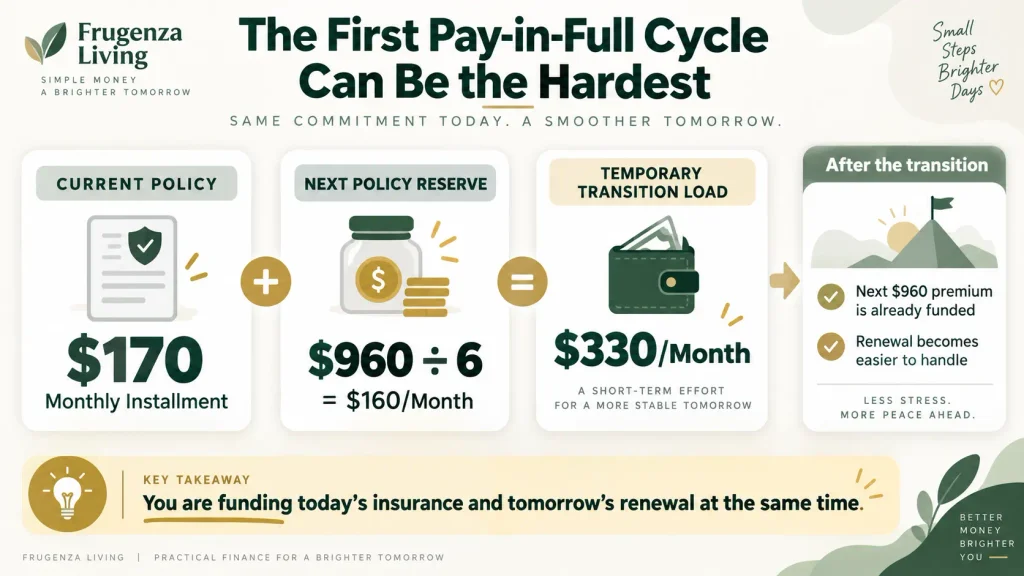
This is where a simple “premium ÷ six months” formula can hide the real cash-flow problem.
Suppose you currently pay $170 per month through an installment plan.
You want to have $960 ready to pay the next policy term in full, and renewal is six months away.
To build that reserve:
$960 ÷ 6 = $160 per month
But you still have to pay the current $170 installment.
For part of the transition, your budget may effectively carry:
$170 current payment + $160 future reserve = $330 per month
That may be too much.
Do not count the current installment money as if it were also funding the next policy.
If building the entire reserve in one policy cycle would strain groceries, housing, required bills, or push spending onto a credit card, transition more gradually.
You can build part of the reserve during this term and finish the shift during the next one.
The point of a sinking fund is to improve cash flow, not create a temporary cash-flow crisis just to reach pay-in-full faster.
After You Pay, Start Again
Once the premium is paid, begin preparing for the next policy term instead of waiting for another renewal email.
If $960 remains your best working estimate and the next payment is six months away:
$960 ÷ 6 = $160 per month
Think of the cycle as:
Pay → reset → save → update at renewal
This is the Policy-Cycle Reset Method.
If car insurance is only one of several bills you pay once or twice a year, an annual bills sinking fund can help you plan for those recurring expenses together.
The premium may arrive twice a year, but your budget can prepare for it every month.
When the Renewal Quote Changes
Last term’s premium is a useful planning number, not a guarantee.
The National Association of Insurance Commissioners explains that auto insurance premiums may be affected by factors such as driving record, claims history, location, vehicle use, selected coverage, and deductibles.
Suppose your working target was $960, but the new renewal quote is $1,020.
You already have $800 saved and two saving periods remain.
Updated gap:
$1,020 − $800 = $220
New contribution:
$220 ÷ 2 = $110 per period
Once the real renewal quote is available, stop funding the outdated estimate.
If the premium comes in lower than expected, the surplus can remain in the fund as the first contribution toward the following cycle.
Car Insurance Renewal Reserve Calculator
Use this calculator when you are preparing for a non-monthly premium or building a reserve to move toward a full-policy payment.
If you intend to keep paying insurance as an ordinary monthly bill, you usually do not need to treat the entire policy-term premium as a separate sinking-fund target.
The optional payment-comparison fields do not change the funding target automatically.
Car Insurance Renewal Reserve Calculator
Calculate the premium gap first. If you have comparable payment quotes, you can also compare their total cost for the same policy term.
Enter your current numbers to check the plan.
Compare payment quotes only when they cover the same policy term and substantially the same coverage and deductibles. Comparison fields do not change your funding target.
Compare Payment Modes With Actual Quotes
If your insurer offers more than one payment schedule, compare the full quoted totals, not only the size of each installment.
Illustrative example:
- Pay-in-full total: $960
- Total of all installments: $1,014
Difference:
$1,014 − $960 = $54
In that example, the installment total is $54 higher.
But only compare quotes for the same policy term with substantially comparable coverage and deductibles.
And do not chase a modest difference by creating a larger problem somewhere else.
If paying $960 immediately would force required bills onto a credit card or drain emergency savings you cannot comfortably replace, continuing installments temporarily may be the better cash-flow decision.
The sinking fund makes another payment option possible when your budget is ready for it.
What “Frugal” Means Here
Frugal insurance planning is not automatically choosing the lowest-looking premium.
A cheaper quote can reflect different coverage, deductibles, policy terms, or other assumptions.
For budgeting purposes, frugal means:
- knowing the premium you are preparing for;
- comparing genuinely comparable payment choices;
- reserving predictable costs before they become urgent;
- keeping premium money separate from repair and deductible money;
- protecting cash flow while avoiding unnecessary payment costs when practical.
Coverage decisions deserve their own review based on your actual policy, legal requirements, finances, vehicle, lender requirements when applicable, and risk tolerance.
The sinking fund has a simpler job:
make the premium you choose easier to pay.
Make the Next Renewal Boring
Find four numbers:
- Your next premium or best current estimate.
- The amount already reserved.
- The usable paychecks or months before payment.
- The actual renewal quote when it becomes available.
Fund the gap.
Pay the premium.
Then start the next cycle instead of waiting for another large bill to appear.
If the renewal changes, change the target.
If money remains after payment, it can become the first contribution toward the next policy term.
A car insurance sinking fund is working when renewal stops feeling like a financial event.
The bill still exists.
Your budget simply saw it coming.

The ideas shared here come from real-life experience and practical habits that actually work.
→ Read more about Jeffi
- Shop Your Pantry Challenge: Use What You Have and Spend Less - September 16, 2026
- Car Insurance Sinking Fund: Save for Every Renewal - September 14, 2026
- Vacation Sinking Fund: How Much to Save for Your Trip - September 12, 2026