The refrigerator is 10 years old. The washer came with the house. The dishwasher still works, but nobody remembers when it was installed.
None of those facts tells you which appliance will fail first.
That uncertainty is the real budgeting problem.
An appliance replacement sinking fund should not pretend every machine has a precise expiration date. Its job is to give your household enough replacement capacity that one ordinary appliance failure does not automatically disrupt every other savings goal.
There is no useful universal monthly amount. Start with one realistic Replacement Floor, subtract the appliance savings actually available to it, and divide the remaining gap by a catch-up period your budget can support. Then check how much coverage would remain for the next appliance.
That last step is what separates useful planning from a spreadsheet full of imaginary failure dates.
Treat Appliance Replacement as a Coverage Problem
Annual bills usually have a visible due date. Appliances do not.
You may know that a refrigerator, washer, dryer, dishwasher, or range is getting older, but not whether it has three months or three years left.
Published lifespan ranges make the point. The InterNACHI life-expectancy chart lists broad expected-life ranges for household components and treats those numbers as guidelines rather than guarantees. A dishwasher may have a different planning range from a washer, and even appliances of the same type can have very different real-world lives.
Use lifespan information to decide what deserves attention, not to predict a failure month.
That boundary also keeps this fund narrow. Roofs, HVAC, water heaters, plumbing, and broader structural or home-system costs belong in a home repair sinking fund, not inside an appliance replacement reserve.
Build a Replacement Floor, Not a Dream-Appliance Target
The original purchase price is often a poor planning number.
So is the price of the upgrade you would love to own.
For each appliance, estimate a Replacement Floor: the current all-in amount required to obtain an acceptable functional replacement for your household.
Depending on the purchase, that may include the appliance itself, required delivery, necessary installation or connection items, haul-away, and applicable sales tax.
Not every purchase includes every cost. The purpose is to estimate the amount you would realistically need to complete the replacement, not merely the sticker price.
Suppose an acceptable refrigerator would cost about $1,300 all-in, while the premium model you prefer would cost $2,300.
For replacement readiness:
Functional Replacement Floor: $1,300
Optional Upgrade: $1,000
You can save for the upgrade if you want. But the basic appliance reserve does not have to treat the full $2,300 as unavoidable.
That distinction keeps the sinking fund tied to financial resilience rather than lifestyle inflation.
Decide What Deserves Attention Now
Instead of creating a separate savings account for every machine, sort appliances into three planning lanes.
Priority means replacement readiness deserves attention now. Signals might include older age, repeated recent repairs, unreliable operation, an expired useful warranty, active replacement research, or major household disruption if the appliance stopped working.
Watch means the appliance is still functioning, but ignoring replacement entirely would feel financially uncomfortable.
Later means there is no meaningful replacement pressure right now.
These are budgeting classifications, not mechanical diagnoses.
Age alone does not prove that something needs replacement. The lanes simply stop every appliance from demanding equal savings today.
It helps to understand the difference between a sinking fund and an emergency fund, because a planned appliance replacement is different from a sudden breakdown you could not reasonably anticipate.
Use the One-Failure-First Method
If your appliance reserve is small, adding the replacement cost of every refrigerator, washer, dryer, dishwasher, and range can produce a frightening number without telling you what to do next.
The One-Failure-First Method starts with one real question:
If one important appliance needed replacement tomorrow, how much of that cost could your current appliance fund absorb?
Choose the appliance whose replacement would create the biggest practical financial disruption for your household.
Then calculate:
First Replacement Gap = Replacement Floor − Current Appliance Fund
Use zero as the minimum gap.
Next choose a catch-up period based on your budget, not on a guessed failure date:
Catch-Up Pace = First Replacement Gap ÷ Chosen Saving Periods
Suppose your refrigerator is the First Coverage Target.
Replacement Floor: $1,400
Current appliance fund: $500
First Replacement Gap: $900
Chosen catch-up period: 12 months
Catch-up pace:
$900 ÷ 12 = $75 per month
That does not mean the refrigerator is expected to fail in 12 months.
It means your household wants first-replacement coverage within 12 months.
If dedicated savings categories are new to you, sinking funds for beginners covers the general setup; the method here is specifically about uncertain appliance replacement.
What If the Catch-Up Pace Is Too High?
A calculator is still useful when the answer is uncomfortable.
If $75 per month does not fit but $30 does, do not make the plan look funded by quietly lowering the Replacement Floor.
First check whether the floor includes optional upgrades. If the estimate is already realistic, you can lengthen the catch-up period when that better fits your circumstances, contribute what you can, and keep the remaining shortfall visible.
An unfunded gap is information.
It tells you exactly how much replacement risk your current budget has not yet absorbed.
The Second-Layer Gap Matters More Than a Giant Total
Once the first appliance is covered, the next useful question is not:
“How much would it cost to replace everything I own?”
It is:
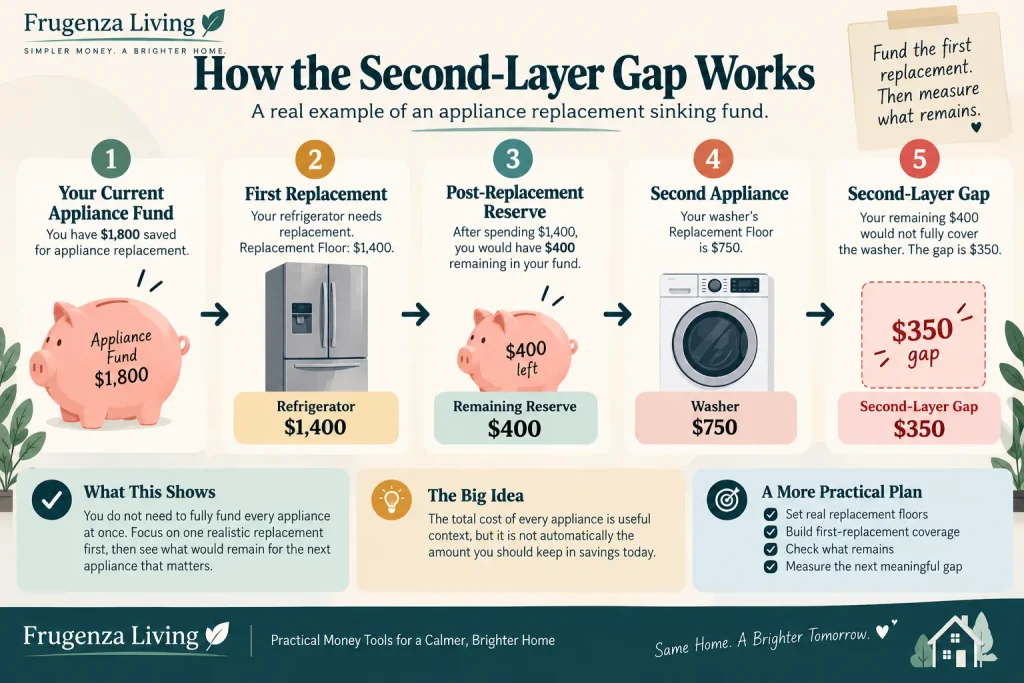
What would remain in the fund after the first replacement, and would that amount cover the next appliance I care about?
Suppose you have:
- Appliance fund: $1,800
- Refrigerator Replacement Floor: $1,400
- Washer Replacement Floor: $750
The refrigerator is covered.
If it is replaced for the full $1,400 floor:
Post-Replacement Reserve = $1,800 − $1,400 = $400
If the washer is your Second Coverage Target:
Second-Layer Gap = $750 − $400 = $350
That $350 is actionable.
By contrast, saying your combined theoretical exposure is $2,150 does not tell you whether both amounts need to sit in cash today.
This is why the article treats the total cost of every appliance as background information, not as the default savings target.
Appliance Replacement Coverage Planner
Use the planner below to choose one First Coverage Target and, if useful, one Second Coverage Target. The tool measures first-replacement coverage, the Post-Replacement Reserve, and the Second-Layer Gap without assuming every appliance needs to be fully funded at once.
Appliance Replacement Coverage Planner
Choose what you want covered first, see what would remain after that replacement, and measure the next meaningful gap.
Your Appliance Coverage
This is a budgeting planner, not a mechanical-life predictor. Replacement Floors should reflect current household-specific costs and responsibilities.
A Potential Replacement Cluster Is a Warning, Not a Prediction
Several appliances may have been purchased with the home, installed during the same renovation, or simply reached older age around the same time.
That can create a potential replacement cluster.
It does not mean the appliances will fail together.
It means more than one Priority or Watch item is competing for the same reserve.
If your first replacement is covered but the Second-Layer Gap is still large, that is a reasonable signal to keep building a second layer of coverage. If every appliance is still Later, there is no reason to manufacture urgency just to keep the fund growing.
One Shared Appliance Fund Is Usually Enough
You do not need a refrigerator account, washer account, and dishwasher account unless that level of detail genuinely helps you.
One Appliance Replacement Fund is simpler for many households.
The important rule is that a single balance should not be mentally counted several times.
If you have $2,000, you do not simultaneously have $2,000 for the refrigerator and another $2,000 for the washer. The planner avoids that problem by starting from one current appliance-fund balance and testing it against the coverage targets you select.
This also keeps planned appliance replacement distinct from genuine emergencies. An appliance breakdown can feel urgent, but appliance replacement is still a foreseeable household category. The broader sinking fund vs. emergency fund guide explains why those two reserves do not have to perform the same job.
Renters Should Fund What They Are Actually Responsible For
Not every appliance in a home belongs in your replacement plan.
If you rent and the landlord owns the refrigerator and is responsible for replacing it under your lease, creating a personal refrigerator replacement target may make no sense.
But a renter might own the washer, dryer, portable freezer, or another appliance.
Base the fund on actual financial responsibility, not simply on what happens to be inside the home.
When responsibility is unclear, check the lease or ownership arrangement before assigning money.
After a Replacement, Reset the Coverage Map
Eventually the fund will do what it was built to do.
Suppose your $1,400 refrigerator target is covered and replacement ends up costing $1,250 all-in.
Spending that money is not a failure.
A withdrawal for a planned appliance replacement is the success case of the sinking fund.
Afterward, perform a Replacement Reset:
- Record the actual all-in cost.
- Remove the old appliance’s obsolete target.
- Put the new appliance in Later.
- Keep the remaining appliance fund intact.
- Choose the next meaningful Priority or Watch item.
- Recalculate first coverage and the Second-Layer Gap.
Do not automatically rebuild to the old total just because it used to be the target.
That target belonged to an appliance you have already replaced.
Actual purchase data also improves the next estimate because it reflects the costs your household really encountered.
What This Fund Is Actually Buying You
The value of an appliance replacement sinking fund is not that it predicts which machine dies next.
It gives you a controlled response to uncertainty.
Set a realistic Replacement Floor. Choose one First Coverage Target. Build enough capacity to absorb it. Then look at the money that would remain and measure the Second-Layer Gap for the next appliance that matters.
If several Priority and Watch items are competing for the reserve, you have a potential replacement cluster, not a prediction.
If every appliance is Later, you do not need to create an artificial monthly target.
The goal is not to accumulate the theoretical replacement cost of your entire home.
The goal is to know:
What can I cover now?
What would remain after I use the fund?
What is the next meaningful gap?
That is a more practical way to save for appliance replacement than guessing failure dates years in advance.

The ideas shared here come from real-life experience and practical habits that actually work.
→ Read more about Jeffi
- Vacation Sinking Fund: How Much to Save for Your Trip - September 12, 2026
- Moving Sinking Fund: How Much to Save Before Moving Day - September 12, 2026
- Appliance Replacement Sinking Fund: How Much Should You Save? - September 11, 2026