
A roof can be aging while an HVAC system is becoming less reliable and a water heater is already well into its service life. Those three costs do not wait politely for separate years.
That is what makes a home repair sinking fund different from a simple savings goal. The problem is not only how much a future repair may cost. It is also which repair needs money first—and whether paying for one would leave the next one underfunded.
Instead of choosing one generic savings number and hoping it works, build a repair calendar. List the expensive components that matter in your home, estimate what each may cost, record what is already reserved, and give each a realistic planning horizon.
If sinking funds themselves are new to you, this beginner’s guide to sinking funds covers the basic system. Here, the focus is narrower: preparing for several possible home-repair costs without losing track of what each saved dollar is meant to cover.
Build a Repair Calendar Before Choosing a Savings Target
Start with the expensive systems that actually apply to your property:
- roof;
- heating and cooling equipment;
- water heater;
- major appliances;
- known plumbing work;
- exterior components;
- structural work already identified;
- other high-cost systems specific to the home.
Then record what you actually know.
A contractor estimate, inspection note, installation date, warranty, service record, or repair history is more useful than assuming every roof or HVAC unit follows an exact lifespan chart.
Material, climate, installation quality, maintenance, usage, previous repairs, and current condition can all affect timing.
Your planning horizon is therefore not a prediction that something will fail in exactly 18, 36, or 48 months. It is the date by which you would prefer the money to be available based on the best information currently available.
A repair calendar does not predict failure. It shows which foreseeable costs are competing for your future dollars.
Update it when better information arrives.
Home repairs are not the only large household costs worth planning for. An appliance replacement sinking fund can help you prepare for a refrigerator, washer, dryer, or other major appliance reaching the end of its life.
What Actually Belongs in a Home Repair Sinking Fund?
The strongest candidates are repairs or replacements you can reasonably foresee even if you cannot predict their exact date.
For example:
Routine HVAC servicing belongs more naturally in a regular home-maintenance budget.
A roof approaching a known replacement window is a stronger candidate for a home repair sinking fund.
An optional kitchen redesign is usually a separate improvement goal.
Sudden storm damage may involve homeowners insurance depending on the cause, policy, deductible, exclusions, and other terms.
An unexpected non-covered breakdown may require repair savings, emergency resources, or both depending on the household’s setup.
Do not turn every house-related expense into one giant category.
For this article, the key distinction is simple:
Foreseeable home repair → plan for it.
Routine upkeep → budget for it.
Optional improvement → give it its own goal.
Potential insurance event → check the actual policy before assuming coverage.
It is also important to understand the difference between a sinking fund and an emergency fund, because not every home repair should come from the same savings bucket.
Use the 1%–4% Rule as a Benchmark, Not a Diagnosis
One common way to estimate home-maintenance needs is to base the annual amount on the value of the home.
Fannie Mae’s maintenance and repair budgeting guidance gives a rule of thumb of roughly 1% to 4% of a home’s value per year for maintenance costs, including repairs and replacements. It also notes that factors such as the age of the home can influence the amount.
For a $350,000 home:
- 1% = $3,500 per year;
- 2% = $7,000 per year;
- 4% = $14,000 per year.
That range can be useful when you know little about the property.
But it cannot tell you:
Does the roof need funding before the HVAC?
Two houses with the same market value may have completely different near-term repair exposure.
One may have a recently replaced roof and new mechanical systems.
Another may have several expensive components approaching the same period of uncertainty.
So use a percentage as a broad benchmark—not as proof that a particular balance is enough.
Calculate the Monthly Load From Repairs You Already Know About
Once you have component-level information, calculate each remaining funding gap.
Use:
Monthly Contribution = (Estimated Future Cost − Amount Already Reserved) ÷ Months Until Funding Goal
If the amount already reserved is equal to or greater than the estimate, the remaining funding gap is zero.
Consider this illustrative example.
Roof
Estimated future cost: $12,000
Already reserved: $3,000
Funding horizon: 36 months
Remaining gap:
$12,000 − $3,000 = $9,000
Monthly contribution:
$9,000 ÷ 36 = $250
Water Heater
Estimated future cost: $1,800
Already reserved: $300
Funding horizon: 18 months
Remaining gap:
$1,500
Monthly contribution:
$1,500 ÷ 18 ≈ $83.33
Because the exact result repeats beyond two decimal places, a real transfer may require a few cents of rounding or a small final adjustment.
HVAC
Estimated future cost: $9,000
Already reserved: $1,500
Funding horizon: 48 months
Remaining gap:
$7,500
Monthly contribution:
$7,500 ÷ 48 = $156.25
Together, the known-repair monthly load is approximately:
$250 + $83.33 + $156.25 = $489.58 per month
The costs above are illustrative planning estimates, not national average replacement prices.
Replace them with local estimates, service records, warranty information, inspection findings, or other credible information specific to your property.
If $489.58 does not fit the household budget, do not pretend every target can still be funded on schedule. Recheck uncertain estimates and planning dates, and give known safety-related or active repair concerns appropriate priority based on qualified professional guidance.
The calculation is not telling you what you must spend.
It is showing you where the funding pressure currently exists.
Run the Repair Stack Check
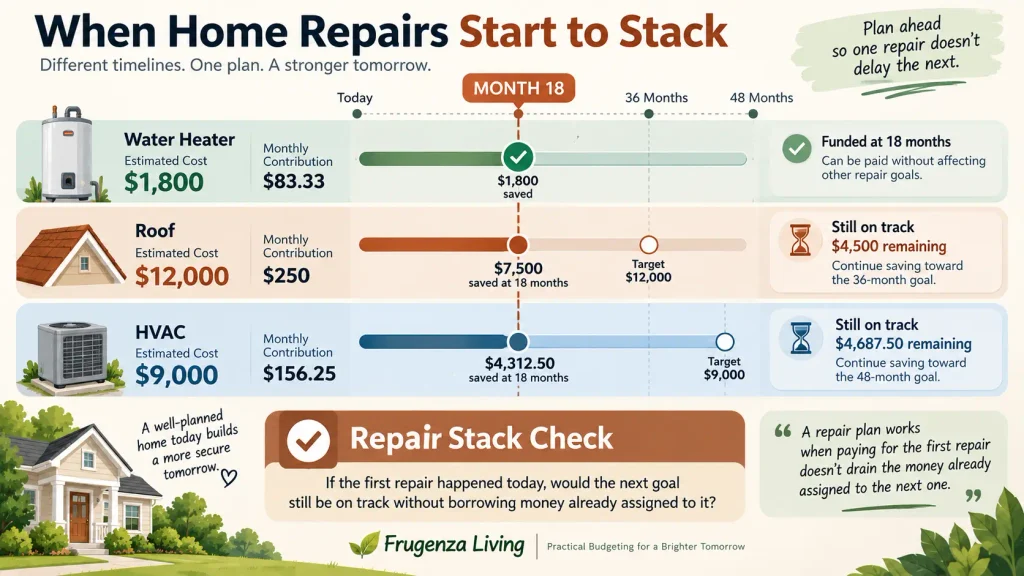
Looking at each repair separately can hide the bigger problem.
Using the same example:
- water heater funding goal: 18 months;
- roof funding goal: 36 months;
- HVAC funding goal: 48 months.
Now move the calendar forward 18 months.
If the savings plan stayed on track, the water-heater target would be approximately funded.
At the same time:
Roof reserve:
$3,000 + ($250 × 18) = $7,500
HVAC reserve:
$1,500 + ($156.25 × 18) = $4,312.50
The $1,800 assigned to the water heater can be spent without erasing the money already assigned to the roof and HVAC.
Now ask:
If the first major repair used its reserved money today, would the next major repair still be on track without borrowing from its assigned balance?
If yes, the repair targets are functioning independently.
If no—if paying for one requires raiding money already set aside for another—the total account balance may look healthy while the repair plan itself is still fragile.
That is the Repair Stack Check.
It matters because several moderate-looking goals can become a difficult funding problem when their timelines overlap.
Home Repair Sinking Fund Planner
Enter up to three repair needs below. The planner calculates each remaining gap, sorts active goals by funding horizon, identifies what still needs money first, and provides a downloadable repair plan.
Home Repair Sinking Fund Planner
See which repair still needs money first, how large each remaining gap is, and what the combined monthly funding pace looks like.
| Order | Repair | Status | Remaining Gap | Months | Monthly Pace |
|---|
If the first active repair used its assigned reserve today, would the next repair still stay on its funding path without borrowing money already assigned to it?
Where Does This Expense Usually Belong?
For budgeting education only. Repair costs, conditions, timing, insurance coverage, and household priorities vary. Seek appropriate professional evaluation for structural, electrical, plumbing, gas, HVAC, water-intrusion, or other safety-related concerns.
One Account Can Still Hold Several Repair Targets
You do not necessarily need a different bank account for the roof, HVAC, water heater, and appliances.
One home-repair savings account can work if your records still show what the balance is supposed to cover.
For example, imagine the account holds $7,200:
- $3,000 assigned to the roof;
- $1,500 assigned to HVAC;
- $300 assigned to the water heater;
- $2,400 assigned elsewhere in the home-repair plan.
If that $3,000 already belongs to the roof, do not also count it as $3,000 available for HVAC.
That is the practical issue—not how many bank accounts you have.
If you want to decide whether multiple goals should live in separate categories or one broader fund, this guide to how many sinking funds to use covers that question in more depth.
Here, component-level assignments matter because the Repair Stack Check only works when you know which money belongs to which future repair.
Do Not Double Count the Same Repair Risk
Another mistake appears when several budgeting methods are combined without checking what each one covers.
Suppose a broad percentage benchmark suggests:
$4,500 per year
for maintenance and repairs.
Your component plan separately calculates:
$5,875 per year
toward known replacements.
It would be a mistake to automatically conclude:
$4,500 + $5,875 = $10,375 required
because part of that $4,500 benchmark may already be intended to account for the same roof, HVAC, appliance, or repair exposure that appears in the component plan.
Before adding the numbers, ask:
What is each amount supposed to pay for?
When you have little information about the property, a broad percentage can provide a starting point.
As actual estimates, service records, and component timelines become available, specific repair targets can take a larger role.
There is no universal formula that perfectly reconciles the two methods for every home.
The important part is avoiding a situation where one future repair quietly receives two savings assignments while another receives none.
After a Repair, Update the Calendar
Suppose the water heater eventually needs replacement and you use the money reserved for it.
The home-repair balance falls.
That is not automatically a setback. The money completed its job.
What should change is the calendar.
Do not continue planning around the old water heater as though it were still approaching replacement. Remove the completed target and use the information available about the new unit when you eventually reassess that component.
The same applies when:
- a contractor provides a better estimate;
- a repair changes the expected replacement timeline;
- an inspection identifies another priority;
- a warranty changes what you expect to pay;
- actual cost differs from the original estimate.
A reusable sinking fund tracker template can help keep targets, balances, contributions, and withdrawals visible as those assumptions change.
A good home repair fund is not a number you calculate once and preserve forever.
The house changes, so the plan should be allowed to change too.
Ask Better Questions Than “How Much Do I Have Saved?”
A large home-repair balance can feel reassuring, but the balance alone does not tell you whether the plan works.
Ask instead:
What is this money assigned to?
Which repair still needs funding first?
If I pay for the first major repair, does the next target remain intact?
Am I counting the same repair twice through both a broad percentage benchmark and a specific component target?
Has new information changed the timeline?
A home repair sinking fund cannot predict when a roof, HVAC system, appliance, or water heater will need attention.
What it can do is make the financial consequences visible before every expense becomes an immediate cash-flow problem.
That is the better goal: not predicting the house perfectly, but knowing which future costs you are preparing for, how much is already assigned to them, and whether the next repair can happen without dismantling the plan for everything coming after it.

Read about Jeffi and Frugenza Living
- How to Budget a 10-Month Salary Over 12 Months - October 16, 2026
- Pet Adoption Budget Checklist: What You Still Need to Pay - October 16, 2026
- Proportional Bill Split Calculator for Two Incomes - October 15, 2026