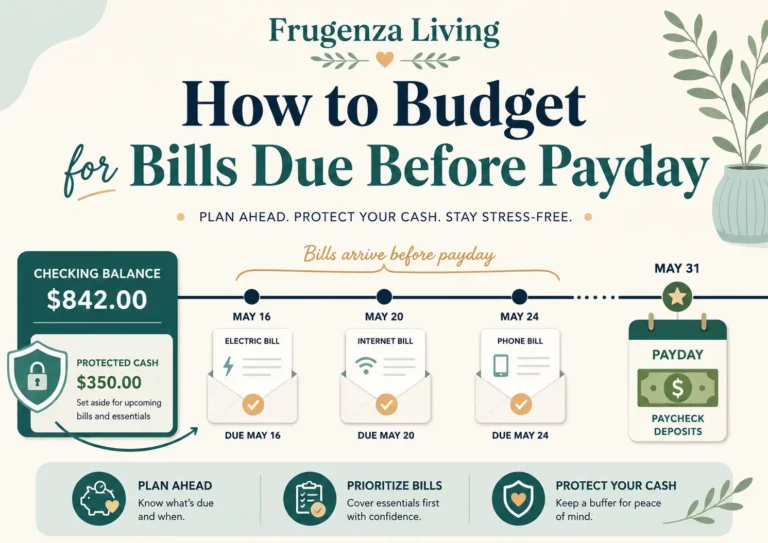
A checking-account balance can look reassuring right up until you remember what has to leave before the next paycheck arrives.
Suppose you have $1,050 available today. Payday is ten days away. Before then, three bills totaling $540 are due, and you still need groceries and transportation.
The useful question is no longer, “Do I have $1,050?” It is:
“How much of that $1,050 is actually uncommitted?”
To budget for bills due before payday, total the unpaid bills that need money before your next confirmed paycheck, add the essential spending you still need until payday, and include a small buffer if your budget allows. Protect that amount before treating the rest of your balance as available.
If the numbers still do not work, the next question matters just as much: is this a timing gap, or does the monthly budget itself not have enough money?
First, Find Out Whether You Actually Have a Gap
This guide uses a practical editorial term: your Pre-Payday Cash Floor.
It means the minimum amount of cash that needs to remain available for bills and essential spending before your next paycheck safely arrives.
Pre-Payday Cash Floor = bills still due before payday + essential spending until payday + optional minimum buffer
Then calculate:
Uncommitted Cash = usable cash today − Pre-Payday Cash Floor
For this calculation, usable cash means money genuinely available for the current pay-period window.
It may include checking-account cash, a bill reserve intended for expenses in this window, or another designated cash-flow reserve meant for this cycle.
Do not automatically include available credit, overdraft limits, expected income that has not arrived, retirement money, or sinking funds earmarked for unrelated expenses.
Also avoid double counting. If a $300 bill reserve is already part of the $1,050 shown in checking, it is already included in usable cash. Do not add the same $300 again.
Here is what the calculation looks like.
Today is September 8. Your next confirmed payday is September 18.
Usable cash: $1,050
Bills due before then:
- Electricity — September 10: $150
- Insurance — September 12: $300
- Phone — September 14: $90
Bills total $540.
You still expect to need:
- Groceries: $180
- Gas/transportation: $70
- Minimum buffer: $75
Essential spending totals $250.
Your cash floor is therefore:
$540 + $250 + $75 = $865
Then:
$1,050 − $865 = $185 uncommitted
Your banking app says $1,050.
After protecting the next ten days, only $185 is currently uncommitted based on the needs included in the calculation.
That does not make the $185 “free money.”
Before-Payday Cash-Flow Check
Use this tool to separate your displayed balance from the cash that needs to survive until payday.
Before-Payday Cash-Flow Check
See how much cash needs protection before your next paycheck—and where a shortage begins based on the amounts you enter.
Results are based only on the cash, bills, essentials, and buffer entered below. Include only cash genuinely available for this cycle. If a reserve is already included in your checking balance, do not add it again. Available credit is not cash.
—
Your Bank Balance Is Not Your Spendable Balance
A bank balance answers one question: how much money is currently in the account.
It does not tell you how much has already been promised.
You may see $900 in checking and feel relatively safe even though $600 is waiting for an insurance premium, utility bill, and rent contribution. Add groceries and transportation, and the truly uncommitted amount may be small—or negative.
A balance shows what is in the account. A cash floor shows what must stay there.
This is also why reserved money needs careful treatment. Money does not become “extra” simply because it still appears in checking.
A Bill Due Before Payday Cannot Wait for Payday
If a bill needs funding on September 12 and your paycheck arrives September 18, that future paycheck cannot retroactively fund the earlier obligation.
Budget from the last money available before the bill needs funding.
That does not mean every bill should be paid early or automatically split 50/50. Use the provider’s actual due date, planned payment date, and expected debit timing.
If one large obligation creates most of the shortage, use the dedicated method to work out how much an earlier paycheck actually needs to reserve rather than turning an aggregate cash-flow problem into a generic 50/50 split.
For variable bills such as electricity, use the current statement when available. If you must estimate before the statement arrives, use recent actual bills and replace the estimate when the real amount is known.
Autopay does not eliminate timing risk. Automatic payments still need protected cash before the debit occurs.
If the Cash Floor Is Negative Right Now
A negative result tells you where the shortage begins.
If available cash is lower than bills due before payday, there is already a bill-funding shortfall.
If cash covers the bills but not groceries, transportation, and other essential spending, the automatic payments may technically be funded while the rest of the pay period still is not.
First verify the actual amount due, actual due or expected debit dates, next confirmed paycheck availability, and essential spending still required until then.
Pause discretionary purchases from making the gap larger, but do not pretend necessary groceries, transportation, childcare, or household needs are discretionary.
Use money already intended for this purpose if it genuinely exists, such as a relevant bill reserve or checking buffer.
If payment difficulty remains, contact the provider before the deadline and ask what current due-date, payment-arrangement, or hardship options may be available. Terms vary; do not assume a grace period or approval.
The Consumer Financial Protection Bureau explains that people can face cash-flow problems when the timing of income and expenses does not line up. Its Bill Calendar guidance recommends mapping bills by amount and due date so those timing conflicts are visible.
If bills regularly fall due before your next payday, a longer-term goal is to get one paycheck ahead on bills so upcoming expenses are already funded.
Timing Gap or Affordability Gap?
A negative cash-floor result does not automatically explain why you are short.
Timing Gap or Affordability Gap?
The shortage may look the same in checking, but the long-term fix is different.
Timing Gap
- Reliable monthly income covers recurring bills and essential living costs overall.
- The shortage appears mainly during a specific week or pay period.
- Several due dates cluster before income arrives.
- Moving funding earlier can improve the sequence.
- The monthly math still works after the timing is reorganized.
Affordability Gap
- Required bills and essential living costs exceed reliable take-home income.
- The shortage persists regardless of where due dates fall.
- Paying one obligation earlier creates another shortage later.
- Each paycheck starts by repairing the previous one.
- A buffer cannot be built without another essential category going short.
A timing gap means reliable monthly income can cover recurring bills and essential living costs overall, but too much money is required before a particular payday.
An affordability gap means required bills and essential costs exceed reliable income even after the dates are rearranged.
Moving a due date may help the first problem. It cannot create the money needed to solve the second.
If a major moving payment will be due before payday, a moving sinking fund can help you prepare for that deadline from earlier paychecks.
If you receive two checks on fixed semi-monthly dates and the mismatch keeps occurring around those dates, use the schedule-specific approach to budget a fixed 1st-and-15th pay schedule rather than applying a generic twice-monthly rule.
Build One Pay Cycle of Distance From a Recurring Timing Gap
If the monthly math works but the same shortage keeps returning, the goal is not to borrow mentally from the next paycheck forever.
It is to move enough money one pay cycle earlier that the recurring timing mismatch stops reopening.
This guide calls that a One-Cycle Bridge—an editorial planning concept, not a banking product.
Suppose your Pre-Payday Cash Floor is repeatedly about $180 higher than the cash available at the same point in otherwise normal pay cycles.
If the broader monthly budget genuinely has room, you might choose to build the $180 bridge across three earlier paydays:
$180 ÷ 3 = $60 per payday
After the bridge reaches $180, that money remains assigned to the timing problem. It is not additional spending money.
Do not size a bridge from one unusually expensive cycle. A high utility bill, annual renewal, one-off purchase, or abnormal grocery week can temporarily distort the gap. Base the bridge on a shortage that has repeated under reasonably normal spending, and recalculate when variable bills materially change.
Three paydays is only an illustration. Two, four, or another number may fit your situation better.
More importantly, each bridge contribution must come only from money that remains uncommitted after that earlier payday’s own bills and essential spending are protected.
If setting aside $60 merely creates a $60 shortage somewhere else, you have not built a bridge. You have moved the problem.
And if no realistic bridge contribution fits without another essential category going short, revisit whether the issue is actually affordability rather than timing.
Keep the Fix From Disappearing
Planning to protect $300 for a future bill is not the same as actually protecting it.
Once money is assigned, separate or track it using whatever system works for your accounts. Then confirm that bill money assigned to a paycheck has really been reserved rather than assuming a budget line equals funded cash.
If the problem extends beyond one awkward pre-payday window, use a paycheck budget template to rebuild bills, essentials, savings, and remaining cash for the whole paycheck instead.
Common Mistakes When Bills Come Before Payday
Treating the checking balance as spendable money. Some of that balance may already belong to bills and essentials.
Assigning a bill to income that arrives after the funding deadline. Future income cannot fund an earlier obligation unless the provider’s actual terms allow later payment.
Protecting bills but forgetting life before payday. Groceries, transportation, and other essentials still need room.
Moving the shortage forward every cycle. A timing fix should eventually create distance, not make each paycheck repair the previous one.
Treating an affordability gap as a calendar problem. If required monthly costs exceed reliable take-home income, rearranging dates alone cannot fix the math.
Quick Answers
What should I do if bills are due before payday?
Total every unpaid bill that needs funding before your next confirmed paycheck, add essential spending needed until then, and compare that amount with usable cash today. If there is a shortage, verify the dates and amounts and determine whether the problem is timing or affordability.
How much money should I keep for bills before payday?
Keep enough to cover unpaid bills due before payday, essential spending until payday, and any minimum buffer you intentionally use. This guide calls that amount the Pre-Payday Cash Floor.
Should I change bill due dates to match payday?
It may help when the problem is mainly timing and the provider offers a suitable change. Availability and terms vary, so ask rather than assuming a due date can be moved.
Why do I run short before payday even when I make enough monthly?
Bills may cluster before income arrives, or money assigned to future obligations may still appear spendable. If reliable monthly income covers required bills and essentials overall, the problem may be timing. If it does not, the issue is broader affordability.
Protect the Money That Has to Survive Until Payday
When bills are due before payday, the most useful number is not the balance displayed in your banking app.
It is the amount that must remain available until the paycheck actually arrives.
Calculate that cash floor first. If there is a shortage, identify whether the problem is timing or affordability. If it is a recurring timing problem, gradually move money earlier only when the previous paydays genuinely have room to do so.
A timing fix should eventually stop the same gap from returning.
If rearranging paydays and bill dates only moves the shortage somewhere else, the budget needs a broader repair—not another calendar trick.
Editor’s note: This article provides general budgeting education, not individualized financial, legal, tax, credit, or debt advice. Use your actual paycheck dates, account balances, provider terms, and household needs.

Read about Jeffi and Frugenza Living
- How to Budget a 10-Month Salary Over 12 Months - October 16, 2026
- Pet Adoption Budget Checklist: What You Still Need to Pay - October 16, 2026
- Proportional Bill Split Calculator for Two Incomes - October 15, 2026