One birthday is usually easy to absorb. Ten or twenty birthdays scattered unevenly across a year are a different budgeting problem.
A birthday sinking fund sets money aside for recurring birthday gifts and celebrations before they land in your everyday spending. But knowing what birthdays cost over a full year is only half the job. You also need to know when those costs pile up.
This guide focuses on a rolling fund for birthdays that regularly appear on your calendar. If one unusually large milestone celebration would consume a large share of the annual total, keep it separate rather than allowing one exceptional birthday to permanently inflate your normal monthly contribution.
If sinking funds are new to you, this beginner’s guide to sinking funds explains the general setup.
A birthday budget should measure what your finances can repeat—not how much you care about someone.
Start With a Birthday Roster, Not a Round Number
Instead of deciding that “$50 a month should be enough,” list the birthdays you normally spend money on during the next rolling 12 months.
For each birthday, record:
- person or birthday label;
- next birthday date;
- realistic all-in spending cap;
- Regular or Milestone status.
Use the next occurrence of each birthday, not only the birth month. If you build the plan on August 20, an August 5 birthday belongs next August, while an August 28 birthday may still need money this month.
An all-in birthday cap is more useful than a gift-only budget because the gift may not be the entire cost.
Use:
All-In Birthday Cap = Gift + Celebration-Related Extras You Intend to Cover
That might include a card, wrapping, shipping, meal contribution, or a birthday-specific activity.
Different birthdays can have different caps. This is not a ranking of relationships. A cap simply tells your budget what it is expected to absorb in a way that remains affordable and repeatable.
If birthdays are infrequent enough that another account would create unnecessary complexity, this guide to how many sinking funds you should have can help you decide whether birthdays belong inside a broader Gifts & Celebrations fund instead.
Map the Birthday Load Before Choosing a Monthly Amount
Once the roster exists, calculate four useful numbers.
Regular 12-Month Birthday Load
Add the all-in caps for Regular birthdays occurring during the next 12 months.
Average Monthly Baseline
Regular Birthday Load ÷ 12
This is your long-run savings pace.
Peak Birthday Month
Find the calendar month carrying the largest Regular birthday load.
Next 90-Day Birthday Load
Add the Regular birthdays that actually occur during the next 90 days.
The average is useful, but it does not prove that your fund can survive the calendar.
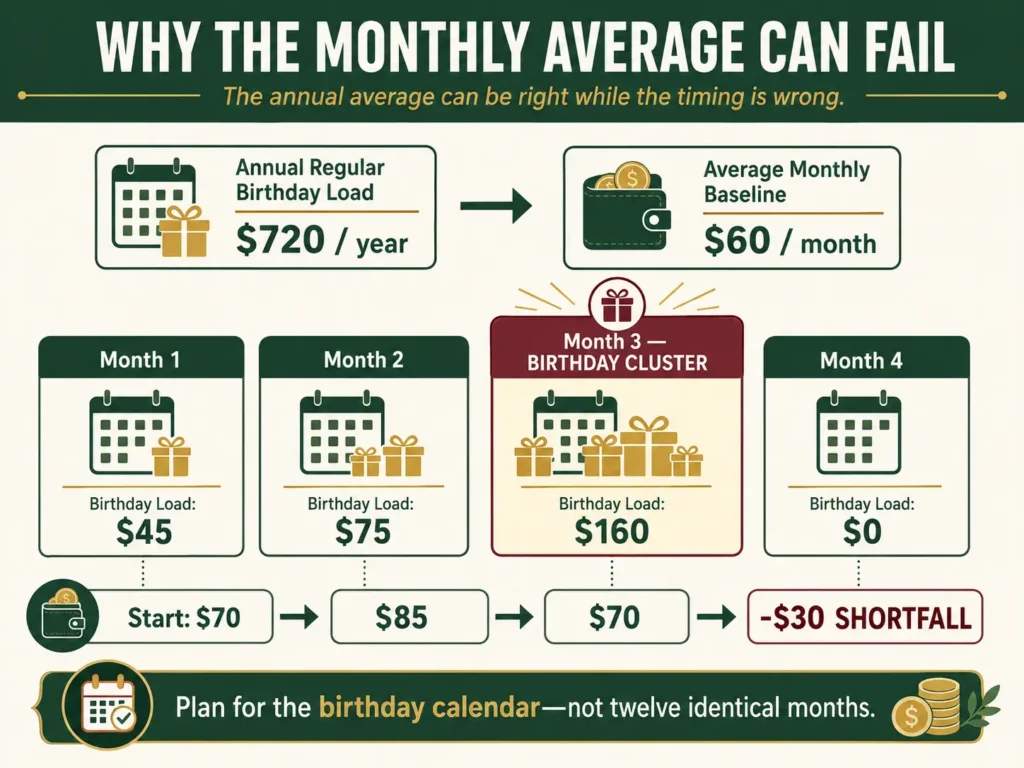
Suppose Regular birthdays total $720.
$720 ÷ 12 = $60 per month
But the next three birthdays cost $45, $75, and $160 and arrive during three consecutive months. If you are starting with little saved, a mathematically correct $60 annual average may still leave the fund short when that cluster arrives.
Annual averages tell you the pace. The birthday roster tells you whether that pace works in time.
There is no need to reset the system every January. When a birthday passes, review the cost and move its next occurrence roughly one year forward.
Birthday Sinking Fund Calendar & Load Planner
Use this planner to test whether your proposed monthly contribution keeps your Regular birthday fund non-negative across the birthdays actually coming up.
Enter the next birthday date for each person. Mark unusually large celebrations as Milestone so they remain visible without being treated as ordinary recurring spending.
The planner supports up to 24 birthdays and can download your completed plan as a CSV file.
Frugenza Living Budget Tool
Birthday Sinking Fund Calendar & Load Planner
Test your savings against the birthdays actually coming up.
Regular balance: Enter the money currently available in your birthday fund before protecting any amount for unexpected invitations. Do not include money already saved for a separate Milestone goal.
Rolling 12-Month Birthday Load Map
Because the plan begins today instead of on the first day of a month, the rolling 12-month window can touch parts of 13 calendar months. The first and final cards may therefore represent partial months.
The average monthly baseline shows the long-run annual pace. The minimum monthly figure also considers your current scheduled balance and the exact dates of upcoming Regular birthdays.
The current balance should already include any transfer you planned for this month. Beginning next calendar month, the proposed contribution is added at the start of each month before scheduled Regular birthday spending. Milestone goals and your invitation reserve are excluded from the Regular projection.
The Average Monthly Baseline and Minimum Monthly to Avoid a 12-Month Shortfall answer different questions.
The baseline shows what Regular birthdays cost over a typical year. The minimum uses your current balance and the placement of upcoming birthdays to estimate what is needed to keep this specific 12-month projection from falling below zero.
Example: When $60 a Month Is Correct but Still Too Late
Consider Jordan and Elise, a fictional U.S. household. All dollar amounts are illustrative.
Their Regular birthday roster totals $720.
The annual baseline is:
$720 ÷ 12 = $60 per month
They currently have $70 available for scheduled Regular birthdays and plan to add $60 monthly.
Their next three birthday costs are:
- $45 next month;
- $75 the following month;
- $160 in the third month.
Assuming each future monthly contribution arrives before that month’s birthdays:
Month 1:
$70 + $60 − $45 = $85
Month 2:
$85 + $60 − $75 = $70
Month 3:
$70 + $60 − $160 = −$30
Their projected shortfall is therefore about $30 in the third month.
Nothing is wrong with the $60 annual average. The problem is that too much birthday spending arrives before the annual average has had enough time to build the balance.
Jordan and Elise could temporarily contribute more before the cluster, reduce one or more all-in caps, or begin with a larger Regular birthday balance.
They also have an illustrative $450 milestone birthday later in the year.
If they combined it with the recurring $720:
($720 + $450) ÷ 12 = $97.50 per month
That would make ordinary birthday spending appear permanently more expensive because one unusual celebration happens this year.
Keeping the milestone separate preserves a clearer recurring baseline.
Leave Room for Birthdays You Did Not Know About
A roster cannot predict every invitation.
A child’s new classmate, a new coworker, a new friend, or an additional family celebration may appear after you build the plan.
You can protect part of your current birthday-fund balance as an Invitation Reserve so scheduled birthdays do not consume every available dollar.
This is not a universal target. If you currently have $300 saved and want $50 of that left untouched for unexpected invitations, enter $50 in the planner. If you do not already have an invitation reserve, leave the field at $0.
Over time, use your own experience to decide whether maintaining a reserve is worthwhile.
And if that reserve runs out, you do not automatically need to increase it. A smaller gift, an appropriate gift already on hand, a lower-cost gesture, or declining optional spending may be reasonable.
Once your birthday budget is set, choose a few frugal birthday ideas for adults that make the day feel special without pushing you past the amount you planned.
Keep Milestone Birthdays Out of the Regular Math
A milestone can matter deeply without becoming the baseline for every future year.
A larger child’s party, a partner’s significant birthday, or a parent’s milestone celebration may cost several times your normal birthday cap.
Track it separately:
Milestone Funding Gap = Milestone Target − Amount Already Saved
Then fund that goal alongside your Regular birthday fund.
The planner displays Separate Milestone Target Total, but Milestone balances and contributions are intentionally excluded from the Regular birthday projection.
This keeps two questions separate:
What do birthdays normally cost us?
and:
What does this exceptional celebration cost?
If a milestone involves a major trip, that travel may deserve its own savings goal. Christmas and other year-end gifts also follow a different pattern; the holiday sinking fund guide covers that concentrated seasonal spending.
Do All Birthdays Need the Same Spending Cap?
No.
Repeatable caps can reflect household traditions, whether you normally exchange gifts, whether a meal or activity is included, and what your finances can currently support.
Avoid rigid relationship tiers.
You might intentionally budget more for a child’s birthday than for a casual friend’s gift, or choose a shared meal instead of a physical gift for someone else. Neither decision measures how much that person matters.
A useful birthday cap is:
intentional + affordable + repeatable
If actual spending repeatedly exceeds the cap, that gives you useful information. Either next year’s cap should change intentionally or the way you celebrate needs to become less expensive.
After Each Birthday, Roll the Plan Forward
Do not wait until January to rebuild the birthday plan.
After each birthday:
- Record the actual all-in cost.
- Compare it with the planned cap.
- Decide whether next year’s cap should stay, increase, or decrease.
- Enter that person’s next birthday date roughly one year ahead.
Over time, your roster becomes based on actual household behavior instead of generic gift estimates.
If you want a reusable place to record contributions and withdrawals outside this planner, the sinking fund tracker template can handle the ongoing balance.
Frequently Asked Questions
How much should I put in a birthday sinking fund?
Add the realistic all-in caps for Regular birthdays occurring during your next rolling 12 months. Keep unusually large Milestones separate, then test whether your existing Regular balance and planned contributions can survive the actual calendar.
How much should I save for birthday gifts each month?
Regular birthday spending divided by 12 gives you a useful long-run baseline. If several birthdays arrive early or cluster together, you may temporarily need more than the baseline or a larger starting balance.
Should birthday and Christmas gifts use the same sinking fund?
They can, but the spending patterns are different. Birthdays roll throughout the year, while Christmas and other year-end holiday spending usually concentrates within a shorter period. Separate tracking often makes the two plans easier to understand.
What if I am saving only for my own birthday?
Treat it as a single-date goal rather than a rolling birthday roster. Decide what you want available, subtract what you have already saved, then divide the remaining gap by the months or paychecks before your birthday.
The Bottom Line
A birthday sinking fund becomes more useful when you stop treating the year as twelve identical months.
Write down the birthdays actually coming up, assign realistic all-in caps, and look for the places where several celebrations pile up.
Your annual average tells you the long-run savings pace. Your rolling roster tells you whether that pace can survive the calendar you actually have.
Keep unusually large Milestones separate, reserve money for unexpected invitations only when it makes sense for your household, and roll each birthday forward after it passes.
That turns recurring birthday spending into something your budget can see coming.
Educational note: This guide provides general budgeting information. Use your own household priorities, dates, and current costs when setting birthday spending caps.
Methodology Note
The planner uses exact next-birthday dates within a rolling 12-month window. Regular birthdays are included in the recurring projection; Milestones remain separate. The current month’s planned contribution should already be reflected in the starting balance, while future monthly contributions are added at the beginning of subsequent calendar months. The 90-day calculation uses actual dates rather than three full calendar months. All dollar examples are illustrative.

Read about Jeffi and Frugenza Living
- Proportional Bill Split Calculator for Two Incomes - October 15, 2026
- How to Split Grocery Bills With Roommates - October 14, 2026
- First Apartment Kitchen Essentials on a Budget - October 13, 2026