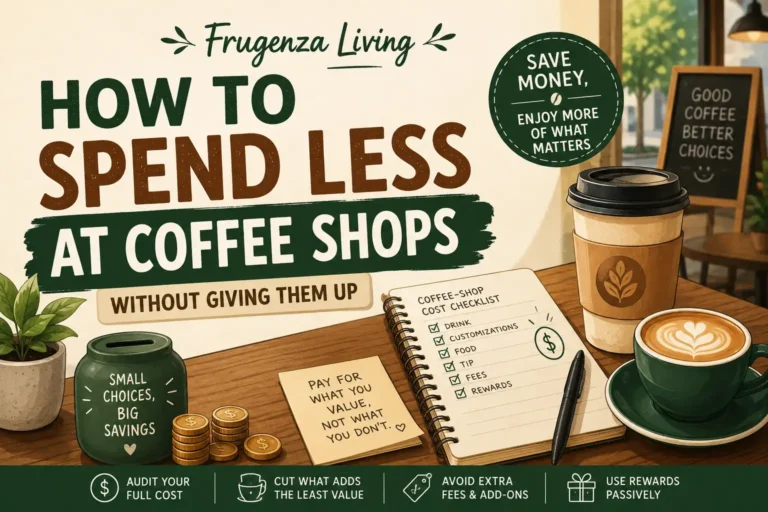
A coffee-shop visit rarely ends at the price printed beside the drink. A $5 latte can become an $11 or $14 purchase after alternative milk, cold foam, a pastry, a tip, and an app suggestion you never planned to add.
Learning how to spend less at coffee shops is not about ordering the cheapest possible drink or giving up the café experience. It is about separating the parts you genuinely value from the extras you barely remember afterward.
When the main problem is how often you stop for coffee rather than what you spend once you are there, this separate guide explains how to stop buying coffee every day without relying on an extreme no-coffee rule.
Quick answer: Calculate the full cost of one visit, including the drink, paid customizations, food, tip, and avoidable fees.
Keep the part of the order you enjoy most, then remove the highest-cost extra you would miss the least. Audit the cost of each order before deciding whether you also need to reduce how often you visit.
How to Spend Less at Coffee Shops: Audit the Full Cost
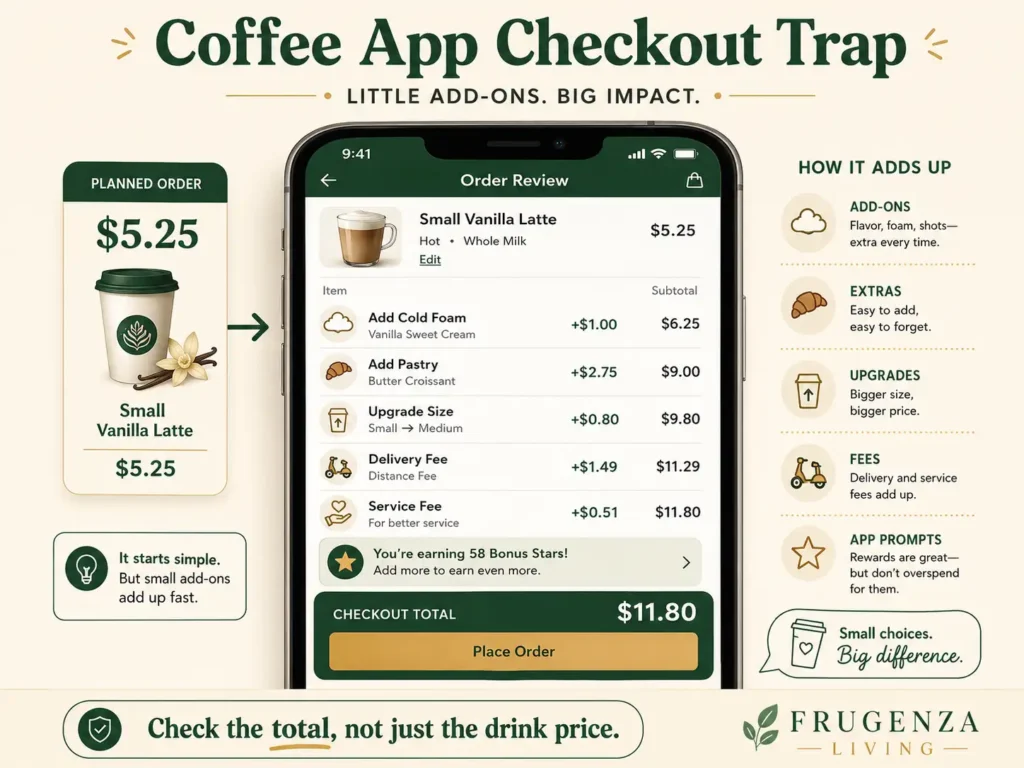
Calling the entire purchase “coffee” hides where the money actually goes. A better approach is to divide one receipt into layers:
True visit cost = base drink + customizations + food + tip + avoidable convenience costs
The tip belongs in the total because it is part of what you pay. However, fair compensation for service should not be treated as the first place to save. Reduce unnecessary upgrades, delivery fees, or impulse food before cutting the amount you intentionally budget for service.
To estimate the monthly effect:
Average true visit cost × weekly visits × 4.33
Suppose your average visit costs $7.80 and you go five times per week:
$7.80 × 5 × 4.33 = $168.87 per month
Now keep the same five weekly visits but lower the average order to $5.25:
$5.25 × 5 × 4.33 = $113.66 per month
The illustrative difference is $55.21 per month without reducing the number of visits. If you later decide to visit less often, the savings may be larger, but that is a separate decision from lowering the cost of each order.
Coffee Shop Cost Stack Checklist
Use one recent receipt. Write down what each layer cost, then circle the part that added the least satisfaction.
Base drink
Did the drink and size match what you actually wanted?
Your cost: $_____
Customizations
Which paid extra changed the taste enough to justify its price?
Your cost: $_____
Food
Was it planned, or did the display case make the decision?
Your cost: $_____
Service
Include the tip honestly as part of the visit total.
Your cost: $_____
Convenience
Count delivery, service fees, parking, or a special trip.
Your cost: $_____
Rewards
Did a promotion make you add anything you had not planned?
Extra spent: $_____
Monthly estimate: average true visit cost × weekly visits × 4.33
Find the Expense You Would Miss the Least
The best first cut is not automatically the largest item. It is the expense with the weakest relationship to your satisfaction.
Ask:
Would I willingly pay the same total for this exact experience again?
If the answer is yes, the visit may be worth keeping. If the latte was excellent but the pastry was forgettable, the pastry is the likely leak. If the food was the reason you went but the upgraded drink tasted no better than your usual order, simplify the drink instead.
A simple value test helps:
- Low cost, high satisfaction: Keep it.
- High cost, high satisfaction: Keep it less often or simplify one layer.
- Low cost, low satisfaction: Optional, but not urgent.
- High cost, low satisfaction: Cut this first.
This prevents a frustrating mistake: removing the one part you love while continuing to pay for several extras you do not care about.
A Complete Coffee-Shop Order Audit
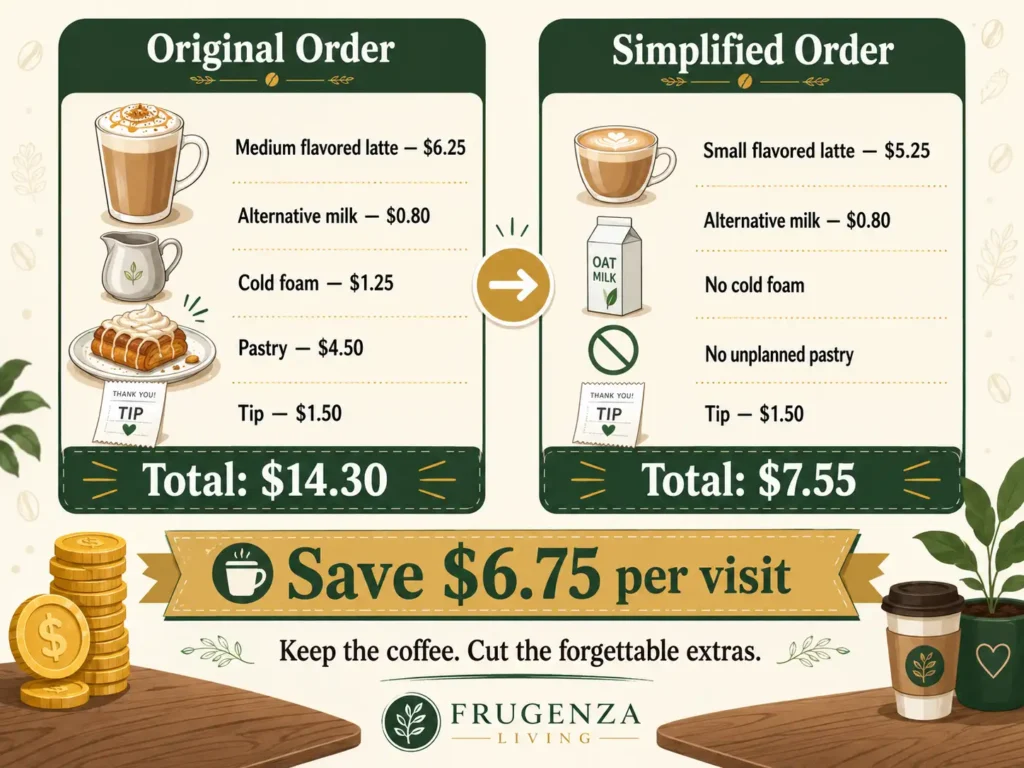
The example below is illustrative. It separates one order into the drink, paid modifiers, food, tip, and extras, then removes only the parts that contribute little to the experience. Local prices will vary.
Original order
- Medium flavored latte: $6.25
- Alternative milk: $0.80
- Cold foam: $1.25
- Pastry: $4.50
- Tip: $1.50
- Total: $14.30
The customer enjoys the flavored latte and alternative milk, barely notices the cold foam, and usually buys the pastry because it appears during checkout.
Simplified order
- Small flavored latte: $5.25
- Alternative milk: $0.80
- No cold foam
- No unplanned pastry
- Tip: $1.50
- Total: $7.55
The difference is $6.75 per visit. The café, flavor, preferred milk, and planned tip remain. The savings come from a smaller but still satisfying size and two additions that did not meaningfully improve the visit.
Cut the Parts of the Order That Add the Least Value
Simplify One Drink Detail at a Time
Changing everything at once makes it hard to know which adjustment actually worked. Test one layer.
You might keep the preferred milk but remove a topping, order a smaller version of the same drink, or alternate a premium drink with a simpler option you still enjoy. Fewer syrup pumps may work when the flavor matters but the sweetness does not. An extra shot may be unnecessary on days when caffeine is not the reason for the visit.
A cheaper drink is only a better value if it remains satisfying. Buying an unsatisfying option and then ordering something else later is not a saving.
Decide About Food Before You Arrive
A coffee break can become a small meal before you consciously choose one. Label the visit before opening the app or reaching the counter:
- Drink only
- Drink and planned meal
- Social visit
- Work session
Removing a $4.50 pastry from two weekly orders would reduce spending by about $38.97 per month:
$4.50 × 2 × 4.33 = $38.97
That is an illustrative calculation, but it shows why food often matters more than a small drink discount. When snacks are the repeated problem, use a dedicated plan to stop spending money on snacks rather than trying to solve every purchase through the coffee order.
Eating before leaving home can also help when hunger, not coffee, is driving the total. You do not need to reject every pastry. The useful distinction is whether you chose it before arriving or added it because it was placed beside the register.
Treat Mobile Ordering Like a Checkout Environment
Saved payment details, upgrade prompts, food recommendations, and bonus-point banners can make a larger order feel routine.
Before submitting an order:
- Remove anything you did not intend to buy before opening the app.
- Compare the final total with your normal in-store purchase.
- Check whether the promotion lowered the cost or increased the basket.
- Avoid delivery when pickup already fits your route.
Delivery may add menu markup, service fees, and a tip. When app-based food is becoming a broader expense, this guide to save money on takeout addresses that pattern without turning coffee spending into a general food-budget discussion.
Use Rewards Passively
A reward saves money only when it discounts a purchase you already planned.
Rewards become expensive when they encourage an earlier visit, a larger size, an extra food item, or more money loaded into an app. Before pursuing an offer, ask whether the visit and order would remain exactly the same without the promotion.
If not, the reward may be causing “spaving”: spending more to feel that you saved. Policies and thresholds vary by chain and location, so check current terms before depending on a particular benefit.
Coffee-Shop Order Decision Card
Use these four questions before paying. The goal is to keep what improves the visit and remove what only increases the total.
Keep
Would removing this make the order or café experience disappointing?
Simplify
Could you test one paid modifier, topping, extra shot, or size separately?
Separate
Did you decide to buy food before arriving, or only after seeing it?
Avoid
Would you buy this without the app prompt, delivery option, or promotion?
Set a Rule That Works at the Register
“Spend less on coffee” is too vague to guide a real purchase. A useful rule tells you what to do before the order begins.
Examples:
- No food during solo coffee visits.
- One paid customization per drink.
- No coffee delivery.
- Premium drinks are for planned visits, not rushed stops.
- Rewards may be used but never chased.
- Check the final app total before submitting.
- Set a maximum cost per visit.
Choose the rule that matches your cost stack. Someone who buys pastries impulsively does not need the same rule as someone paying repeated delivery fees.
You can estimate a monthly allowance with:
Planned visits × target cost per visit
For example, two $6 visits per week equal about $51.96 per month:
$6 × 2 × 4.33 = $51.96
This is not a universal recommendation. It is a way to convert a vague intention into a number based on your own plan.
Keep the Visits That Earn Their Place in Your Budget
Coffee-shop spending is not automatically wasteful. A visit may be worth the full cost when it creates meaningful time with a friend, replaces a more expensive activity, supports a local business you value, or provides a useful place to work.
A $6 drink may feel worthwhile if it comes with two focused hours, but less so if it disappears during a rushed commute you barely remember. The ingredient cost alone does not determine value. What matters is whether you would willingly pay for the same experience again.
The strongest frugal decision is often not “never buy this.” It is “keep the version worth repeating.”
Give the Savings a Destination
Reducing a $14 order to $8 does not automatically improve your finances. The difference can disappear into another impulse purchase unless you direct it somewhere.
Record or transfer the savings toward a specific purpose, such as emergency savings, a sinking fund, debt repayment, a grocery buffer, or a planned activity. Connecting the change with other realistic ways to save money every month makes the result visible instead of turning a smaller order into an abstract sacrifice.
The Bottom Line
The most practical way to spend less at coffee shops is to look beyond the menu price. Separate the drink, customizations, food, tip, convenience costs, and reward-driven extras. Keep what makes the visit worthwhile, then remove the high-cost part you would miss the least.
Start with one recent receipt. Rebuild that exact order around satisfaction rather than habit. You can keep the café experience without keeping every addition to the bill.
Frequently Asked Questions
How much should I budget for coffee shops each month?
Multiply your planned visits by a realistic target cost per visit, then check whether the total fits after essentials, savings, and debt obligations. Two $6 visits per week equal about $51.96 per month. That is an illustration, not a universal limit.
Is drip coffee usually cheaper than a latte?
Drip coffee often costs less than a latte, but menus vary. Compare your usual order with the least expensive drink you genuinely enjoy. A cheaper but disappointing choice may not help if it leads to another purchase later.
Are coffee-shop rewards worth using?
Rewards can reduce the cost of purchases you already planned. They become less useful when challenges lead to extra visits, larger drinks, or food add-ons. Compare the reward with any additional spending needed to earn it.
What is the easiest coffee-shop expense to cut first?
Look for the expense with the lowest satisfaction: an unplanned pastry, an unnoticed modifier, delivery fees, or an app add-on. The easiest sustainable cut is usually the part of the order you would miss the least.
Do reusable cups save much money at coffee shops?
Reusable-cup discounts are usually a small saving, so they should support larger changes rather than replace them. Bring one when convenient, but check the current policy because discounts and eligibility vary by coffee shop and location.

Read about Jeffi and Frugenza Living
- No Spend Month Challenge for Beginners: A 30-Day Plan - September 24, 2026
- Low Buy Month Challenge: Realistic Rules for 30 Days - September 23, 2026
- How to Stop Buying Groceries You Already Have - September 20, 2026