Before adding another frugal rule, check what the last attempt actually cost. A cheaper meal plan can include food you did not use, an extra shopping trip, and the takeout you still bought. Those payments belong in the result.
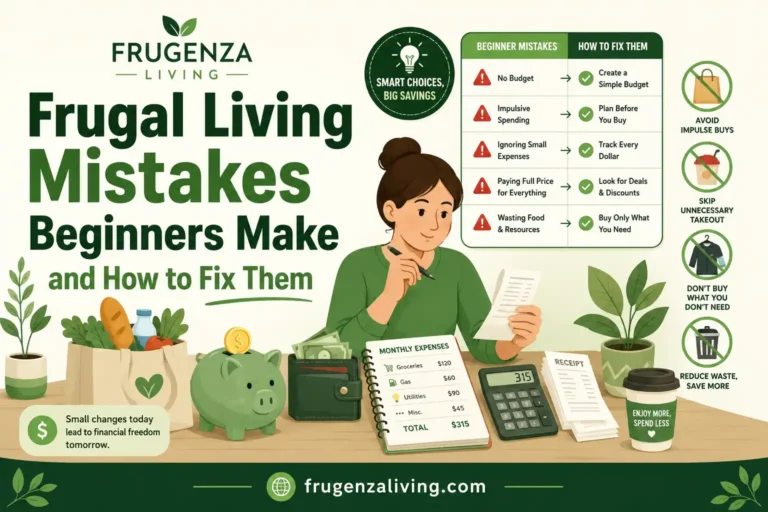
This guide examines frugal living mistakes beginners make through a practical cost review. Identify the expense or constraint you missed, correct that part, and test the revised choice. The worked example and printable worksheet help you separate a spending reduction from a cash shortfall.
If you need to establish what your money must cover first, use the frugal living guide for beginners. Then return to review one specific decision.
Start With the Result You Can Verify
Choose one attempt you can describe using receipts, charges, or a spending record. Name the need and the period: four evening meals over two weeks, a particular shopping trip, or one subscription renewal.
Record what you expected, what you actually paid, and whether the choice met the need. A disappointing result can reveal an omitted cost, an unavailable alternative, or a plan that did not fit the money available. The result alone does not tell you which explanation applies.
Seven Mistakes to Check Before Trying Again
1. Treating a Planned Saving as an Observed Result
A shopping list or meal plan estimates what could happen. To establish the result, include actual purchases and the occasions when you still used the original option.
Check: did you compare the estimate with receipts for the same period and needs? Fix: keep an estimated column and an actual column until the trial is complete. Do not multiply the estimate into a monthly or annual claim before checking whether the change occurred.
2. Leaving Replacement and Fallback Costs Out
An avoided delivery order has a replacement cost when you buy food instead. If you buy that food and later order delivery anyway, both purchases count. Added travel, supplies, fees, and preparation requirements can also change the comparison.
Check: what did the alternative require, including the occasions when it was impractical? Fix: record the full cost rather than treating the original purchase price as money saved.
3. Assuming Spending Less Means the Choice Is Affordable
A $64 plan costs less than a $72 option, but it still exceeds a $60 allowance. A reduction can narrow a gap without producing money available to save.
Check: how much remains after existing payments, essentials, and reserved money? Fix: compare the revised payment with that amount. The daily spending check shows how to include pending charges and money already assigned to other needs.
4. Counting Stock or Waste Incorrectly
Food already owned has a cost even when using it requires no payment today. A large purchase can also leave usable stock for another period. Record that stock separately when comparing checkout cash and the value of food used.
Discarded food is part of the amount originally paid. Its value helps identify waste, but adding it to the purchase price again would count the same cost twice.
Check: what was bought, used, still usable, or discarded? Fix: keep those descriptions alongside the purchase record. Do not treat usable carryover as waste or a temporary stock drawdown as a permanent reduction.
5. Buying a Deal That Changes the Need or the Cash Required
A lower unit price can require more cash upfront, extra travel, or a quantity you cannot use. A discount on an item you would not otherwise buy creates a purchase to evaluate; its advertised discount is not automatically an avoided expense.
Check: would you need this amount, and what would you otherwise buy? Fix: compare suitable quantities and complete costs. For larger packages, the bulk-buying guide for one person separates upfront cost, usable quantity, and remaining stock.
6. Treating an Item’s Future Lifetime as Certain
A higher price does not establish durability. A repair quote also does not establish how long the repaired item will remain useful. Cost-per-use estimates depend on those assumptions.
Check: which parts of the comparison are known, and which are forecasts? Fix: identify the required job, the item’s condition, the complete quote, and what happens if it does not work as expected. Label any future-use calculation as conditional.
7. Making the Rule Stricter Without Identifying the Obstacle
If you bought prepared food and still ordered delivery, find out why. The planned meal may have been unavailable, unsuitable, or too much work at that moment. Each problem calls for a different adjustment.
Check: what specifically prevented the planned choice? Fix: change that requirement or choose another option. The guide to preparing a busy-day backup helps you name an alternative you can actually use. Completing the revised action still needs a separate cost check.
Worked Exercise: Find the Error in a Meal-Saving Plan
This is a hypothetical US-dollar example for a 14-day trial. The four meal occasions and all prices are assumed for illustration. Each meal option meets the same person’s needs, and the stated prices include applicable taxes, delivery fees, and tips where relevant.
The usual option would be four $18 delivery meals, totaling $72. The initial plan replaces them with four $6 ready-to-eat grocery meals, totaling $24. That estimate predicts a $48 reduction.
What actually happens:
- All four grocery meals are bought for $24.
- Two are eaten, and two are discarded by the review date.
- Two delivery meals are still bought for $18 each.
- An extra shopping trip costs $4.
Assume there are no refunds, additional cooking costs, equipment purchases, or other added expenses. There is no usable food left from this purchase to carry into the next period.
| Cost | Initial estimate | Actual cash paid |
|---|---|---|
| Grocery meals | $24 | $24 |
| Additional travel | $0 | $4 |
| Delivery meals still purchased | $0 | 2 × $18 = $36 |
| Total | $24 | $64 |
Before reading the answer, calculate the actual reduction against the $72 usual option. Then check whether the trial fits a $60 allowance for these meals after other commitments. Should the $12 value of the discarded food be added to the total again?
Check Your Answer
The actual total is $24 + $4 + $36 = $64. The reduction is $72 − $64 = $8. The initial $48 estimate exceeds the observed reduction by $40, reflecting the additional $4 trip and $36 of delivery purchases.
The two discarded meals represent $12 of the $24 grocery purchase. That identifies waste; it is already included in the $64 total. Adding another $12 would double-count it.
Against the $60 allowance, the actual result still leaves a $4 shortfall. The $8 reduction does not establish an $8 surplus available for a savings transfer.
Choose a Correction Based on the Evidence
Two grocery meals were used successfully. For the next comparable four occasions, consider buying two $6 grocery meals during the regular shopping trip and retaining two $18 deliveries. If both substitutions occur and there are no other added costs, the plan costs $12 + $36 = $48.
That conditional plan fits a $60 allowance with $12 remaining. Check why the two previous meals were discarded before choosing it. A different food, purchase date, or arrangement may be needed. The next plan is an estimate to test, not proof of a future result or a rule that everyone should halve takeout.
Use the Printable Frugal Mistake Review
The revised checklist contains the worked example and a blank review for your own decision. It records the comparable baseline, actual purchases, added costs, refunds or rebates received, available funds, and the correction you will test.
Download the printable Frugal Living Mistakes Checklist (PDF)
This is a manual worksheet for printing or copying into your own notes. It does not calculate amounts or save entries automatically. You can also use these questions without downloading it:
- What need did the choice have to meet, and by what deadline?
- What comparable expense would otherwise have occurred?
- What was actually paid, including extra purchases and fallback choices?
- What remains usable, and what was discarded?
- Does the full payment fit the funds available for this need?
- Which single correction will you test, and when will you review it?
The Consumer Financial Protection Bureau’s budgeting guide recommends recording income, tracking expenses, and noting bill dates to create a realistic budget. Use those records to check available funds and the actual result of a change.
Frequently Asked Questions
Does one unsuccessful attempt mean the habit cannot work?
One attempt gives you information about that occasion. Identify the omitted cost or practical obstacle before deciding what to repeat, change, or stop. It does not establish a permanent outcome.
Should I add wasted food to the amount spent?
If the food’s purchase price is already included, adding its value again counts the same cost twice. Record waste separately to understand what went wrong. Usable stock carried forward is a different category from discarded food.
Can I count a canceled shopping cart as money saved?
First establish whether you would actually have bought the items. A cart value alone is not evidence of an expense avoided. Check later purchases and any alternative spending before assigning a result.
Are the figures documented personal results?
The figures are constructed illustrations of a cost review. They do not reconstruct the author’s finances or establish a typical saving. Use your own records, needs, and current prices for your decision.

Read about Jeffi and Frugenza Living
- How to Budget a 10-Month Salary Over 12 Months - October 16, 2026
- Pet Adoption Budget Checklist: What You Still Need to Pay - October 16, 2026
- Proportional Bill Split Calculator for Two Incomes - October 15, 2026