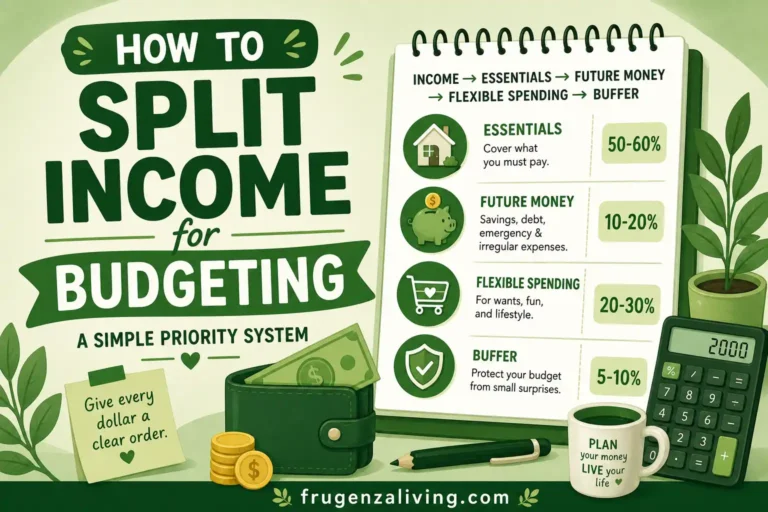
To split income for budgeting, list what your take-home pay must cover during one clear period. Fund current necessities and required payments, account for upcoming nonmonthly bills, then choose an affordable buffer, savings contribution, and flexible-spending allowance.
The useful result is an allocation you can reconcile: money spent, money reserved, money contributed to a goal, and anything still unassigned. Assigning money to a category does not itself reduce an expense.
This guide works through a complete $2,000 monthly example, then checks the cash remaining at month-end. All figures are hypothetical US-dollar illustrations, not personal results, local price estimates, or recommended percentages.
1. Define the Money and Period You Are Splitting
Start with take-home income after payroll deductions. If retirement contributions or insurance premiums have already been deducted, do not subtract them again from the deposit you are allocating. Separately account for any taxes or obligations that still need payment from that money.
Choose matching dates for income and expenses. A monthly plan covers the whole calendar month. A paycheck plan must cover the commitments that need funding until the next reliable payday, including any contribution needed toward a later bill.
Existing cash needs a label too. Money already reserved for rent, an emergency fund, or another goal is not available to assign again. If you include an unassigned opening balance, show it separately from new income.
When household bills are shared, use your agreed contribution rather than charging the entire shared bill to both personal budgets. The proportional bill split calculator addresses contributions between two people. Here, the task is allocating one person’s available income.
2. Separate Required Payments From Optional Goals
A single label such as “future money” can hide an important difference. A minimum payment due now, a known insurance renewal, and an extra emergency-fund contribution have different purposes.
- Current essentials: housing, food, utilities, necessary transport, healthcare, and other needs that apply to you.
- Required debt payments: the minimums and other payments due under your agreements. Additional repayment is a separate choice.
- Nonmonthly bill reserves: money assigned toward known future costs, with an amount and due date.
- Checking buffer: a specifically assigned amount left available for payment timing or small variations.
- Savings goals and additional debt repayment: contributions chosen after checking what is affordable.
- Flexible spending: the allowance for optional purchases after the other allocations fit.
MoneyHelper’s guide to managing your money recommends accounting for household, living, insurance, travel, and leisure costs. It also distinguishes required loan and credit-card payments from the choice to focus extra repayment on a particular debt.
Give each commitment one place. For example, if an insurance premium is in the annual-bill reserve, do not include that same premium again in monthly essentials. Use the budget categories list to check for missing costs, then choose labels that make your own records clear.
3. Work Through a Complete $2,000 Monthly Split
Assume one adult receives $2,000 of take-home pay at the beginning of the month, before any payment is due. The next pay arrives at the start of the following month. There is no cash carried over, no additional income, and no borrowing during this illustration.
The housing figure is this person’s agreed share. Debt minimums relate to a balance owed before this month; new purchases are paid from the available cash. All current obligations are represented below, with no additional taxes, childcare costs, fees, or other bills to fund from this deposit. A reader with different commitments must add them before treating a remainder as available.
| Allocation | Amount assigned | Still unassigned |
|---|---|---|
| Housing share | $650 | $1,350 |
| Utilities and phone | $130 | $1,220 |
| Groceries | $250 | $970 |
| Necessary transportation | $100 | $870 |
| Routine medical and basic personal-care costs | $70 | $800 |
| Required debt minimums | $100 | $700 |
| Reserve for annual insurance renewal | $100 | $600 |
| Checking buffer | $100 | $500 |
| Emergency-fund contribution | $200 | $300 |
| Flexible spending | $300 | $0 |
| Total assigned | $2,000 | $0 |
Current essentials total $650 + $130 + $250 + $100 + $70 = $1,200. Adding the $100 required debt payment brings current necessities and minimum payments to $1,300.
The remaining $700 is assigned as $100 insurance reserve + $100 checking buffer + $200 emergency-fund contribution + $300 flexible spending. The full check is $2,000 − $1,300 − $100 − $100 − $200 − $300 = $0 unassigned.
Zero unassigned does not mean an empty bank account. Some allocations will be spent; others will remain held for their stated purpose. If you prefer to track this approach in more detail, the zero-based budgeting guide explains assigning every dollar a job.
Why the Annual Bill Needs $100 Now
Assume the insurance renewal will cost $600, nothing is reserved yet, and exactly six monthly contributions can be made before its due date, including this month’s contribution. The amount needed per contribution is ($600 − $0) ÷ 6 = $100.
Dividing by 12 would give $50 per month, but six deposits of $50 would provide only $300 by this due date. The annual average would underfund the first payment.
After the renewal is paid, a new cycle with twelve contributions before another $600 renewal would need $50 per contribution. Confirm the next amount and date first. Do not reserve the same bill twice under another category.
Let Percentages Describe the Plan
In this example, $1,300 for current necessities and minimum payments is 65% of take-home income. The emergency-fund contribution is 10%, and flexible spending is 15%. The insurance reserve and checking buffer are 5% each.
Those percentages come from the stated costs and choices. They are not targets for another household. Changing a label to make a ratio look better does not make a bill smaller.
4. Reconcile the Actual Spending and Cash Left
At month-end, suppose essentials and minimum debt payments were paid exactly as planned. Flexible spending was $260 rather than $300. The $200 emergency-fund transfer was made, and the insurance reserve and checking buffer were untouched.
Assume all payments have cleared, with no pending purchases, withdrawals from savings, interest, fees, or other changes. The result is:
| Actual use or remaining allocation | Amount |
|---|---|
| Essentials paid | $1,200 |
| Required debt payments made | $100 |
| Flexible spending paid | $260 |
| Insurance reserve still held | $100 |
| Checking buffer still held | $100 |
| Emergency-fund contribution still held | $200 |
| Unassigned flexible-spending remainder | $40 |
| Total accounted for | $2,000 |
Payments total $1,200 + $100 + $260 = $1,560. Cash still held totals $100 + $100 + $200 + $40 = $440. Together, $1,560 plus $440 accounts for the original $2,000.
If only the emergency-fund contribution moved to a separate account, checking holds $240: $100 for insurance, $100 buffer, and $40 unassigned. The emergency account holds $200. An account’s balance is not the same as the amount free to spend.
The goal contribution is $200. Flexible spending came in $40 below its plan; that $40 has not also been contributed to the goal. Transferring the $200 did not create an additional $200 expense reduction. The insurance reserve is money for a future bill, not another emergency-fund contribution.
5. Adjust a Split That Does Not Fit
Suppose the same person’s essential costs are $250 higher before the plan begins. Keeping every other allocation unchanged would assign $2,250 against $2,000 of income: a $250 shortfall.
Reducing the flexible allowance from $300 to $50 would balance that revised plan, assuming all other figures remain valid. This is a planning adjustment, not evidence of $250 already saved.
If current necessities and required payments alone total $2,050, there is already a $50 gap before any optional goal, flexible allowance, or buffer. A smaller savings percentage cannot solve that gap. Identify the payments at risk, check feasible changes or reliable support, and contact providers or lenders before due dates if you cannot pay. Leave the shortfall visible until a real change covers it.
Use the Split Before You Spend
- Write the period, available income, and any unassigned opening cash.
- Check current needs, required payments, and nonmonthly bills against records.
- Calculate reserve contributions using amounts already held and deposits available before due dates.
- Choose the buffer, additional goals, and flexible allowance within the remaining funds.
- Check that allocations plus any unassigned remainder equal the funds available.
- Review actual payments and held balances before assigning a leftover amount again.
Check dates as well as totals. If income arrives in several installments, a balanced monthly total does not make a later paycheck available for a bill due today. The weekly budget guide can help you organize the shorter review period; keep later bills and the whole pay cycle funded when doing so.
Frequently Asked Questions
How should I split my income for budgeting?
Start with available take-home pay and a defined period. Account for necessities, required debt payments, and upcoming bills, then choose affordable reserves, goals, and flexible spending. Reconcile the total before using the allowance.
Where do minimum debt payments belong?
Record them among required payments. Keep additional repayment separate so a general savings or “future money” category does not hide an unpaid minimum.
Is money reserved for an annual bill savings?
It is cash set aside, but it already has a spending purpose. Track it separately from an emergency fund or another savings goal, even if the money shares one bank account.
Does assigning all my income mean I should spend it all?
No. A fully assigned plan can include money that stays in checking, reserves for later bills, and savings contributions. Zero unassigned means each dollar has a purpose, not that every dollar leaves your accounts.

Read about Jeffi and Frugenza Living
- Recipe Cost Calculator for Home Cooking - November 10, 2026
- How to Save for a Car Insurance Deductible - November 9, 2026
- How to Rebuild an Emergency Fund After Using It - November 4, 2026