
Start with your next real activity: work, errands, dinner, or time at home. Put together the whole outfit, wear it for that activity, and keep a short note about what works. You can repeat clothes, use your entire wardrobe, and begin without emptying a single drawer.
Start With the Week You Actually Have
Look at your calendar and the weather before choosing clothes. An outfit for a seated office day has different requirements from one for a long walk, even if both look equally good in a mirror.
Choose a few activities you genuinely expect to do. Then pull out clothes that fit now, plus the shoes and layers those activities require. Leave special-occasion pieces alone unless you have a special occasion coming up. You do not need a fixed number of items or a newly purchased “essential.”
Keep the rules light:
- Use what you own before shopping for outfit additions.
- Repeats are allowed; a reliable combination can stay in rotation.
- Skip anything uncomfortable, unsuitable for the weather, or incompatible with a required dress code.
If you wear a uniform, use the prompts for off-duty clothes or the choices your uniform allows. If seven consecutive days do not suit your routine, spread the tasks over seven dressing occasions. Move them around to match your plans.
Aim to finish with at least one combination you have worn through a real activity and would choose again. Keep untested ideas labeled Planned or Tried on; a mirror check does not tell you how an outfit feels through a commute or afternoon at home.
This challenge does not require postponing a genuine need, such as replacing clothing that no longer fits or footwear that is unsafe to wear.
Seven Days of Outfit Prompts
Day 1: Dress for One Real Plan
Choose your next activity and build an outfit around a piece you already trust. Include the shoes and any necessary outer layer from the beginning. A top-and-bottom combination that needs shoes you do not own is still unfinished.
Before leaving—or starting your activity at home—sit, reach, and walk around in the outfit. Notice a waistband that digs in or sleeves that pull under a layer.
Make any necessary adjustment, then wear it for the activity. Afterwards, record whether it stayed comfortable and what you would change.
Clothing can be your starting category, then a low-buy month can help you apply similar rules to other discretionary spending.
Day 2: Change One Piece
Keep most of a familiar outfit and swap in one underused item that fits comfortably. Try a patterned shirt with trousers and shoes you wear regularly, or a skirt with your usual top and layer.
Changing one component makes it easier to see what you like or dislike. If the shirt bunches under the cardigan, you have a specific problem to address. You do not have to reject the entire outfit or assume you need something new.
Wear the variation at the next suitable opportunity. Until then, mark it Tried on. Describe the pieces precisely: “Blue shirt with navy trousers,” rather than “wear that shirt more.”
Day 3: Give One Item a Different Job
Take an item from a combination you have worn and use it for another activity on your calendar. A button-down worn with trousers for work might go with jeans and comfortable sneakers for a casual meetup, provided it is still ready to wear.
Change the pieces that affect how the outfit functions. Walking shoes may matter more than adding jewelry; removing a warm layer may matter more than changing colors. Dresses, skirts, and modest layers can follow the same approach.
If you use a saved inspiration photo, borrow one feature—such as a contrasting layer—using something you own. A photo pairing a light sweater with a dark skirt can suggest your light top with dark trousers. Look at the relationship between pieces rather than making a list of exact replacements.
Day 4: Check What Your Outfits Share
Compare the combinations you have assembled. Mark any shirt, shoes, or layer that several outfits require. If two activities fall before your next laundry day, both plans may depend on the same item being ready twice.
Choose the activity that would be hardest to dress for without that item: perhaps work with a required dress code, rather than a casual visit. This gives tomorrow’s backup task a specific job. If your combinations share few pieces, check the outfit you would be most inconvenienced to lose.
Day 5: Make a Laundry-Day Backup
Set aside the item identified yesterday and assemble an alternative for the activity you chose. You do not have to wash anything for this exercise; you are checking what happens when that piece is unavailable.
Start with the activity, then look for another owned item that performs the necessary job. A clean plain tee may replace a shirt for a casual meetup, but it may not satisfy your work dress code.
If nothing suitable remains, record that limitation. Do not add a duplicate to a shopping list just to complete the prompt.
Day 6: Wear and Recheck a Combination
Repeat a combination you would like to keep, or wear the backup for a suitable activity. If you have only tried your outfits on so far, use this opportunity for the first real wearing test. Shoes may feel fine standing still but uncomfortable after walking; a layer may need constant adjusting when you sit.
Keep the parts that worked and change only what caused trouble. “Use sneakers for the walk, then change into owned loafers at work” is a useful note when carrying another pair is practical.
Reuse garments only when their condition allows. The prompt is to revisit a combination, not to wear clothing that needs cleaning.
Day 7: Choose What to Repeat
Review what happened when you wore the outfits. Choose one you would readily wear again and identify any adjustment worth another attempt. Remove combinations you would not choose again rather than keeping every experiment.
If none has been worn yet, you have outfit plans, not a tested result. Keep their current status and use the next suitable activity to try one. There is no need to invent an event or mark a combination successful just to finish the week.
Three Outfit Plans—and One Shirt in the Wash
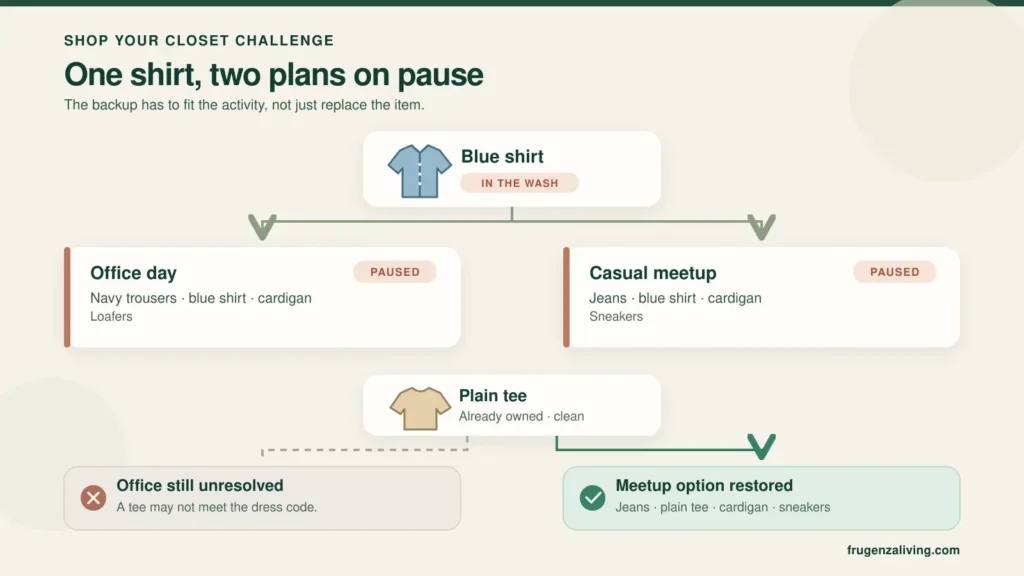
The following is an illustrative example. Assume all the pieces are already owned and fit, the weather is cool and dry, and the office permits smart casual. These are outfit plans, not tested results or a shopping list.
Office day
Navy trousers, blue shirt, cardigan, loafers
Availability: Requires the blue shirt.
Errands
Jeans, striped tee, jacket, sneakers
Availability: Does not require the blue shirt.
Casual meetup
Jeans, blue shirt, cardigan, sneakers
Availability: Also requires the blue shirt.
Meetup backup
Jeans, plain tee, cardigan, sneakers
Availability: Uses another owned top.
The first three plans look like three choices. But if the blue shirt is in the wash, both the office and meetup combinations become unavailable. Only the errands outfit remains complete, and it may not meet the office dress code.
The plain-tee backup restores an option for the meetup, assuming the jeans, cardigan, and sneakers are ready to wear. It does not automatically solve the office problem. For the next workday:
- Check whether the blue shirt can be washed and dried according to its care instructions in time. If so, prepare it before you need it.
- If not, try another clean, owned top with the navy trousers and loafers. Check the complete combination against the actual dress code.
- If neither route works, the office outfit remains unresolved. That may be a genuine need requiring another solution; the casual tee does not remove it.
You need not create a separate backup for every look. Focus first on the activity with the fewest suitable alternatives. Sometimes the solution is another combination; sometimes it is getting an existing garment ready through your normal laundry routine.
When an Outfit Still Doesn’t Work
Identify the obstacle before deciding what to do with the clothes. A combination that feels wrong can have several different causes.
Fit or discomfort: Stop using the item for this attempt. An old purchase price does not make tight sleeves or painful shoes more wearable. Alterations are an option when appropriate and affordable, but paying for them is not a requirement of the challenge.
An awkward pairing: Change the component creating the problem. If a shirt’s sleeves bunch under a cardigan, try another owned layer or wear it without that layer when the conditions allow. A piece can work in one outfit and fail in another.
Something is unavailable: Check whether the problem is temporary. A shirt waiting to be washed is different from having no suitable shirt. Follow its care instructions instead of trying a faster cleaning method just to keep the challenge moving. The FTC’s guidance on garment care labels explains the role of cleaning instructions and warnings about procedures that could damage clothing.
A missing function: If nothing you own meets a work requirement, fits your current body, or protects you from the weather, acknowledge that. Before buying a “finishing piece,” check whether a clothing purchase solves a real problem. An essential replacement and an accessory added for novelty deserve different decisions.
You can leave a combination unresolved. With a small wardrobe, a backup may still use the same trousers and shoes, so it only solves the missing-top problem. Keep that limitation visible rather than buying duplicates just to complete the exercise.
Save the Outfits You Can Actually Use Again
Keep your notes where you would look while getting dressed: a phone note, a notebook, or a small card near your clothes. A photo is optional. A written list is often enough if it identifies the specific pieces.
Use this format for each combination:
My Repeatable Outfits
Keep the pieces, the occasion, and what you learned in one place.
Copy this template into a note or notebook for each outfit.
- Activity: Where or when would I wear it?
- Pieces: Clothes, shoes, and any necessary layer.
- Status: Planned / Tried on / Worn.
- Useful note: Comfort, weather, or an adjustment to remember.
- If unavailable: Which frequently used piece could block this outfit?
- Owned alternative: A suitable replacement, if one exists.
Download your notes before closing this page. They are not saved automatically.
You can leave the last two fields blank until you need them. Start with one entry instead of turning this into an inventory of everything you own.
For example, a hypothetical note after a try-on might read:
Activity: Casual meetup, cool and dry weather.
Pieces: Jeans, blue shirt, cardigan, sneakers.
Status: Tried on; not yet worn to the meetup.
Useful note: Shirt sleeves feel tight under this cardigan; try the owned jacket instead.
If unavailable: Blue shirt.
Owned alternative: Plain tee; comfortable at try-on, still to be worn for the activity.
Update the note after wearing the outfit. Worn does not automatically mean comfortable: record any problem and the conditions that mattered, such as a long walk or a warm room.
You do not need to keep experimenting every day after the week ends. Use the combinations you like, and return to the prompts when a particular item or activity leaves you stuck. If you want to extend the pause on nonessential purchases, set rules for a longer clothing-shopping pause that fit your needs.
For now, choose the next activity on your calendar and lay out one complete outfit. If a frequently used piece is unavailable, try an owned alternative and write down whether it works. That gives you something useful to reach for the next time you get dressed.
Read about Jeffi and Frugenza Living
- Proportional Bill Split Calculator for Two Incomes - October 15, 2026
- How to Split Grocery Bills With Roommates - October 14, 2026
- First Apartment Kitchen Essentials on a Budget - October 13, 2026