
Weekend field notes · Seven ways to spend a little time
A one-session library workshop, a short local history route, and a homemade mini-zine offer three different ways to spend a weekend on your own. You can join something organized, explore at your own pace, or stay home with materials you already have.
Some choices give you quiet time alone; others let you attend without bringing a friend. Each idea below includes a starting point and the conditions that affect whether it fits your time, access, and spending limit.
Pick something you can start—or join on your own
Start with how much structure you want:
Leave when you like, with no event booking
A local history route or nature observation.
Have a scheduled activity to join individually
A library workshop, public swim, or organized volunteer session.
Find a workshop, check a public swim, or look for a volunteer session.
Stay home and avoid travel costs
A paper mini-zine or solitaire with an existing deck.
For scheduled options, use the listing for the Saturday or Sunday you plan to attend. Having a short list of free activities ready can make it easier to enjoy an open weekend without automatically browsing stores or shopping online.
Plan for one person. At organized sessions, going alone means attending individually; the workshop or volunteer activity may be shared with a group.
Free admission and no new purchases are different. An outing with no entry fee can still need a fare or supplies. Using things you own avoids a new purchase, but does not make their original cost—or your household costs—disappear.
Times below are planning suggestions unless a venue sets the session length. Check current listings, access, and travel time before choosing an outing.
7 affordable activities to try this weekend
1. Follow a two-stop local history route
Time: Try a 45–60 minute block for the two stops, plus any travel. This is a planning suggestion; adapt it to the route.
Choose two nearby public landmarks, historical markers, or buildings you can view from a public area. A municipal website or local historical society can provide background. Pick places close enough together that traveling between them remains manageable.
Save a short description of each before leaving. At the first stop, look for one detail mentioned in the description: an old building name, a date, a former use, or a feature that remains visible. At the second, compare what has changed and what has survived. Two stops give the outing a clear purpose and endpoint without researching an entire city itinerary or paying for a tour.
Check the route, public access, and any entry charges first. Use places you can reach comfortably in daylight, and shorten the route if the journey would take more time or money than the exploring.
If the route does not work: choose the observation activity using a view you can access. A closed site or costly journey is a reason to change the plan.
2. Join a one-session library workshop
Time: The workshop’s full listed duration, plus travel. Bring: only the materials the listing says you need.
Open your local library’s official events calendar and filter by date and adult programs. Look for a standalone craft, drawing, writing, or beginner skills session that interests you. Read the listing for prerequisites; a workshop halfway through a course may be difficult to join casually.
Before registering, check whether materials are supplied and whether you can attend individually. If the wording is unclear, ask: “Can I come on my own, and do I need to bring anything?” A scheduled session gives you a task to begin when you arrive, with opportunities to talk to other participants.
Seattle Public Library’s official event calendar, for example, describes its events as free and open to everyone. Check each listing for registration and materials; your local library may have different policies.
If the session is full or supplies cost too much: make the mini-zine at home with existing paper and a pen, or choose the observation activity.
3. Try a public swim without a membership
Time: The public swim slot you choose, plus changing and travel. Cost check: entry, travel, and any required locker or equipment charges.
If you already enjoy swimming and own suitable swimwear, look for a municipal or community pool offering single-entry admission. Buying one visit lets you try the facility without paying for a membership or multi-visit pass.
Check the timetable for a public recreation or lap-swim session that suits your ability. The building’s opening hours alone will not tell you when you can use the pool. Also check whether that particular session requires a reservation.
Bring a towel and any required equipment you already own. Ask about lockers, towel rental, and other charges if the website leaves them unclear. Include travel before deciding whether the visit fits your budget.
Choose a supervised public facility and follow its rules. If the outing requires buying equipment as well as admission, another activity may be a better fit for this weekend.
4. Sign up for a supervised park volunteer session
Time: The full advertised volunteer slot, plus travel. Bring: the clothing and equipment specified by the organizer.
For an outdoor activity with a shared task, check a parks department or established conservation organization’s volunteer calendar. Look for a one-time session accepting individual beginners, rather than a role requiring ongoing training or weekly attendance.
Read the task description before signing up. Planting, spreading mulch, and removing weeds can involve different physical demands. Check what the organizer provides, what clothing you need, and where participants meet. Supplied tools can keep the required shopping list short, but do not assume every event includes them.
This is a useful choice if you would enjoy working alongside others while following an organizer’s instructions.
Sign up only if you can stay for the advertised slot, and follow the cancellation instructions if your plans change. For an outing you can end whenever you like, choose the history route or nature observation instead.
Some cheap weekend activities are even better when they become hobbies you can enjoy regularly instead of one-time plans.
5. Watch what changes in one outdoor spot
Time: 15–20 minutes. Equipment: none required; making notes is optional.
Choose a comfortable public sitting area, your yard, or a suitable view from a window. Spend about 15 to 20 minutes noticing one small area. A tree, patch of grass, or view of the sky is enough.
Give yourself three things to look for:
- Something moving: a bird, insect, leaf, or cloud.
- A change in light, shadow, or color.
- A sound you can describe, even if you cannot identify its source.
Make brief notes or simply watch. You do not need to identify species or buy binoculars. If getting to a park would create an expensive journey, use a view available where you are. Observe without disturbing wildlife.
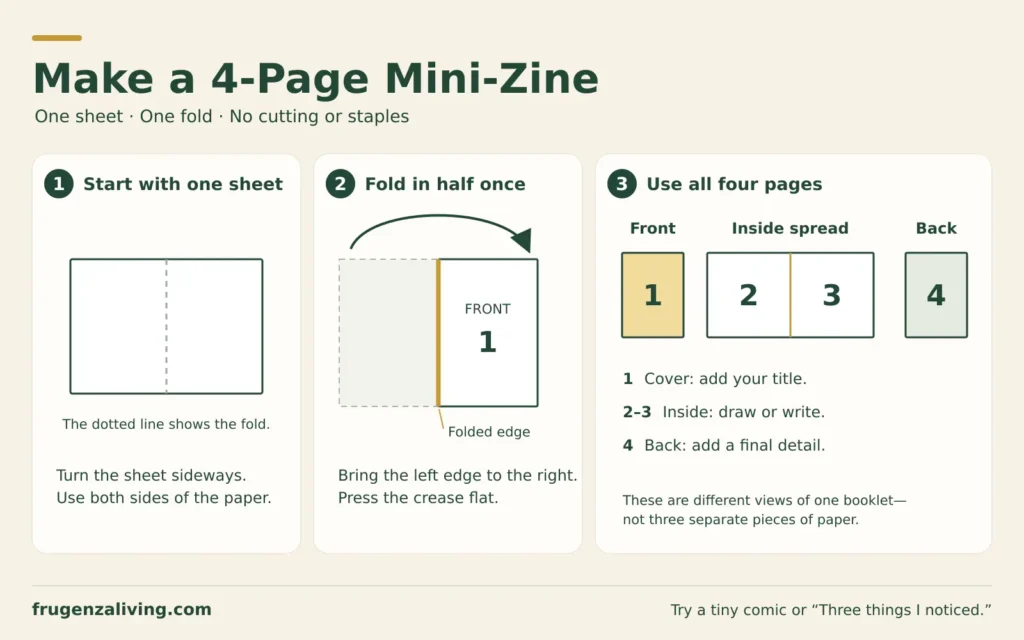
6. Make a four-page mini-zine
Time: Try the 25-minute plan below. Materials: one sheet of paper and a pen you already have.
A mini-zine is a small homemade booklet. Take one sheet of paper and fold it in half once. That gives you a front cover, two inside pages, and a back cover. A pen is enough to fill them, so this requires no new purchase if both materials are already available.
Try a tiny comic about a household object, a guide to your favorite sandwich, or “Three things I noticed this week.” Put the title on the cover, the main drawings or notes inside, and a final detail on the back. Keeping the topic small makes deciding what to put on each page easier. Plain paper works; no printing or binding is needed.
ONE PERSON · A 25-MINUTE PLAN
A tiny booklet you can finish today
Set out one sheet of paper usable on both sides, one pen, and a place to write. Use what you already own; no printer, scissors, glue, or craft kit is needed.
5 minutes · Fold and chooseFold the sheet in half once. Choose one small topic and write its title on the front cover.
15 minutes · Fill the pagesAdd a drawing or a few lines to each inside page, then one final detail on the back. Leave space blank if you like.
5 minutes · Read and put awayRead the four pages in order and clear your writing space. The suggested session totals 25 minutes; take longer if you prefer.
New purchases: $0 if the paper and pen are already available. This assumes no extra travel, paid access, or other purchase is needed for your session. Existing materials and household costs still have a cost. If you lack the materials, try the observation activity instead of buying supplies.
See the one-fold mini-zine guide
7. Learn one solitaire game with a deck you own
Time: Set aside 20–30 minutes to learn and practice; a deal may take longer. Materials: an existing 52-card deck, space to lay it out, and access to the rules.
An existing deck of cards can give you a game to learn without an opponent or an app. Standard solitaire uses one 52-card deck; Bicycle’s solitaire rules explain the layout and play.
Clear enough space to leave the cards visible and follow the instructions for a practice deal. Keep the rules open while you learn, and stick with one version so you are not switching between conflicting instructions. If you do not have a deck, the paper booklet is an alternative that avoids buying cards.
Check the session and the cost before you leave
A planned outing needs to fit your spending limit and be available when you want to go. Add admission, round-trip travel, required supplies, and any food or drinks you intend to buy. Then confirm that you can actually attend the chosen session.
One workshop, two possible totals
Illustrative US-dollar prices for one person and one session, not a local quote or a typical cost. The spending limit is $10.
A confirmed place, with materials supplied
Here is a hypothetical example, using illustrative prices. Suppose your limit is $10 in new discretionary spending. A library workshop has free admission, and your assumed round-trip fare is $6. If your place is confirmed and materials are supplied, the planned total is $6.
$0 entry + $6 return fare + $0 supplies = $6
$4 remains within the $10 limit. That is unused budget, not a measured saving.
The same outing, but materials must be bought
If you must buy $5 of materials, the total becomes $11.
$0 entry + $6 return fare + $5 supplies = $11
$1 over the $10 limit. Choose another plan, use organizer-approved materials you already own, or reconsider the outing within money you can afford.
These totals assume no additional food, drink, access, or other charge is required. Add any such cost your plan needs before comparing it with your limit.
If the workshop is full, it is unavailable regardless of how well the fare fits your budget. Those are different reasons to choose another option: one requires a lower-cost plan, while the other requires an available activity.
If you prefer a meal, film, or café outing, these inexpensive solo-date ideas cover those formats. Otherwise, choose one activity from this list and take its first step: identify the two stops, open the calendar, or set out the paper. When you want to plan the rest of your weekend, build around that choice and leave room for unplanned time.

Read about Jeffi and Frugenza Living
- How to Host a Clothing Swap With Friends - November 13, 2026
- How to Request a Price Adjustment After Purchase - November 12, 2026
- Return Deadline Tracker Template: Track Returns and Refunds - November 12, 2026