Your registration expires in four months. You have $72 set aside, but the amount you remember paying last time is only a rough guess.
The useful question is not, “What did I pay last year divided by 12?”
It is:
What will this renewal actually require, how much is already reserved, and how much time is left?
A car registration sinking fund works best when you build the target first, close the gap for the upcoming deadline, and then use the actual cost and term of the next registration cycle to set a steadier baseline.
Quick answer: Yes—if your registration renewal is predictable and paid separately, it is a good sinking-fund candidate. Add only the recurring costs tied to your next renewal, subtract money already reserved, and divide the remaining gap by the saving periods left. After payment, match the next target to the registration term it actually covers.
That last step matters. A 24-month registration target should be divided by 24 only when the dollar amount you are using represents the full cost of that 24-month term.
Start With a Registration Renewal Stack
Before deciding how much to save each month, build the number you are actually trying to fund.
Think of it as a Registration Renewal Stack:
Registration Renewal Target = Verified Registration-Linked Costs
Depending on your vehicle and jurisdiction, that stack might include:
- the base registration or renewal charge;
- a recurring plate, county, or local registration fee;
- a vehicle-specific surcharge shown with renewal;
- an EV or hybrid surcharge where applicable;
- an inspection or emissions cost when it is a separate, predictable charge connected to your renewal process;
- another recurring mandatory registration-related fee confirmed by an official source.
Do not add every possible item just because another driver pays it.
Requirements vary.
Your best starting point is usually your current renewal notice. If that is not available yet, use your official state motor-vehicle portal or fee estimator. A recent registration receipt can serve as a temporary reference until current information becomes available.
A national average is much less useful than a number your own agency can verify.
What Does Not Belong in This Fund?
A common budgeting mistake is creating one vague “car fund” and asking it to cover registration, tires, insurance, repairs, fuel, and whatever else happens next.
That makes the balance difficult to trust.
Usually keep these outside the registration target:
- gasoline or charging;
- car payments;
- auto insurance premiums;
- oil changes and routine service;
- tires and brakes;
- unexpected repairs;
- parking and tolls;
- one-time title-transfer or vehicle-purchase costs;
- replacement cards or plates caused by loss or damage;
- avoidable late penalties.
Maintenance needs a different planning method because timing depends on mileage, wear, service intervals, and repair uncertainty. Keep that money in a separate vehicle maintenance reserve rather than letting registration compete with it.
The registration category should answer one narrow question:
If renewal were due today, how much of this balance is actually assigned to getting the vehicle registered?
Match the Target to the Registration Term
This is where “just divide by 12” can become misleading.
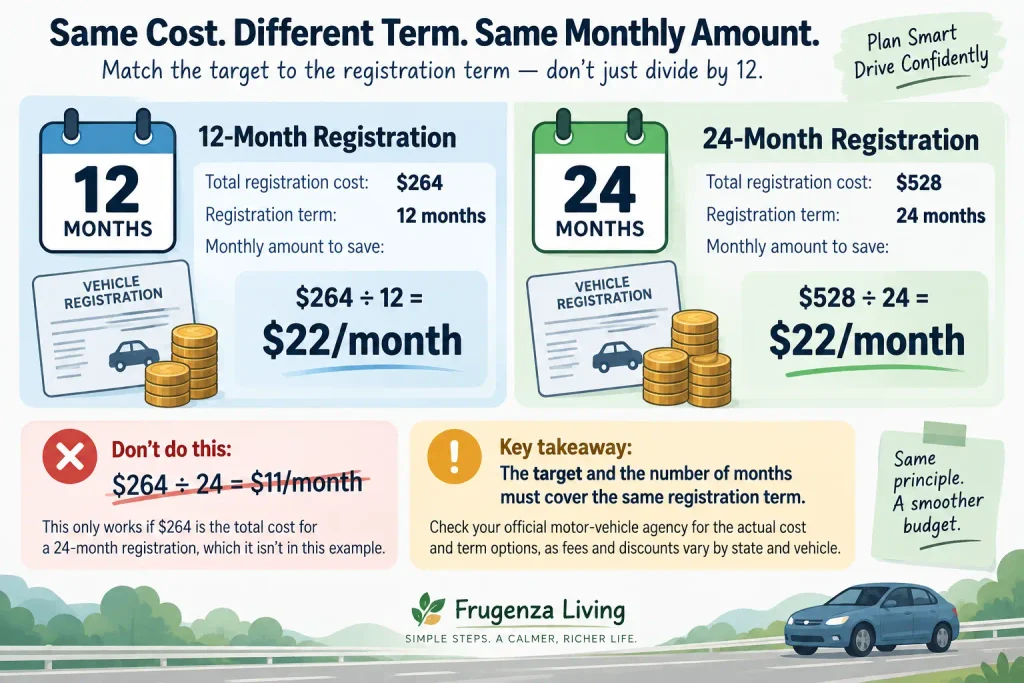
The denominator and the dollar target must describe the same registration term.
Virginia DMV’s official vehicle registration guidance provides one useful example of why this matters: eligible motorists may have multi-year renewal options, and the pricing for those terms can include term-specific discounts.
That does not mean every state offers the same choices or uses the same pricing.
It means you should verify both:
How much does this option cost?
and
How many months does that payment cover?
Use:
Monthly Registration Baseline = Total Cost for the Chosen Registration Term ÷ Months Covered by That Term
For example, suppose an official portal quotes:
12-month registration total: $264
Then:
$264 ÷ 12 = $22 per month
Now suppose the same portal quotes:
24-month registration total: $528
Then:
$528 ÷ 24 = $22 per month
The longer term did not automatically cut the monthly cost in half.
If the agency offers a multi-year discount, surcharge, or another pricing structure, use the actual quoted total for that term instead.
Never change the denominator without checking whether the target changes too.
If registration is only one of several predictable renewals you are coordinating, Frugenza’s broader annual-bill funding system is better suited to managing several due dates. This guide stays focused on registration itself.
Close the Upcoming Gap Separately From the Next Cycle
Your upcoming renewal may require a higher monthly contribution simply because you are starting partway through the cycle.
Consider this illustrative example:
Upcoming registration target: $264
Already reserved: $72
Months until renewal: 4
First find the remaining gap:
$264 − $72 = $192
Then:
$192 ÷ 4 = $48 per month
So the amount that matters today is:
$48 per month
After renewal, suppose the next confirmed or reasonable 12-month target is again $264.
Then:
$264 ÷ 12 = $22 per month
Those two numbers are both valid.
$48/month solves the short runway before the upcoming renewal.
$22/month represents a complete future 12-month cycle.
Do not let a temporary catch-up requirement become a permanent monthly assumption.
Car Registration Renewal Fund Builder
Use this tool to build your upcoming Registration Renewal Stack and calculate what needs to be saved before the deadline.
If you already know or can reasonably estimate the total cost and term of the next registration cycle, you can also calculate a term-matched future baseline.
If you do not know that future amount yet, leave it blank. The calculator will still solve the upcoming renewal.
Car Registration Renewal Fund Builder
Build the upcoming renewal stack first. Add a separate next-cycle target only when you have a useful estimate for the full registration term.
1. Build the Upcoming Renewal Stack
Use only registration-linked costs that actually apply to your upcoming transaction.
2. Optional: Plan the Next Registration Term
Leave this section blank if you do not yet have a useful estimate. The upcoming-renewal calculation will still work.
Your Registration Plan
Planning tool only. Registration charges, inspection requirements, terms, discounts, deadlines, surcharges, and penalties vary by jurisdiction and vehicle. Verify current figures with the official motor-vehicle agency responsible for your registration.
The downloadable plan records the individual renewal-stack components instead of saving only the final total. If the next-cycle amount is still unknown, the file simply records that it has not been calculated yet rather than forcing an estimate.
Find the Number Before You Fund It
If your renewal notice has already arrived, use it.
If not, a practical order is:
- Check your official state DMV, MVA, BMV, or equivalent motor-vehicle portal.
- Use an official fee estimator if one is available for your transaction.
- Review your latest registration receipt as a temporary reference.
- Replace the estimate when the new official renewal amount arrives.
A remembered number may omit a local fee, vehicle surcharge, or another recurring item. It can also include a one-time charge that should not appear in the next target.
Do not aim for false precision.
Use the strongest information available today and update the target when better information arrives.
Do Not Save for the Penalty. Save for the Deadline.
Late-registration rules and penalties vary by jurisdiction, so an avoidable late charge should not become a normal recurring component of the sinking fund.
Instead, make the date part of the system.
Record the expiration date. Set a reminder early enough to review the official renewal amount. Compare the updated target with what is already reserved, then close whatever gap remains.
A reminder and a sinking fund do different jobs:
The reminder protects the date. The fund protects the cash flow.
A sinking fund tracker can help you record the renewal date, savings target, current balance, and amount still needed before registration is due.
After Renewal, Save the Receipt—Not Just the Memory
The payment itself gives you better information for the next cycle.
After registration is complete:
- keep the receipt or confirmation;
- separate recurring charges from one-time items;
- note the term the payment actually covered;
- record the next expiration date;
- use the confirmed recurring total and registration term as the starting baseline for the next cycle.
This creates a simple feedback loop.
The first cycle may begin with an estimate. The second cycle can start with better information than the first, even though the eventual renewal amount may still change.
When the next official notice becomes available, update the target again rather than treating the previous receipt as permanent.
Does Car Registration Need Its Own Bank Account?
Not necessarily.
It needs a separate assignment, not necessarily a separate institution.
If your savings account contains $1,000 and $264 is assigned to registration, that $264 should not also be counted as available for tires, travel, or another yearly bill.
You can track the assignment through bank subaccounts, a spreadsheet, budgeting software, or a simple ledger.
If you need the underlying setup before creating specific categories, this beginner-friendly sinking fund framework covers the broader system.
For registration itself, keep the process narrower:
Verify the stack.
Match the target to the term.
Subtract what is already saved.
Close the upcoming gap.
Then restart with better data.
The Goal Is a Boring Renewal
The best car registration sinking fund is not the one with the most categories or the most complicated spreadsheet.
It is the one that makes renewal uneventful.
You know the amount you are preparing for. You know which costs belong in the target. You know what period that target covers. And you know how much is already reserved.
If $48 per month is required because renewal is only four months away, save $48 while that short runway exists.
After payment, do not automatically keep saving $48. When reliable information for the next cycle is available, match its total cost to the registration term and calculate a new baseline.
If that future information is not available yet, you do not need to invent it.
Fund the obligation you can verify today, keep the deadline visible, and improve the next plan when better data arrives.
That is the difference between budgeting around a guess and budgeting around the actual registration obligation.
Methodology note: All dollar figures are illustrative planning examples, not estimates of registration costs nationwide. Registration fees, periods, inspection requirements, surcharges, deadlines, discounts, and penalties vary by vehicle and jurisdiction. Verify current information with the official motor-vehicle agency responsible for your registration. This article provides general budgeting education, not individualized financial, tax, legal, or vehicle-registration advice.

The ideas shared here come from real-life experience and practical habits that actually work.
→ Read more about Jeffi
- Vacation Sinking Fund: How Much to Save for Your Trip - September 12, 2026
- Moving Sinking Fund: How Much to Save Before Moving Day - September 12, 2026
- Appliance Replacement Sinking Fund: How Much Should You Save? - September 11, 2026