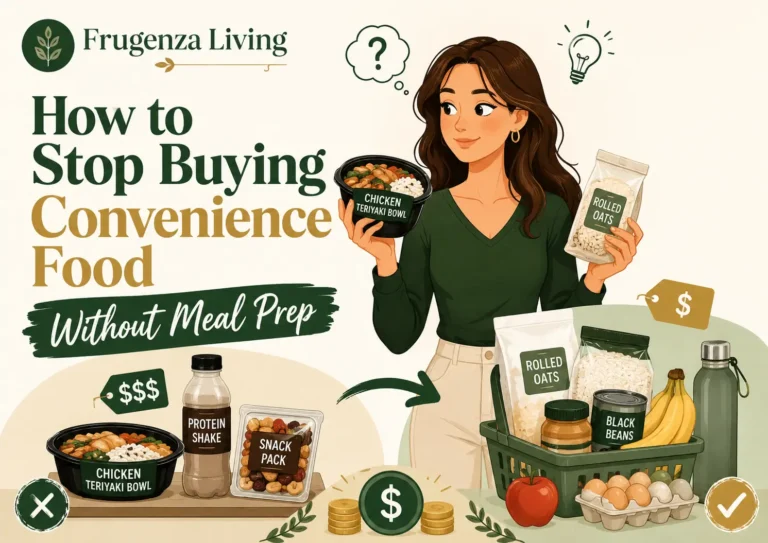
You stop at the grocery store after a draining day and place a prepared bowl, pre-cut fruit, bottled drink, and individual snack in the cart. You are not only buying food. You are buying fewer decisions, less preparation, and almost no cleanup.
That is why learning how to stop buying convenience food rarely works when every replacement requires chopping, cooking, and several dishes. The practical solution is to replace the convenience function with a lower-cost option that demands about the same effort.
Quick answer: Review your last three convenience-food purchases. Identify what each one saved—time, decisions, cleanup, portioning, or portability—then compare it with a lower-cost option that performs the same job with similar effort and meal coverage. Reduce the purchase with the highest premium and lowest value while keeping shortcuts that prevent waste or a more expensive order.
In this guide, convenience food means grocery-store ready meals, prepared sides, pre-portioned foods, and grab-and-go products. Restaurant takeout is a separate spending category.
Decide Which Convenience Purchases Are the Real Problem
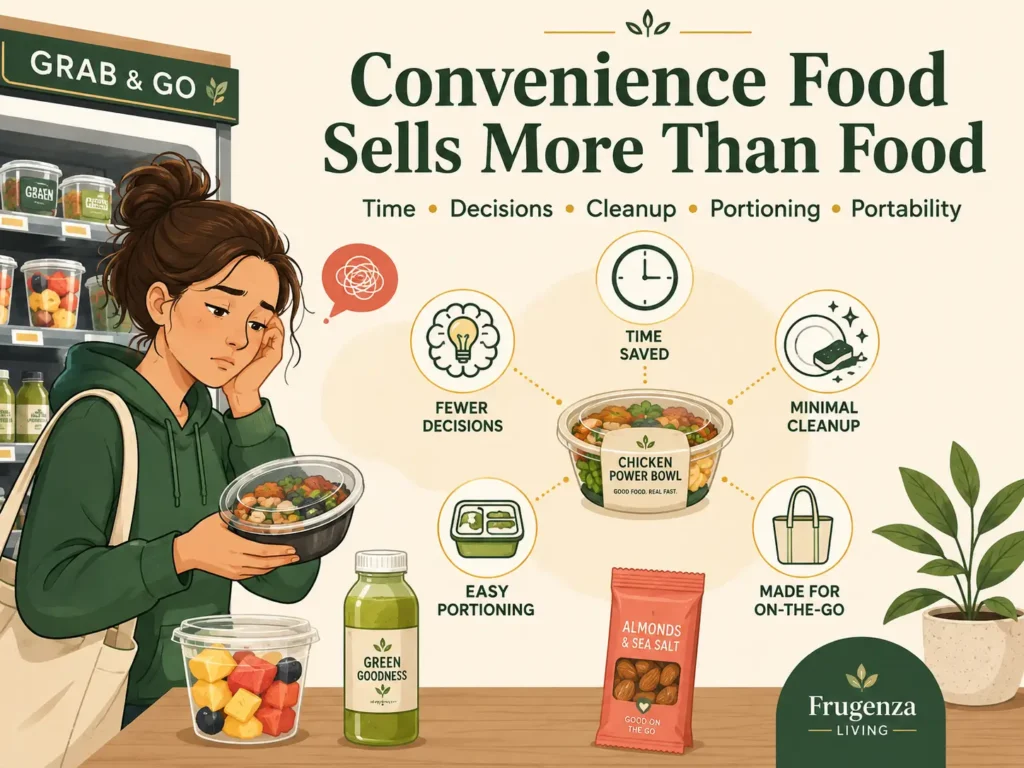
Convenience food is not one uniform category. A frozen entrée that prevents a $25 delivery order is different from a bottled drink added to a prepared meal.
Separate recent purchases into four groups:
- Meal replacement: It becomes breakfast, lunch, or dinner.
- Meal add-on: It raises the total without replacing a meal.
- Scheduled convenience: It has a likely use window, such as a specific day, work shift, travel day, or low-capacity situation.
- Impulse convenience: It is bought because it looks easy in the moment.
The objective is not to reduce every convenience product to zero. Frozen vegetables, canned staples, prewashed greens, and selected ready meals can provide good value when they are fully used.
The weakest purchases usually duplicate food already at home, function only as add-ons, or expire before they are eaten. Start there rather than banning the items that make eating at home realistic.
Compare Equivalent Eaten Servings
Look at three recent receipts, app orders, or card transactions. For each item, record the full price, servings ultimately eaten, whether it replaced a meal, the job it performed, and the cost of a realistic same-effort swap.
Use this formula:
Convenience premium per serving = convenience-item cost per eaten serving − same-effort swap cost per equivalent eaten serving
Suppose a prepared grocery bowl costs $8.99 and provides one eaten serving. A five-minute alternative with similar meal coverage costs $3.85:
- Prepared grain portion: $1.10
- Beans or another filling component: $1.20
- Prewashed vegetables: $1.05
- Sauce: $0.50
- Illustrative total: $3.85
The convenience premium is:
$8.99 − $3.85 = $5.14 per equivalent serving
These are ingredient-used costs, not national averages.
For larger packages, use:
Real cost per eaten serving = total purchase cost of the item ÷ servings consumed before the remainder spoiled or was discarded
If the package is still being used, wait until it is finished or discarded before judging the final serving cost. For ingredients used across several meals, count only the portion assigned to the convenience-food replacement.
A lower cost per serving may require a higher checkout total. If cash flow is tight, record both the amount paid today and the eventual serving cost.
Convenience Food Swap Scorecard
ONE-PURCHASE AUDITCompare one convenience purchase with an alternative that provides similar time savings, cleanup, and meal coverage.
1. Record the Purchase
Item: __________________
Full checkout cost: $_____
Servings ultimately eaten: _____
Cost per eaten serving: $_____
Meal replacement or add-on? __________
2. Compare the Swap
Same-effort alternative: __________________
Upfront checkout cost: $_____
Cost per equivalent serving: $_____
Premium per serving: $_____
Likely use window: __________________
convenience-item cost per eaten serving − same-effort swap cost per equivalent eaten serving
3. Does the Swap Really Match?
Keep
It is fully used, replaces a meal, fits cash flow, and prevents a more expensive purchase.
Test the Swap
The item is useful, but an equivalent alternative may provide the same convenience for less.
Reduce First
It is impulsive, repeatedly wasted, duplicates food at home, or functions only as an add-on.
Checkboxes work temporarily in your browser and do not save personal data.
Use the Same-Effort Swap Test
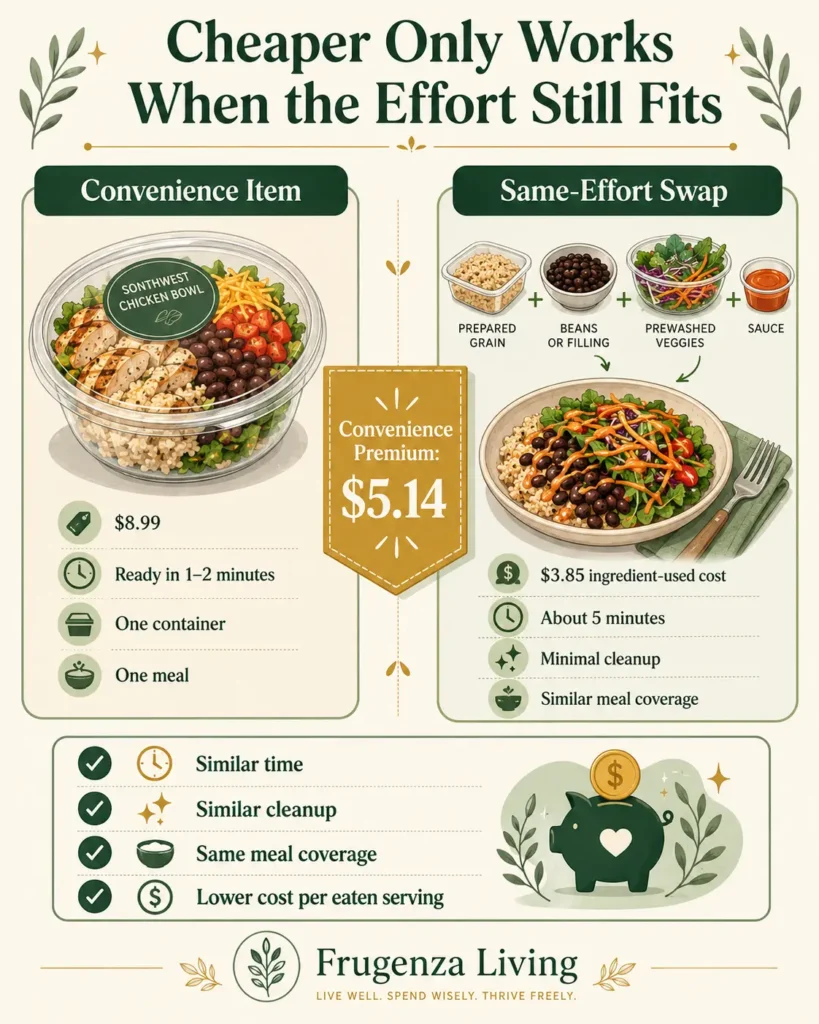
A cheaper alternative is not useful if it demands far more time, cleanup, or decision-making than the purchase it replaces.
A realistic swap should match six conditions as closely as possible:
- Similar preparation time.
- Similar number of decisions.
- Similar cleanup.
- The same meal or component.
- Enough meal coverage to avoid a predictable second purchase.
- A lower final cost per serving actually eaten.
A single-serve snack pack may be replaced by portioning a larger package only if the larger package will be used. A prepared side may be replaced by a component that needs only opening, heating, or one quick step. A bottled drink may be replaced with a packed or refillable drink.
If decision fatigue is the main trigger, a weekly meal plan for one on a budget can provide default choices. Use that guide for planning; here, focus on product format and markup.
Change the Decision Inside the Store
Give every ready meal a likely use window before placing it in the cart. That window might be a specific day, work shift, travel day, or low-capacity situation. If no realistic use comes to mind, the product may be aspirational rather than practical.
Shopping for an ideal week instead of the week you actually live is one of the most common grocery shopping mistakes for one person. A convenience item is useful only when it fits the schedule, storage, and appetite you are likely to have.
Ask whether the item replaces a meal or merely adds to one. A prepared entrée may solve dinner, while a bottled drink, packaged side, and dessert can double the total without creating another meal.
Keep only the convenience products you can assign to a realistic use before they expire. Several “just in case” purchases can become several expired products.
Compare the complete eating occasion, not the package alone. A $6.99 entrée may still lead to another snack or side if it does not cover the meal.
Buy a larger package only when its portions are likely to be eaten. When package size and food visibility are the main problem, use a system to make groceries last longer rather than assuming bulk is always a bargain.
Reduce one category first. Removing bottled drinks, single-serve sides, or one type of prepared meal makes the result easier to measure than a total convenience-food ban.
Keep Convenience That Earns Its Price
Convenience can have financial and practical value. A prepared item may be worth keeping when it is fully used, replaces a meal, prevents waste, or avoids a more expensive purchase.
The value does not have to be purely financial. Convenience food may also support disability-related needs, illness, caregiving, limited kitchen access, unpredictable schedules, or periods of low capacity.
A frozen meal may cost more than its ingredients and still be cheaper than restaurant delivery. In that case, it can support a broader plan to save money on takeout rather than becoming the next product to eliminate.
Question items bought for a version of the week that rarely happens. Prepared salads for an imagined quiet lunch, several backup dinners, or single-serve foods already duplicated at home can create expensive waste.
Run a One-Category Experiment
Choose one category from your recent purchases and test a same-effort swap for one or two weeks.
Track:
- The upfront cost of the swap.
- The number of servings ultimately eaten.
- The final cost per eaten serving.
- Whether the swap covered the same meal.
- Whether it caused another purchase.
- Whether the extra preparation felt sustainable.
Keep the swap only if it works in the situation that normally triggers the convenience purchase. A theoretical saving that fails on the first tiring evening is not a useful replacement.
The cost examples in this article compare equivalent eaten servings and use illustrative prices rather than national averages.
The Bottom Line
The most practical way to learn how to stop buying convenience food is to stop treating convenience itself as the enemy. Compare one purchase with a same-effort alternative that offers similar time savings, cleanup, and meal coverage.
Keep shortcuts that prevent waste or a more expensive purchase. Reduce the products with the highest premium and lowest practical value. Start with one category, not the entire grocery cart.
Frequently Asked Questions
Is convenience food always more expensive?
No. Some prepared foods cost more per serving, while others reduce waste or prevent pricier takeout. Compare equivalent eaten servings, not package prices alone. Also consider the upfront checkout cost when a lower per-serving alternative requires several ingredients.
How do I stop buying ready meals every week?
Give every ready meal a likely use window before buying it. Review meals that were wasted or followed by extra purchases, then test one same-effort swap. Avoid stocking several backup meals without a realistic plan to use them.
How do I know whether a convenience food is worth the markup?
It is more likely to be worthwhile when it is fully eaten, replaces a complete meal, saves meaningful time or cleanup, fits available cash flow, and costs less than the purchase you would otherwise make.
Is a larger package always cheaper than single-serve food?
Not necessarily. Compare the final cost per serving actually consumed, not only the shelf price per ounce. A larger package saves money only when you can store, portion, and finish it before the remaining food is discarded.
How can I reduce convenience food without meal prepping?
Use repeatable meal formats and same-effort swaps rather than preparing several complete meals in advance. Keep realistic shortcuts, assign them likely uses, and replace only high-markup products that provide little convenience.

The ideas shared here come from real-life experience and practical habits that actually work.
→ Read more about Jeffi
- No Spend Month Challenge for Beginners: A 30-Day Plan - September 24, 2026
- Low Buy Month Challenge: Realistic Rules for 30 Days - September 23, 2026
- How to Stop Buying Groceries You Already Have - September 20, 2026