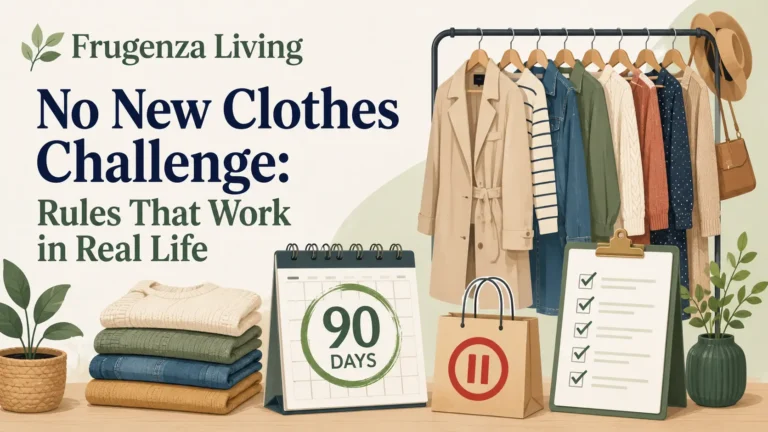
“No new clothes for 90 days” sounds like a complete rule until your work shoes split in Week 3, a wedding invitation arrives in Week 6, and a friend suggests a thrift-store afternoon in Week 8.
That is why a useful no new clothes challenge needs more than a start date and a streak counter. It needs rules for real life, a way to handle genuine needs, and a plan for what happens when the challenge ends.
At its simplest, the challenge means pausing some or all clothing purchases for a defined period. The useful part is not proving that you can buy nothing. It is learning which purchases were habitual, which needs were real, and which rules deserve to survive after the finish line.
Decide What You Are Actually Testing
Before choosing 30 days, 90 days, or a full year, decide what you want the experiment to reveal.
If your main goal is saving money, pausing both new and secondhand purchases may give you the clearest result. If your goal is reducing demand for newly produced clothing, secondhand purchases may remain within the rules. If you want to use what you already own, a broader pause on nonessential clothing acquisition may be more revealing than simply changing where you shop.
Your goal should determine your rules.
A challenge can technically succeed while missing the behavior you wanted to test. Someone can stop buying brand-new clothing but visit thrift stores every weekend. Someone else can buy no clothes for 90 days but redirect every dollar to another shopping category.
The challenge also does not need to become household-wide. Unless you deliberately choose that version, a personal no new clothes challenge does not need to restrict necessary clothing for children or other family members.
And a temporary clothing pause should not turn into indiscriminate deprivation. If every enjoyable purchase starts feeling forbidden, it may be more useful to cut spending selectively instead of treating everything you enjoy as the problem.
Build the Rules Before Day 1
Write your rules while there is nothing in front of you to buy.
Decide whether secondhand counts, whether shoes, bags, and accessories count, which essentials are automatic exceptions, what qualifies as a replacement, whether unsolicited gifts count, and what happens when work, weather, fit, safety, or health creates a genuine need.
I use rule leakage here as an editorial term, not a research concept. It happens when exceptions gradually expand until the challenge no longer tests what you intended.
“Secondhand is allowed for genuine needs” becomes weekly recreational thrifting. “Replacements are allowed” becomes replacing anything that has a slightly nicer alternative. “Event clothing is an exception” turns every dinner or party into a reason to shop.
The answer is not zero exceptions. The answer is defining them before the situation becomes convenient.
Underwear, socks, truly unusable essentials, changing size or body needs, work requirements, medical or accessibility needs, and weather or safety clothing can all be reasonable exceptions.
The challenge should never require unsafe shoes, inadequate weather protection, inappropriate work clothing, or clothing that no longer fits just to preserve a streak.
Build Your No New Clothes Challenge
Use this planner before Day 1. It turns your decisions into a clear set of rules and lets you download them so you do not have to renegotiate the challenge later.
Build Your No New Clothes Challenge
Set the rules before shopping tests them. Create a clear plan and save it for later.
Your selections stay in your browser. This planner creates a personal challenge outline; it is not a scientific or financial assessment.
Before the challenge ends, divide your clothing categories into Buy as Needed, Buy With a Rule, and Keep Paused.
Choose a Length That Gives You Something to Learn
There is no scientifically perfect challenge duration.
30 days is a low-commitment introduction, but it may be too short for many seasonal, work, travel, or event-related needs to appear.
90 days creates more opportunities to encounter normal shopping triggers without requiring a year-long promise.
Six months lets you observe changing weather and routines.
One year reveals the most across seasons, holidays, vacations, sales, birthdays, and special events—but it also demands clearer exceptions.
For many beginners, 90 days is a practical middle ground. Treat that as editorial guidance, not a universal formula.
A no-new-clothes period becomes much easier when you actively shop your own closet instead of treating the challenge as thirty days of restriction.
Take a Baseline—Then Do Not Stock Up
Before Day 1, record only a few facts: clothing spending during the previous two or three months, approximate number of purchases, the category you buy most often, and one or two situations that frequently lead to shopping.
You do not need to catalog every item in your closet.
The baseline simply gives you something to compare afterward. Without it, “I saved a lot” can mean almost anything.
One rule deserves special attention: do not shop for the challenge before the challenge.
If starting Monday produces a weekend “just in case” shopping spree, part of the spending has merely moved forward.
Replace something genuinely urgent if necessary. Otherwise, start with the wardrobe you already have and let real needs reveal themselves during the experiment.
When You Genuinely Need Something, Use a Need Ladder
A challenge should not turn reasonable clothing needs into emergencies.
When something genuinely becomes necessary, move through this Need Ladder where practical:
- Use something you already own.
- Repair the existing item.
- Borrow when the need is temporary.
- Rent for a one-time situation when the cost makes sense.
- Buy secondhand if your rules allow it.
- Replace with new when the need is genuine and earlier options do not work.
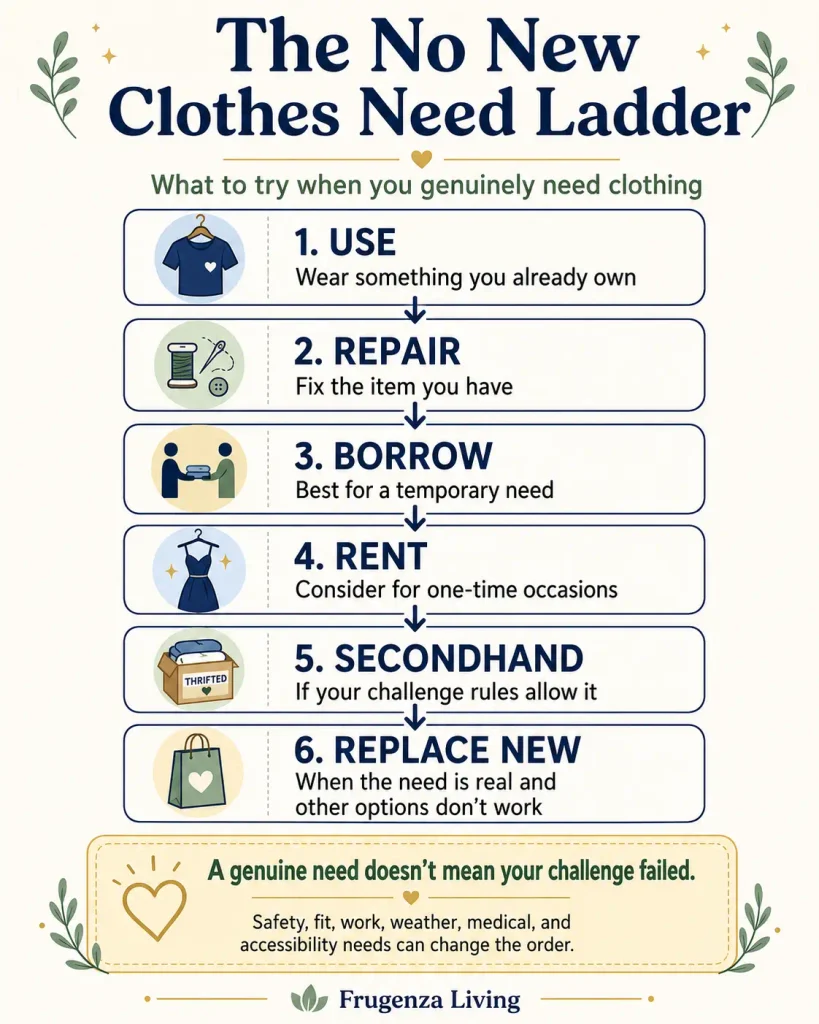
The order is not moral law.
Underwear, medical or accessibility needs, protective clothing, specialized workwear, changing body needs, or urgent weather requirements may reasonably skip several steps.
The purpose is to create options before defaulting to a new purchase—not to make necessary clothing difficult to obtain.
The challenge serves you. You do not serve the streak.
Does Secondhand Count?
There are two legitimate ways to run the challenge.
No Brand-New Clothes
Secondhand remains allowed. This makes sense when the main goal is reducing purchases of newly produced garments or learning to shop used.
No Clothing Purchases
Both new and secondhand purchases are paused, apart from your defined exceptions. This version is usually more informative when your goal is saving money, interrupting shopping frequency, or discovering how much the act of acquiring clothing has become a habit.
The distinction matters because secondhand changes where you buy; it does not automatically change how often you buy.
A 2025 peer-reviewed study comparing sustainable fashion challenges found that after a one-year No New Clothes challenge, 68% of participants said they would prioritize secondhand purchases, while 13% planned to return to fast fashion.
Those figures do not predict what any individual reader will do. The study measured purchasing intentions at the end of the challenge rather than observed long-term buying behavior, so the percentages are best read as evidence that post-challenge plans vary—not as a prediction of what participants ultimately purchased.
The same research suggests secondhand consumption can interact with continued purchasing behavior. That does not make thrifting bad. It means unlimited thrifting may weaken the experiment if the behavior you want to test is shopping itself.
Track Wants, Not Just Days
A streak tells you how long you complied. A waiting list tells you what you learned.
Whenever you want something during the challenge, record the item, date, reason, and approximate price.
Do not promise yourself that everything on the list becomes available on Day 91.
Review it later. Which item still matters? Which need appeared repeatedly? Which problem did you solve another way? Which desire vanished after a few days?
The disappearing items may teach you as much as the purchases you avoided.
If urges cluster around stress, boredom, reward, or wanting to feel different, the challenge may also be exposing a broader spending pattern. In that case, it can help to understand when shopping is being used to change your mood rather than endlessly tightening clothing rules.
If browsing has simply become entertainment, prepare a few ways to replace the shopping window with something that does not require another purchase.
Redirect the Money or It May Simply Move
Suppose your recent baseline shows about $90 per month in clothing spending.
If that pattern would otherwise have continued, a 90-day pause could leave approximately $270 of clothing spending avoided.
That is not automatically $270 saved.
If the money moves to takeout, beauty products, décor, or another shopping category, your challenge changed the label more than your finances.
Give avoided spending a destination: emergency savings, debt, a sinking fund, travel, or another defined priority.
The financial result becomes more visible when the money has somewhere to go.
If online browsing is your biggest weak spot during the challenge, learning to avoid impulse buying online can remove the trigger before willpower is even needed.
One Purchase Does Not Have to End the Experiment
If you buy something on Day 47, do not automatically declare the previous 46 days useless.
Use:
Record → Diagnose → Continue
Record the item and amount.
Diagnose what happened. Was it a genuine need? An exception that should have been defined earlier? A moment when you simply ignored the rule?
Then continue unless restarting would genuinely teach you more.
The most damaging reaction is often:
“I already broke the challenge, so it no longer matters.”
One decision does not erase weeks of useful information.
An unsolicited clothing gift does not automatically need to count as failure either. Asking someone else to purchase the item you want is different. Decide how gifting works before it becomes a loophole.
The Most Important Day Is the Day After the Challenge
Do not let the finish line become a catch-up shopping event.
Before the challenge ends, sort categories into three groups.
What Comes Back After the Challenge?
Do not reopen every category at once. Use what the challenge taught you to decide how each type of clothing returns.
✓ Buy as Needed
Necessary categories that did not create unnecessary spending.
- Essential replacements
- Work clothing you genuinely use
- Categories you rarely overbuy
↻ Buy With a Rule
Categories that still matter but repeatedly created unnecessary purchases.
- Replacement-only shoes
- One clothing purchase per month
- Event wear only when an event exists
‖ Keep Paused
Categories you barely missed or repeatedly wanted without needing.
- Duplicate basics
- Trend-driven categories
- Items with no recurring real-life use
Buy as Needed is for necessary categories that never created a recurring problem.
Buy With a Rule is for categories you still use but repeatedly overbought.
Keep Paused is for categories you barely missed.
Review the waiting list here too. Do not automatically reward yourself by buying everything that survived in a note.
If the pause worked but you still need better buying decisions once shopping returns, use what you learned to build a longer-term system for deciding which clothes are actually worth buying.
That is how a temporary experiment becomes useful after the timer disappears.
Quick Answers
What is a no new clothes challenge?
It is a defined period when you pause brand-new clothing purchases—or all clothing purchases if you choose a stricter version—to learn about your spending, needs, and shopping patterns.
Can I buy secondhand clothes during the challenge?
Yes, if your rules allow it. If your main goal is saving money or interrupting shopping frequency, pausing secondhand purchases too may produce a clearer experiment.
What if I genuinely need clothes?
Use your pre-approved exceptions and practical alternatives. Work, safety, weather, body changes, underwear, accessibility needs, and genuinely unusable essentials are reasonable reasons to adapt the rules.
What happens if I break the challenge?
Record the purchase, identify what caused it, and continue. One purchase does not erase the information you collected before it.
Finish With Better Rules, Not Just a Longer Streak
The point of a no new clothes challenge is not proving that you can resist shopping for a certain number of days.
It is creating enough distance from normal buying for patterns to become visible.
Start with rules that survive real life. Track what you want. Redirect the money. Let genuine needs show you where exceptions belong.
Then write your Day-After rules before the finish line arrives.
A useful challenge ends with fewer questions about what you are “allowed” to buy—and clearer reasons for what deserves your money next.
Read about Jeffi and Frugenza Living
- How to Budget a 10-Month Salary Over 12 Months - October 16, 2026
- Pet Adoption Budget Checklist: What You Still Need to Pay - October 16, 2026
- Proportional Bill Split Calculator for Two Incomes - October 15, 2026