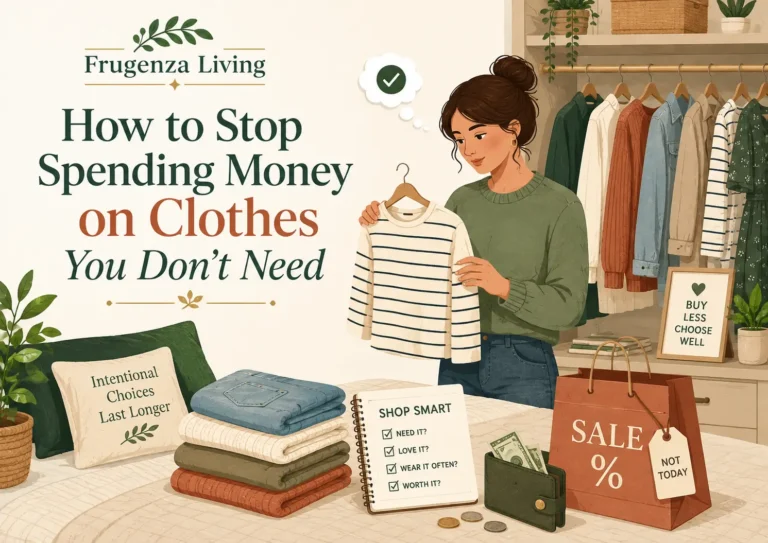
You did not need another black top until the $22 sale email arrived. Now it looks like the missing piece in a closet that already contains four versions of it.
That is the difference between a wardrobe problem and a product-created problem.
If you want to know how to stop spending money on clothes, start by using your current wardrobe long enough to see what is genuinely missing. Then reduce how often you buy, make each new item pass a real-life use test, and count the extra spending it may create before checkout. You do not need to give up fashion or swear off clothes forever.
A sale changes the price. It does not create a need.
First, Figure Out What Kind of Clothing Spending You Have
“Buying too many clothes” can describe several different problems.
Duplicate buying is another cardigan, sneaker, handbag, or black top that does almost the same job as something you already own.
Fantasy-wardrobe buying is clothing for an imagined version of life: more formal events, a different work environment, a future hobby, or a lifestyle that rarely appears on your real calendar.
Novelty buying happens when your wardrobe works, but exposure to something new makes familiar clothes feel temporarily inadequate.
Then there is problem-solving buying. Your coat is worn out. Your job requirements changed. A basic you rely on no longer fits. The same missing function keeps disrupting real outfits.
Those purchases should not be treated alike.
If new clothes are mainly promising confidence, relief, reward, or a better mood, the deeper issue may sit outside the closet. In that case, first look at what happens when shopping becomes a way to change how you feel. For clothing-specific overspending, keep going.
Spend Seven Days Learning What Your Closet Actually Does
In this guide, false wardrobe scarcity is a practical label, not a research or clinical term. It describes having plenty of clothing while still feeling short on usable outfits because much of the wardrobe is difficult to see, combine, wear, maintain, or fit into current life.
Do not inventory every garment. For seven days, observe normal behavior:
- What did you actually wear?
- What did you repeat?
- What did you try on and reject?
- What needs repair?
- Which category felt missing more than once?
- What did you almost buy, and what problem was it supposed to solve?
For this guide, think of the difference between what you own and what enters regular rotation as your wear gap.
If you own ten tops but repeatedly choose three, the first question is not “Which top should I buy next?” Ask why the other seven rarely work. Poor fit, uncomfortable fabric, special-care requirements, awkward combinations, or duplicates can all make a full closet feel strangely empty.
A real wardrobe gap repeatedly causes a problem in your actual life. A product-created gap often appears after exposure to a product, trend, sale, or imagined future occasion.
Make Every New Item Pass a Purchase Gate
Before checkout, make the item explain what job it will do.
The Clothing Purchase Gate below checks five practical signals, including three priority questions that matter most: whether the item has a clear job, works with clothes you already own, and has realistic wear occasions.
You can also save the result and reconsider the item later instead of leaving it in your cart.
Clothing Purchase Gate
Check whether a new item solves a real wardrobe problem—or starts another shopping chain.
Interactive controls become available when the tool loads. If they stay disabled, use the five questions below as a manual checklist.
This is a planning checklist, not a financial or psychological assessment. “Extra outfit cost” means additional spending the item would realistically require before you can use it as intended. The total is item price plus extra outfit cost; it does not test overall affordability.
Entries are not saved by this tool or sent to a server. Save My Check creates a text file in your browser after a valid check. The example is illustrative.
The tool is intentionally stricter about those three priority questions. Passing less important checks should not turn a vague purchase into a green light. If your own answers conflict—for example, you call something a fantasy purchase but can also name near-term occasions—the useful next step is to resolve the contradiction, not to rely on the checkbox total.
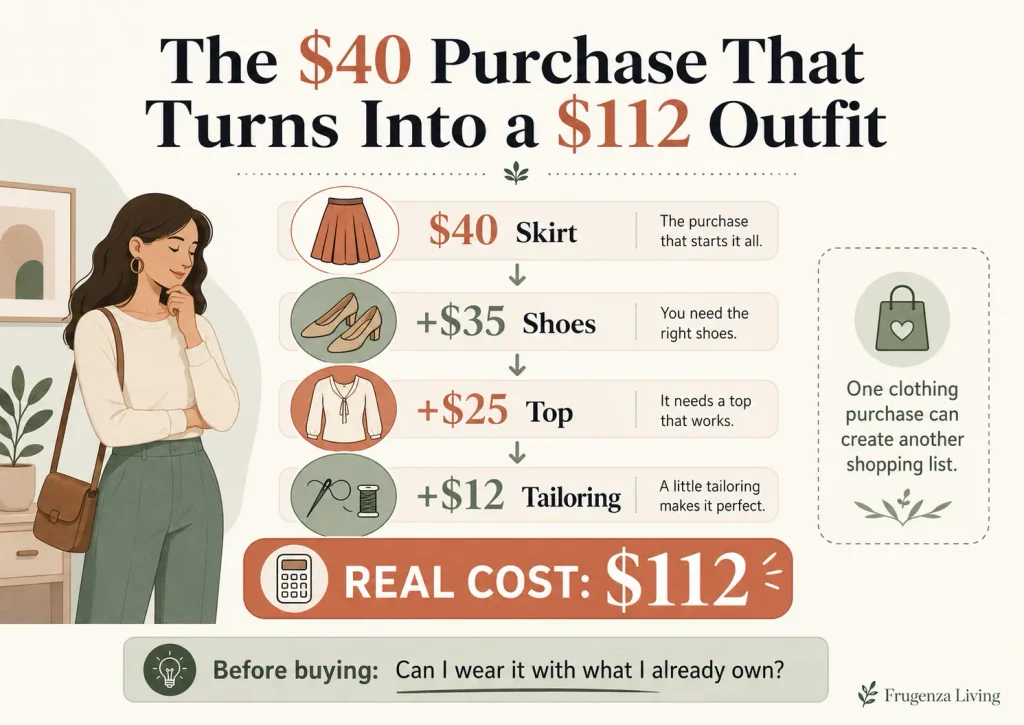
The $40 Purchase That Turns Into a $100 Outfit
The sticker price can hide what I call the outfit completion cost: the additional money required before a new item actually works with your current wardrobe.
A $40 skirt may seem reasonable until it requires:
- $35 shoes because your current pairs do not work with it;
- a $25 top;
- $12 tailoring;
- special-care or dry-cleaning costs.
The issue is not whether those exact numbers are typical. They simply show how one purchase can start another shopping list.
Before buying, ask:
Can I wear this with what I already own, or am I buying the beginning of another outfit?
Cost per wear can help, but only when expected wear comes from your real life. A $150 blazer is not automatically an “investment” if you rarely wear blazers. A lower-priced item is not automatically economical either if it needs three more purchases before leaving the closet.
Real Gap or Product-Created Gap?
Use this quick comparison when “I need something new” feels true but vague.
Real Wardrobe Gap vs. Product-Created Gap
Look for evidence from your actual routine before letting a product define what is missing.
✓ More Likely a Real Gap
- The same missing function has caused problems repeatedly.
- Nothing you own performs the job well.
- It fits your current work, climate, body, or routine.
- You can name specific upcoming wear occasions.
- The item works with several pieces you already own.
✕ More Likely Product-Created
- The desire appeared after a trend, ad, launch, or sale.
- You own several pieces with almost the same function.
- The item belongs mainly to a “someday” lifestyle.
- It requires more purchases to complete the outfit.
- The main problem is that familiar clothes suddenly feel boring.
The strongest buying signal is not excitement. It is repeated evidence from your life.
If simply telling yourself to “buy less” is not creating enough friction, a temporary clothing no-buy challenge can give you clearer boundaries while you reset the habit.
Reduce Buying Frequency Before Trying to Stop Completely
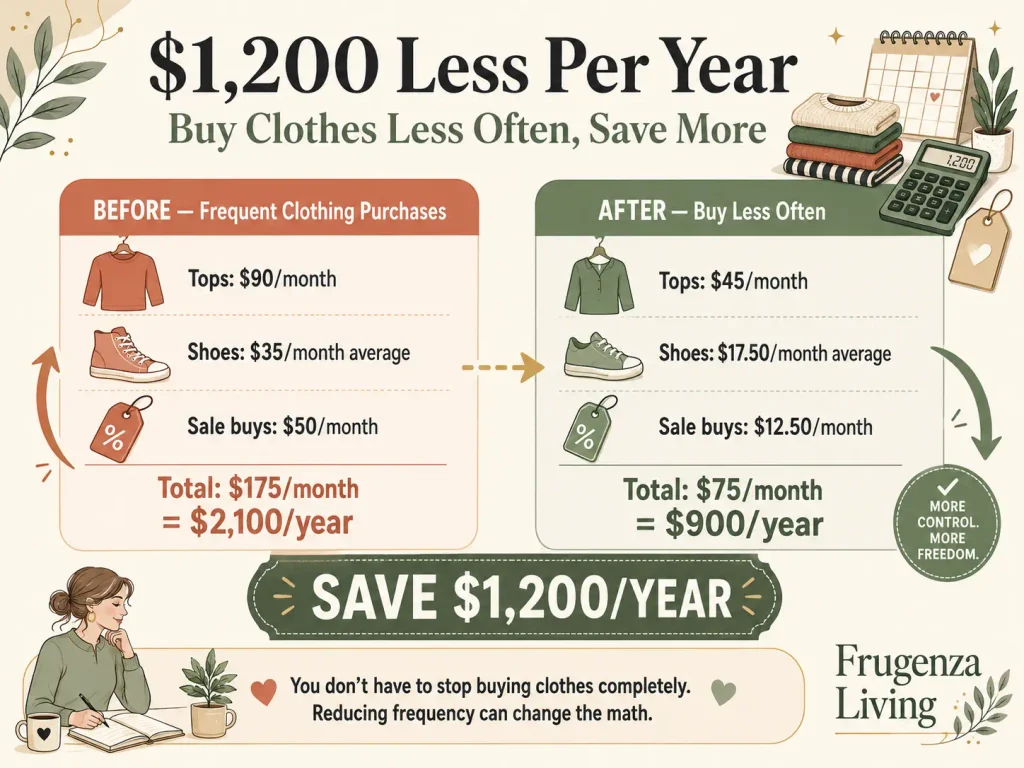
A permanent no-buy sounds decisive, but reducing frequency can create a large financial result without turning clothing into a forbidden category.
Consider this illustrative pattern:
- two $45 tops each month = $90;
- $70 shoes every other month = about $35 per month;
- two $25 sale purchases each month = $50.
That averages $175 per month, or $2,100 per year.
Now reduce the pattern to one $45 top per month, $70 shoes every four months, and one $25 sale purchase every other month. Average clothing spending becomes about $75 per month.
The difference is roughly $1,200 per year.
You still bought clothes. You simply stopped buying them so often.
Once you know what you have been spending, give clothing a defined monthly, quarterly, or annual amount instead of deciding affordability item by item.
That turns:
“Can I afford this $38 sweater?”
into:
“Is this where I want this period’s clothing money to go?”
This is the same reason it helps to put a visible boundary around repeated everyday spending before purchases happen rather than reconstructing the damage afterward.
Use a Category Freeze When One Type Keeps Winning
If one category creates most unnecessary purchases, you do not have to ban all clothing.
A category freeze temporarily stops buying in the category causing the most unnecessary spending while leaving the rest of your wardrobe flexible.
Examples:
- tops: no new purchases for 60 days;
- shoes: replacement-only;
- occasion dresses: no purchase without a real event on the calendar;
- activewear: use the current rotation before adding more;
- handbags: no new bag while several existing ones perform the same function.
The duration is adjustable. This is not a universal 60-day rule.
A category freeze also produces useful evidence. If you stop buying tops for two months and barely notice, you may have been buying novelty rather than solving a shortage.
That fits a broader approach to cutting low-value spending without removing everything you enjoy.
Make Shopping Harder at the Point Where It Starts
Generic willpower advice comes too late if the shopping session has already begun.
If retailer email creates the urge, unsubscribe or move promotions away from your main inbox. If shopping apps fill five empty minutes, delete the app and make the browser the slower route. If social feeds function like personalized storefronts, mute shopping-heavy accounts temporarily.
For sale browsing, reverse the process: write the wardrobe gap first, then search for that category.
If you keep wanting new clothes even though your wardrobe is already full, a shop your closet challenge can help you rediscover what you own before buying anything else.
Keep the friction specific to your actual trigger.
Don’t Let Decluttering Become a Shopping Reset
Decluttering can reveal why a wardrobe is not working, but an emptier closet is not automatically a better shopping system.
A 2024 study on reflective garment decluttering found that participants gained insight into clothing ownership and consumption patterns, while clothing acquisition decreased after the intervention; the researchers also observed some rebound later.
The useful part is the reflection.
Before unwanted clothes leave, group them and ask why you bought them:
- sale pressure;
- uncomfortable material;
- aspirational sizing;
- event panic;
- influencer inspiration;
- difficult care;
- duplicate basics;
- pieces that needed extra purchases to become wearable.
If four unwanted blouses were bought during sales, removing them without identifying that pattern simply creates four empty hangers.
The goal is to stop buying the next version of the same mistake.
Sales Are Savings Only When the Item Already Had a Job
Imagine a jacket marked down from $80 to $32.
If a jacket was already on your replacement or real-gap list, the discount may genuinely reduce the cost of something you planned to buy.
If you had no jacket problem until you saw the markdown, your bank balance did not gain $48.
You spent $32.
A useful sale purchase should still fit the clothing budget, work with existing outfits, and pass the same purchase gate as a full-price item.
Discounts can lower the cost of a need. They should not be allowed to manufacture one.
When Buying New Clothes Is Reasonable
The goal is not to make every purchase suspicious.
Buying can be reasonable when an essential item is worn out, your size or fit needs have changed, work requirements are different, weather exposes a genuine gap, or the same missing function has interrupted real outfits several times.
A specific upcoming event can also create a legitimate need when your existing options truly do not work.
The distinction is evidence: the problem existed before the product appeared.
What to Do After an Unplanned Purchase
If the item is unused and still eligible for return, check the return deadline first.
Keeping something only because the purchase already happened turns a reversible mistake into a permanent expense.
Then review what happened:
- What started the shopping session?
- Did you already own something similar?
- Did the item create extra purchases?
- Has it actually entered normal rotation?
- What one change would have interrupted the purchase?
Do not respond with a punishment plan.
If the trigger was an app, remove the app. If it was event panic, plan outfits earlier next time. If the purchase genuinely solved a recurring gap, keep that information too.
The point is to improve the next decision.
Quick Answers
How do I stop buying clothes I don’t need?
Observe what you actually wear, identify duplicate or low-use categories, give clothing a spending limit, and require new items to solve a repeated wardrobe problem before checkout.
Do I need a no-buy clothes challenge?
No. A no-buy can create a temporary reset, but reducing purchase frequency or freezing one problem category may be easier to maintain while still allowing necessary replacements.
How do I know if I actually need new clothes?
Look for repeated real-life evidence: something essential is worn out, nothing you own performs a needed function, or the same wardrobe gap has interfered with outfits more than once.
Make Your Closet Prove the Need First
You do not have to stop liking clothes to spend less on them.
Use your wardrobe long enough to understand what is actually missing. Reduce purchase frequency. Give clothing a defined budget. Count the outfit completion cost, not just the price tag. Learn from the clothes that leave your closet instead of immediately filling the space again.
Then let real life—not a sale page—decide what deserves to enter next.

Read about Jeffi and Frugenza Living
- How to Budget a 10-Month Salary Over 12 Months - October 16, 2026
- Pet Adoption Budget Checklist: What You Still Need to Pay - October 16, 2026
- Proportional Bill Split Calculator for Two Incomes - October 15, 2026